
Deciding on shoulder dislocation surgery requires concrete, documented clinical data rather than vague reassurances. Success rate of Shoulder Dislocation Surgery differ fundamentally between arthroscopic Bankart repair and the Latarjet procedure, dictated by anatomical and clinical factors evaluated pre-operatively. This article details documented success statistics, prognostic factors, and expected recovery outcomes.
Overall Success Rate of Shoulder Dislocation Surgery
The overall clinical success rate of shoulder stabilization ranges between 85% and 96%. Specifically, arthroscopic Bankart repair yields a 90% success rate in carefully selected candidates. In contrast, the Latarjet procedure achieves over 95% efficacy in preventing recurrence, with about 89% of athletes returning to sport.
Outcomes vary based on the follow-up duration:
- Short-term (<5 years): At 10+ years after arthroscopic Bankart repair, about 16% of patients redislocate and 31% report some recurrent instability (systematic review of 822 shoulders).
- Long-term (≥10 years): Recurrence is significantly higher in unrecognized glenoid bone loss where a Latarjet should have been performed.
- Latarjet Durability: After Latarjet, recurrent dislocation is about 3% (systematic review of 1,904 shoulders). A systematic review of 2,134 Latarjet cases found that 88.8% of athletes returned to sport (72.6% at the same level) after a mean of 5.8 months.
Key Prognostic Factors
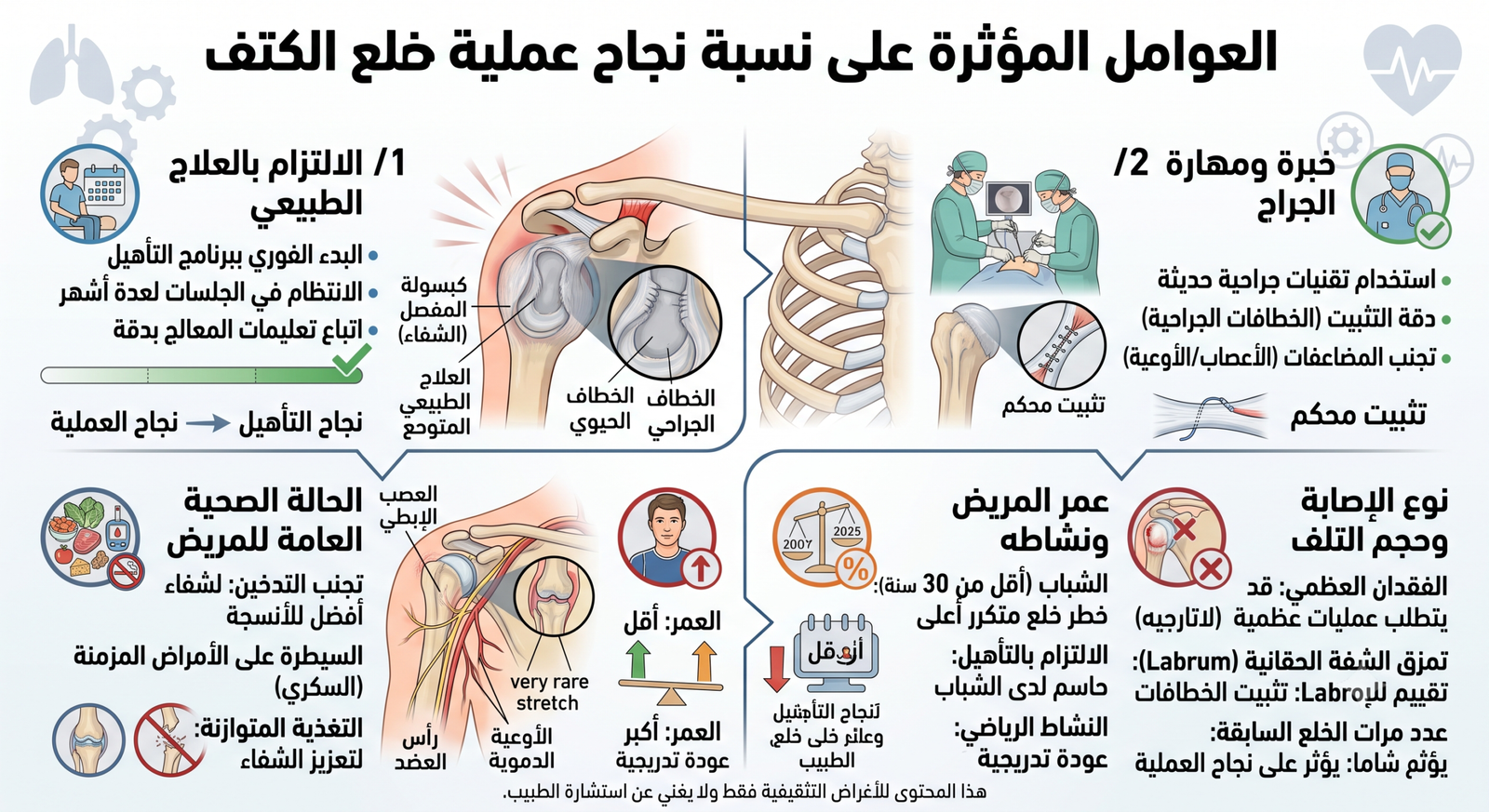
Five primary variables dictate outcomes: glenoid bone loss, patient age and sex, sport classification, surgical technique, and physical therapy compliance.
| Factor | Clinical Impact on Success Rate |
| Bone Loss < 20% | Bankart repair is sufficient (Success Rate: 90%+). |
| Bone Loss ≥ 20% | Latarjet is mandatory (Recurrence: 1–5%). |
| Age < 20 Years | High recurrence risk post-Bankart (up to 30%+). |
| Collision Sports | Latarjet is preferred first-line. |
| Prior Surgical Failure | Latarjet cuts recurrence risk to about one third of Bankart’s. |
An age under 20 at the time of surgery is the strongest predictor of recurrence after a Bankart repair. In Egypt, contact athletes (e.g., football, wrestling) represent a large clinical cohort and frequently require a primary Latarjet due to high re-injury risks.
Functional Recovery: Does the Shoulder Return to Normal?
Yes, in the vast majority of cases. Following Bankart repair, about 78% of athletes return to sport. For Latarjet, about 89% of athletes return to sport, achieving pre-injury range of motion.
Complete recovery relies on Latarjet bony union (achieved in most cases), rehabilitation quality, and return-to-sport timing. Returning prematurely before 4–5 months is the leading cause of surgical failure. Temporary postoperative stiffness is common and resolves with structured physical therapy.
Complications and Safety
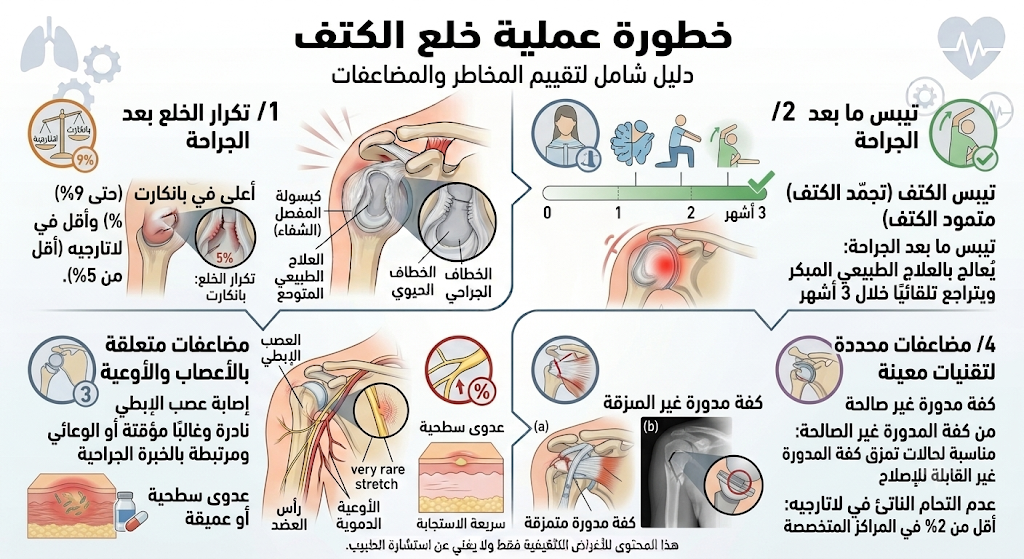
Both procedures are low-risk. Bankart repair has a complication rate is low, while Latarjet has more complications (about 30% overall in a systematic review, mostly minor; reoperation about 7%). Severe neurological or non-union risks remain rare:
- Recurrence (5 years): About 16% at 10+ years (Bankart) vs. about 3% (Latarjet).
- Stiffness: Common; resolves within 3 months of physical therapy.
- Hardware Issues (Latarjet screws): 0–16%, occasionally requiring removal.
- Nerve Injury (Axillary/Musculocutaneous): Rare and mostly transient.
- Long-term Osteoarthritis: 8–42% at 5 years post-Latarjet.
- Infection Rate: <1% for both.
Optimizing Outcomes
Patients can maximize success by: obtaining a pre-operative CT scan to quantify bone loss, avoiding surgical delay after a second dislocation, selecting a specialized shoulder arthroscopist, beginning physical therapy in week one, and avoiding contact sports until cleared (typically 4–5 months).
Surgical Cost in Cairo (2026)
Costs range between 30,000 and 75,000 EGP depending on the procedure and facility.
| Procedure | Cost Range (EGP, 2026) | Recovery Time |
| Arthroscopic Bankart | 30,000 – 50,000 | 3 – 5 Months |
| Latarjet | 45,000 – 75,000 | 4 – 6 Months |
| Open Capsular Shift | 35,000 – 60,000 | 4 – 6 Months |
Shoulder Dislocation Surgery Success Rates
Evidence-based clinical insights, success statistics, and recovery timelines for patients undergoing surgical stabilization for shoulder instability.
The overall clinical success rate of shoulder dislocation stabilization ranges between 85% and 96% on short and mid-term follow-ups. The success rates vary based on the chosen surgical approach:
- Arthroscopic Bankart Repair: Yields a 90% success rate in carefully selected candidates with healthy bone anatomy.
- Latarjet Procedure: Achieves a 95%+ success rate in preventing recurrent dislocations in complex cases.
Success rates are highly dependent on follow-up duration and the presence of unrecognized bone loss:
- Short-term (<5 years): Bankart repair exhibits a very low recurrence rate of only 6.7% in patients without critical bone defects.
- Long-term (10+ years): Recurrence rates can rise to 20.9% over a 13-year period. This increase is typically seen in patients with unrecognized glenoid bone loss who should have undergone a Latarjet procedure instead.
The Latarjet procedure is the gold standard for high-risk cohorts, maintaining a remarkably low recurrence rate of just 4.6%, even in competitive contact athletes with substantial bone loss.
Furthermore, clinical reviews show that 89% of athletes successfully return to sport, 72.6% at the same level, after a mean of 5.8 months.
Source: JSES / ScienceDirect LiteratureFive main factors dictate whether a patient will achieve successful long-term stability:
- Bone Loss Severity: If glenoid bone loss is 20% or more, a Latarjet procedure is mandatory, as Bankart repairs are highly likely to fail.
- Patient Age: Patients under 20 years old face a high recurrence risk (up to 30%+) if stabilized using arthroscopic Bankart alone.
- Type of Sport: High-impact collision athletes (e.g., football, wrestling) often require Latarjet as a first-line treatment to prevent recurrence.
- Surgical Technique: Choosing the correct procedure at the right time.
- Rehabilitation Compliance: Sticking strictly to a professional physical therapy protocol.
Yes, the vast majority of patients achieve normal or near-normal shoulder function.
Approximately About 78% of Bankart patients return to active sport within 5 to 7 months. For those undergoing a Latarjet procedure, up to 89% of patients successfully return to sports with a pre-injury range of motion. Bony union of the Latarjet graft is achieved in most cases.
Source: AAOS OrthoInfo / HSS Clinical OutcomesThe single most common cause of surgical failure is a premature return to high-impact activities or contact sports before complete biological healing has occurred (typically before the 4th or 5th month post-operative evaluation).
Other factors leading to failure include non-compliance with physical therapy, or treating a patient with severe bone loss using an arthroscopic Bankart repair instead of a Latarjet procedure.
American Knee & Shoulder CenterBoth stabilization options are highly safe. Bankart repairs carry a complication rate under 5%, while Latarjet complications range between about 30% (mostly minor) in specialized centers. Key risks include:
- Temporary Stiffness: Extremely common; typically resolves within 3 months of dedicated physical therapy.
- Screw-related Complications (Latarjet): Occurs in 0-16% of cases, sometimes requiring hardware removal.
- Neurological Damage: Rare, transient injury to the axillary or musculocutaneous nerve.
- Long-term Osteoarthritis: Reported in 8-42% of patients 5 years after Latarjet, largely driven by pre-operative trauma.
- Infection: Less than 1% for both techniques.
A successful outcome is a collaborative effort between the surgeon and the patient. You can maximize your success by:
- Getting a high-resolution 3D CT scan before surgery to precisely measure glenoid bone loss.
- Avoiding long delays before surgery; postponing stabilization after a second dislocation worsens bone loss.
- Choosing an orthopaedic surgeon who specializes specifically in advanced shoulder arthroscopy.
- Beginning a professional rehabilitation program within the first week after surgery.
The time required for safe recovery and tissue healing depends on the surgical method used:
- Arthroscopic Bankart Repair: Recovery generally takes 3 to 5 months.
- Latarjet & Open Capsular Shift: Requires a timeline of 4 to 6 months to ensure optimal bony integration and tendon healing.
In Cairo in 2026, the cost of shoulder stabilization surgery ranges between 30,000 and 75,000 EGP, depending on the required technique and facility:
- Arthroscopic Bankart: Ranges from 30,000 to 50,000 EGP.
- Latarjet: Ranges from 45,000 to 75,000 EGP due to the requirement for specialized bone graft fixation screws.
- Open Capsular Shift: Ranges from 35,000 to 60,000 EGP.
References
- Arthroscopic Stabilization Surgery for First-Time Anterior Shoulder Dislocations: Systematic Review & Meta-Analysis — J Shoulder Elbow Surg (2024)
- Management of First-Time Anterior Shoulder Dislocation: Systematic Review & Meta-Analysis — Arthroscopy Association of Canada Position Statement (2025)
- Arthroscopic Bankart Repair for Acute Anterior Shoulder Dislocation: Systematic Review & Meta-Analysis — Orthobullets
- Bankart Repair vs. Conservative Care for First-Time Anterior Shoulder Dislocation: Short & Long-Term Outcomes
- Management of Primary Acute Anterior Shoulder Dislocation: Systematic Review & Quantitative Synthesis (2014)
- Operative vs. Non-Operative Management for First-Time Traumatic Anterior Shoulder Dislocation in Young Adults — EFORT Systematic Review
- Effectiveness of Combined Surgical and Exercise-Based Interventions Following Primary Traumatic Anterior Shoulder Dislocation — BJSM (2023)
- Shoulder Dislocation Surgical Treatment Evidence Summary — Orthobullets (2024)