
Knee pain in women more than men — from patellofemoral syndrome and ACL tears in younger athletes to osteoarthritis after menopause. This comprehensive guide covers causes, diagnosis, vitamin D’s role, red flag symptoms, and evidence-based treatment options including physical therapy, injections, and surgery when needed.
Why Do Women Suffer from Knee Pain More Than Men?
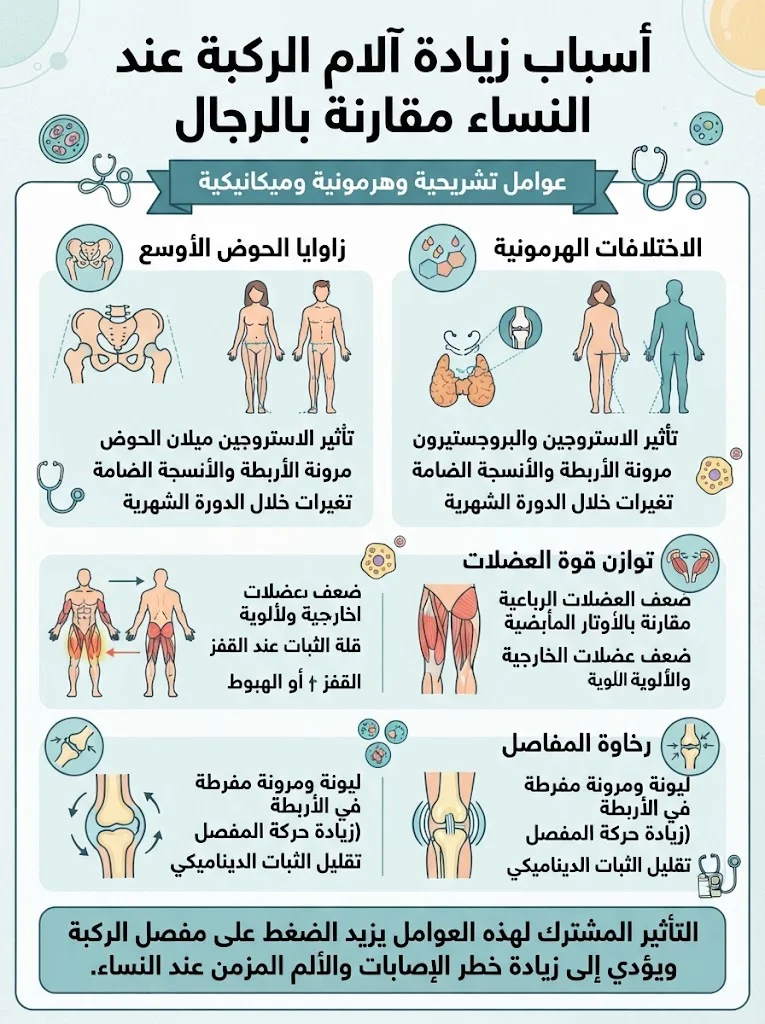
Women are 2 to 8 times more prone to knee pain than men, depending on the type of injury. This disparity is not accidental—it is the inevitable result of unique anatomical, hormonal, and mechanical differences in the female body.
| Factor | Impact on the Woman’s Knee |
| Wider pelvis and larger Q-angle | Tilts the knee inward (valgus) and increases pressure on the anterior cruciate ligament and patella. |
| Thinner anterior cruciate ligament (ACL) | Tears with less force compared to a man’s ligament. |
| Estrogen increases ligament laxity | Protects cartilage before menopause — accelerates its degradation afterward. |
| Relative weakness in the hamstring muscles | Increases pressure on the patella and cruciate ligament during movement. |
| Menopause | Decline in estrogen accelerates cartilage loss after age fifty. |
| Vitamin D deficiency (very common in Egypt) | Associated with a 1.7-fold increased risk of knee osteoarthritis in women under 65. |
Most Common Causes of Knee Pain in Women
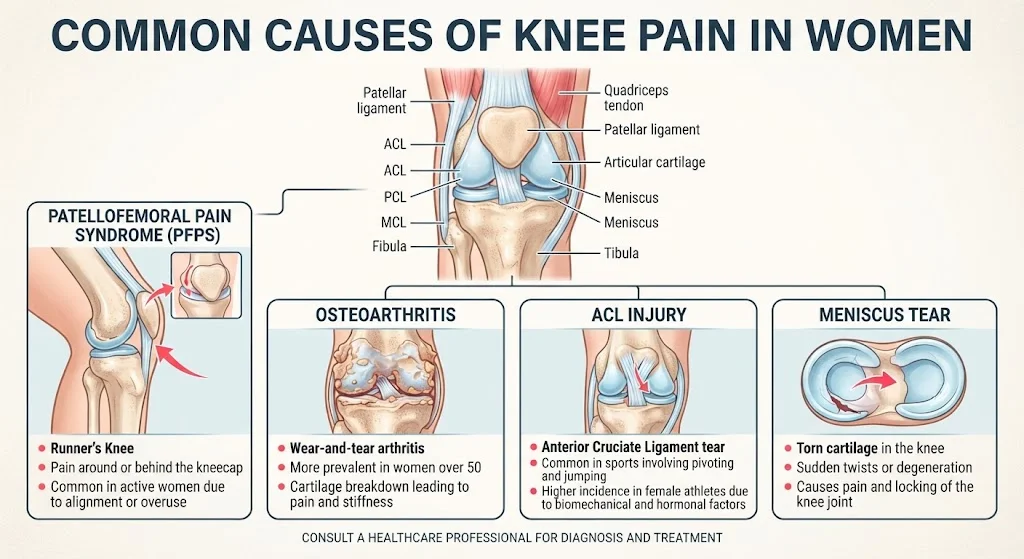
Knee pain in women has six primary causes, each with a different pain pattern, affected age group, and treatment plan.
| Cause | Most Affected Age Group | Pain Location | Primary Trigger |
| Patellofemoral Pain Syndrome (PFPS) — “Runner’s Knee” | 15–35 years, active athletes | Front of the knee under the patella | Climbing stairs — prolonged sitting — squatting |
| Anterior Cruciate Ligament (ACL) Tear | 15–40 years, female athletes | Entire knee with sudden swelling | Sudden change of direction — landing from a jump |
| Rheumatoid Arthritis (RA) | 30–60 years, women 3:1 more | Both knees + other joints | Morning stiffness > 30 minutes |
| Knee Osteoarthritis | Over 45 years, post-menopause | Inside the knee — generalized | Walking — climbing stairs — weather changes |
| Meniscus Tear | 30–55 years | Inner or outer side of the knee | Twisting — sitting on the floor |
| Bursitis | 40–60 years, overweight | Front or below the knee | Prolonged sitting — kneeling (frequent in prayer) |
| Systemic Lupus Erythematosus (SLE) | 20–45 years, mostly women | Multi-joint | Migratory pain with general fatigue |
Postmenopausal knee osteoarthritis deserves special distinction: UT Southwestern research (2024) proved that sex differences in knee structure begin in childhood, and that ligament injuries in youth double the risk of later osteoarthritis. Women who experience an ACL tear in their youth carry a 10-fold increased risk of developing knee osteoarthritis after middle age.
Vitamin D Deficiency and Knee Pain in Egyptian Women
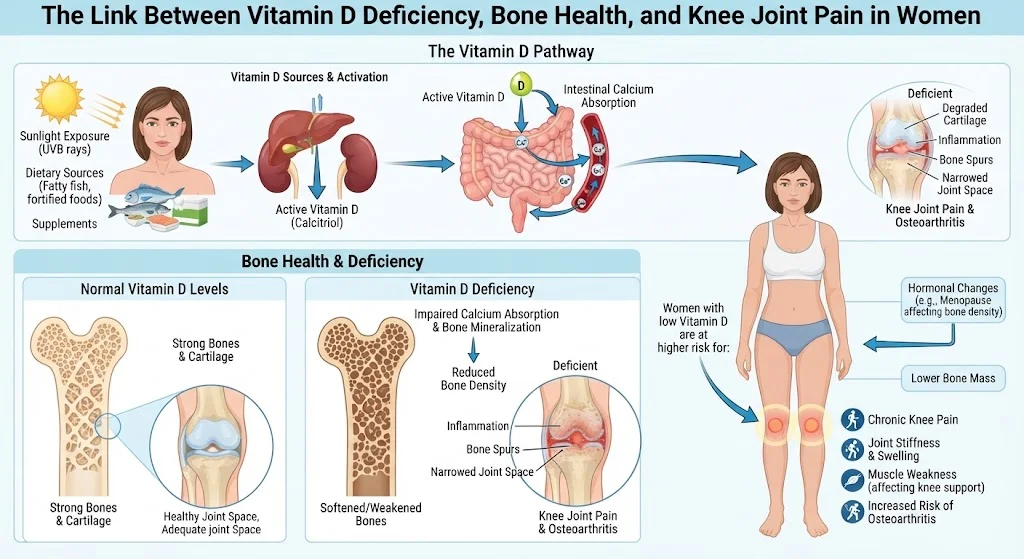
Vitamin D deficiency is associated with a 1.7-fold increased risk of knee osteoarthritis in women under 65, which is a critically important risk factor in Egypt where modest/covered clothing and low sun exposure are prevalent among women.
An Egyptian study (Abu Maaty et al., 2013) proved a direct correlation between low vitamin D levels and newly diagnosed knee osteoarthritis in postmenopausal women (50–60 years old). A second Egyptian study (Egyptian Rheumatology Journal) on 140 knee osteoarthritis patients (110 women) found a strong negative correlation between 25-OH vitamin D levels and pain severity
Vitamin D Levels and Recommended Action:
- more than 30 ng/ml (Normal): No intervention.
- 20-30 ng/ml (Mild deficiency): Dietary supplement $1,000\text{–}2,000\text{ IU daily}$.
- 10-20 ng/ml (Moderate deficiency):$4,000\text{–}5,000\text{ IU daily}$ for 3 months.
- < 10 (Severe deficiency): Oral or intramuscular loading dose — consult a specialist.
Dietary sources available in Egypt: Fatty fish (tilapia and sea bass), eggs, fortified dairy. Sun exposure for 15–20 minutes daily between 10 AM and 3 PM on hands and face produces $1,000\text{–}5,000\text{ IU}$ depending on skin tone.
Methods of Diagnosing Knee Pain in Women
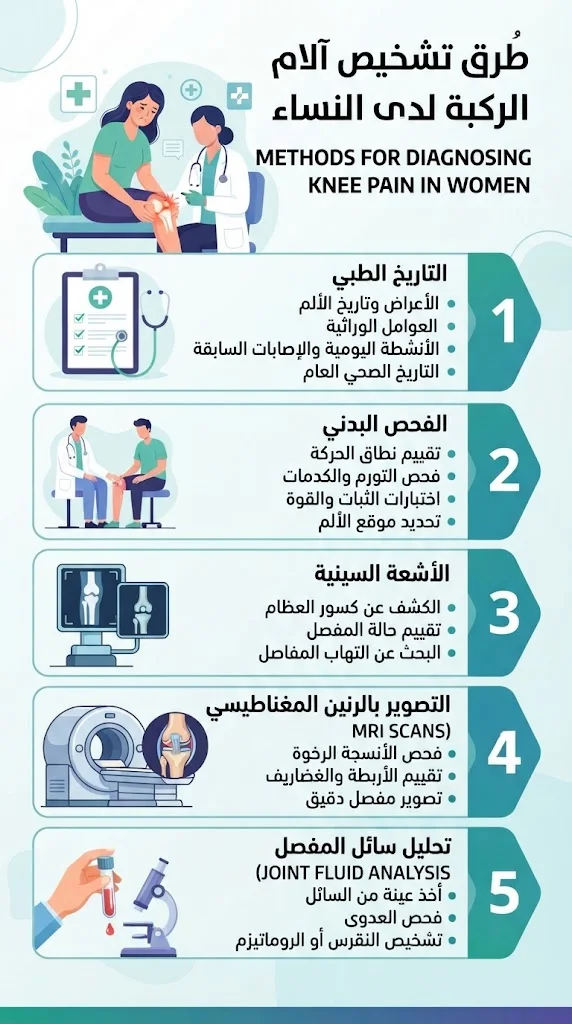
No single test is sufficient to diagnose the cause of knee pain. Accurate diagnosis combines clinical examination, imaging, and targeted laboratory tests.
| Examination | What It Reveals | When It Is Requested |
| X-ray (3 views) | Degree of osteoarthritis — joint space narrowing — bone spurs | First test for any chronic knee pain |
| MRI | Ligament tear — meniscus — articular cartilage | Suspected ligament or meniscus tear — pre-surgery |
| Ultrasound | Bursitis — tendons — joint effusion | Rapid alternative to MRI in inflammation |
| Vitamin D level test | Detection of vitamin D deficiency | Routinely requested for every woman over 40 with knee pain |
| RF + CRP + ESR | Rheumatoid arthritis — lupus | Morning stiffness — multi-joint swelling |
| Blood uric acid | Gout (less common in premenopausal women) | Acute sudden knee swelling |
| Joint fluid aspiration | Septic arthritis — gout crystals — blood | Sudden joint swelling with fever |
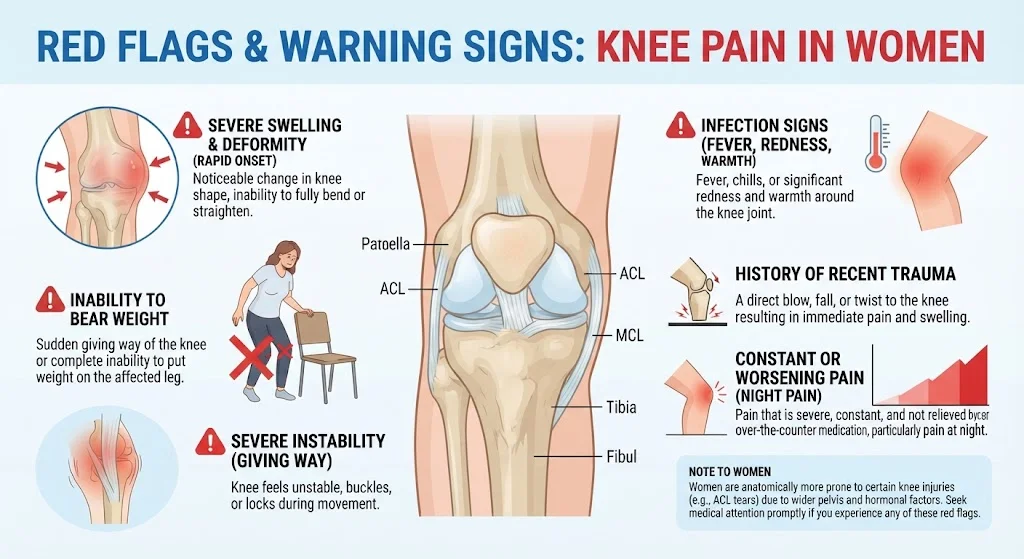
Danger Signs in Women’s Knee Pain
These symptoms require medical evaluation within 24–48 hours rather than a routine appointment:
- Severe sudden swelling with fever and redness: Septic arthritis or acute gout attack — Emergency (joint fluid aspiration).
- Sharp pain with a “popping” sound after a twist: ACL or meniscus tear — Urgent MRI.
- Sensation that the knee suddenly “locks”: Meniscus tear with a displaced flap — Urgent surgical evaluation.
- Knee pain with general weakness, weight loss, and fever: Bone or cartilage tumors — Urgent scans and tests.
- Persistent nighttime pain that does not subside with rest: Rheumatic inflammation — tumor — infection — Medical evaluation within 48 hours.
- Sudden visible deformity in the shape of the knee: Fracture or dislocation — Immediate emergency.
- Knee swelling after a long trip or recent surgery: Deep Vein Thrombosis (DVT) — Immediate emergency (life-threatening risk).
Treatment of Knee Pain in Women
Non-Surgical Treatment
Conservative treatment successfully treats over 70% of knee pain cases in women without surgery, provided the protocol is strictly followed.
| Treatment Option | Details | Best Suited For |
| Weight Loss | Every extra kilogram adds 4 times its weight in pressure to the knee during walking. | Osteoarthritis — PFPS — Bursitis |
| Physical Therapy | Strengthening quadriceps, hamstrings, and hips. | All chronic knee pain causes |
| NSAIDs | Voltaren® / Cataflam® / Celebrex® | Acute and moderate inflammation |
| Cortisone Injections | Relieving acute inflammation — 4–12 weeks. | Osteoarthritis — Acute bursitis |
| Hyaluronic Acid Injections | Joint lubrication — 3–6 months. | Mild-to-moderate knee osteoarthritis |
| PRP Injections | Cartilage regeneration — 6–12 months. | Moderate osteoarthritis — tendon injuries |
| Vitamin D + Calcium Supplements | Correcting deficiency and reducing pain. | All women over 40 with documented deficiency |
| Knee Brace | Offloading pressure from the damaged compartment. | Medial compartment osteoarthritis — PFPS |

Medications by Egyptian Brand Names:
- NSAIDs: Diclofenac (Voltaren® / Cataflam®) — Take with food; do not exceed 4 weeks.
- COX-2 Inhibitors: Celecoxib (Celebrex® / Arthrox®) — Safer for stomach and colon patients.
- Muscle Relaxants: Methocarbamol (Robaxasil®) — For associated spasms.
- Vitamin D: Cholecalciferol (D3) (Neurobion Forte® / Devitol®) — At a dose suitable for the deficiency level.
- Calcium + Vitamin D: Calcium Carbonate + D3 (Calcium Sanofi® / Osteocare®) — For postmenopausal women.
When Do You Need Surgery?
Surgery is indicated in four specific scenarios: a complete ACL tear with knee instability, a locked knee from a meniscus tear, advanced osteoarthritis unresponsive to conservative treatment for over 6 months, or progressive bony deformity.
| Condition | Surgical Option | Recovery Period |
| Anterior Cruciate Ligament (ACL) Tear | Arthroscopic ligament reconstruction | 6–9 months |
| Meniscus Tear Causing Knee Locking | Arthroscopic repair or partial meniscectomy | 4–8 weeks |
| Advanced Knee Osteoarthritis (Grade 4) | Total or partial knee replacement | 3–6 months |
| Unicompartmental Osteoarthritis | Unicompartmental Knee Arthroplasty (UKA) | 6–8 weeks |
| Knee Bowing with Osteoarthritis | High Tibial Osteotomy (HTO) | 3–6 months |
Book Your Appointment with Prof. Dr. Ibrahim Abdelmonem
Prof. Dr. Ibrahim Abdelmonem, Professor of Orthopedic Surgery and Joints at Ain Shams University and Visiting Professor at Ohio State University, specializes in arthroscopic knee surgery and joint replacement. He welcomes female patients at four locations in Cairo: Nasr City, Fifth Settlement, Mohandessin, and Batal Ahmed Abdel Aziz Street.

Frequently Asked Questions: Knee Pain in Women
Why are women more frequently affected by knee pain compared to men?
What is patellofemoral pain syndrome and why does it disproportionately affect women?
Is there a direct link between hormonal changes during menopause and knee osteoarthritis in women?
How do high heels and improper footwear impact female knee joints?
What role do pregnancy and rapid weight gain play in joint and knee pain for women?
references
Acıbadem International — Knee Pain in Women: Unique Causes and Solutions- UT Southwestern (2024) — Sex-Specific Differences in Knee OA Risk: Early Prevention Strategies
- Aster Hospitals — Common Causes of Knee Pain in Women (2025)
- Rheumatology International — Vitamin D Deficiency and Knee OA in Postmenopausal Egyptian Women
- Egyptian Rheumatology Journal — Serum Vitamin D, Knee Pain and WOMAC in Primary OA
- Sex Differences in Risk Factors for Knee Osteoarthritis: Systematic Review — Rheumatology Oxford (2023)
- Effect of Menopause on Knee Pain in Female Patients with Knee Osteoarthritis: A Review (2025)
- Biomechanical and Biological Factors of Sexual Dimorphism in Anterior Knee Pain — J ISAKOS (2024)
- Patellofemoral Pain Syndrome in Female Athletes: Diagnoses, Etiology & Treatment — Orthopedic Reviews (PMC, 2018)
- Patellofemoral / Anterior Knee Pain in Women: Review — Orthopedic Reviews (2024)
- Understanding Risk Factors of Knee Pain Severity among Women with Knee Osteoarthritis — IJMPP (2023)
- Potential Risk Factors and Physical Functioning of Women with Knee Osteoarthritis — Ann King Edw Med Univ (2026)
- Knee Osteoarthritis in Women: Ancient and Modern Treatment Modalities — Review (2024)
- Why Knee Pain Worsens Around the Period: Hormonal Mechanisms — London Cartilage Clinic (2025)
- Estrogen Level and Knee Osteoarthritis Pain in Perimenopause: Non-Pharmacological Measures — IJMS (2025)
Acıbadem International — Knee Pain in Women: Unique Causes and Solutions