
Shoulder crepitus — the clicking, popping, or grinding sensation felt when moving the shoulder — is one of the most common and misunderstood orthopedic complaints. In most cases it is completely harmless, caused by gas bubble release in the synovial fluid or tendons gliding over bony prominences. However, when crepitus is accompanied by pain, swelling, weakness, or progressive loss of movement, it signals an underlying condition requiring medical evaluation — including rotator cuff tears, subacromial impingement, glenohumeral osteoarthritis, or labral pathology. This evidence-based guide explains the biology behind shoulder clicking, distinguishes benign from pathological crepitus, identifies the specific red flag symptoms that demand urgent attention, and outlines the full treatment pathway from targeted exercises and injections to arthroscopic surgery when necessary.
What is Shoulder Crepitus?
Shoulder crepitus—medically known as Crepitus—is an audible sound or palpable sensation of clicking, grinding, or popping when moving the shoulder joint. In the vast majority of cases, this phenomenon is entirely normal and requires no concern or treatment. It only becomes worrisome when accompanied by pain, swelling, or noticeable weakness in the arm.
The shoulder is the most flexible and anatomically complex joint in the human body, featuring three joints, four main rotator cuff tendons, a bursa sac, and a synovial membrane. This complexity makes occasional sounds during movement biologically expected. The real medical question is not “Why does the shoulder click?”, but rather “Is this clicking accompanied by pain or not?”
What are the Causes of Shoulder Crepitus?
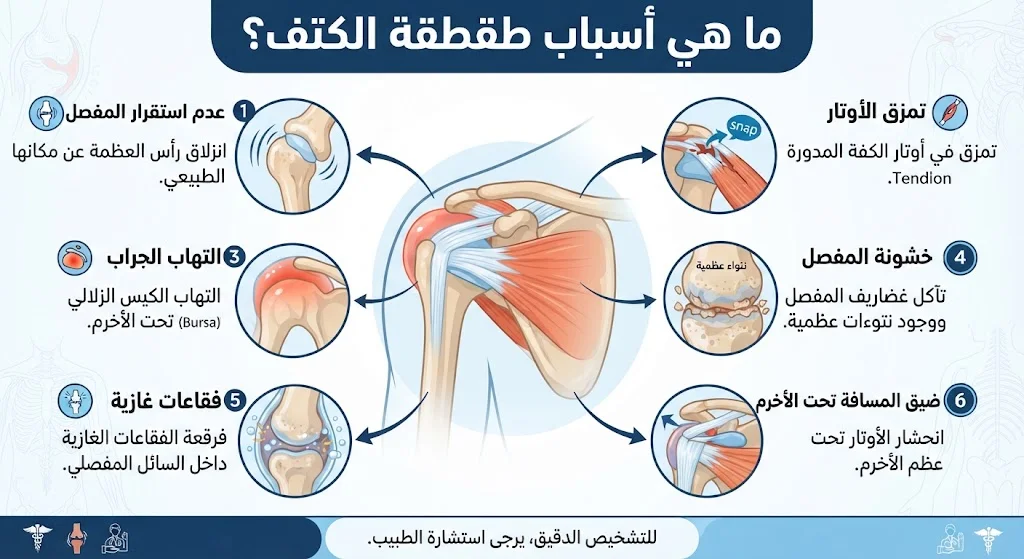
Shoulder clicking stems from four primary biological and mechanical mechanisms:
- Gas Bubble Cavitation: The synovial fluid inside the joint contains dissolved gases. During sudden movement or stretching, pressure drops, causing the gas to form tiny bubbles that collapse and produce a distinct “pop” sound (similar to cracking knuckles). This phenomenon is entirely harmless and painless.
- Tendon Sliding Over Bone: The rotator cuff and biceps tendons glide over small bony prominences during movement. When these tendons snap or slide suddenly, they produce a clicking sound. This type is very common among athletes, weightlifters, and individuals performing repetitive movements.
- Cartilage Wear (Pathological Crepitus): In cases of shoulder osteoarthritis and articular cartilage degeneration, the bone surfaces rub directly against each other, producing a rough, continuous grinding sound accompanied by a grinding sensation.
- Shoulder Tendon Impingement: Narrowing of the space between the humeral head and the acromion causes a repetitive clicking sound when elevating the arm, frequently accompanied by pain within the “painful arc” between 60 and 120 degrees.
Other less common causes: Bursitis, labral tears (such as a Bankart lesion), biceps tendon irritation, or rarely, a benign cartilage tumor (osteochondroma).
Is Shoulder Crepitus Normal?
Yes, in most cases. Shoulder clicking that is unaccompanied by pain, swelling, or arm weakness is entirely normal and requires no medical intervention. The sound alone—no matter how annoying—is not a sign of disease.
- Normal Crepitus: Intermittent, occurs occasionally rather than constantly, and disappears with continued movement.
- Pathological Crepitus: Continuous, repeats in the exact same spot with every movement, and gradually worsens over time.
When is Shoulder Crepitus Dangerous?
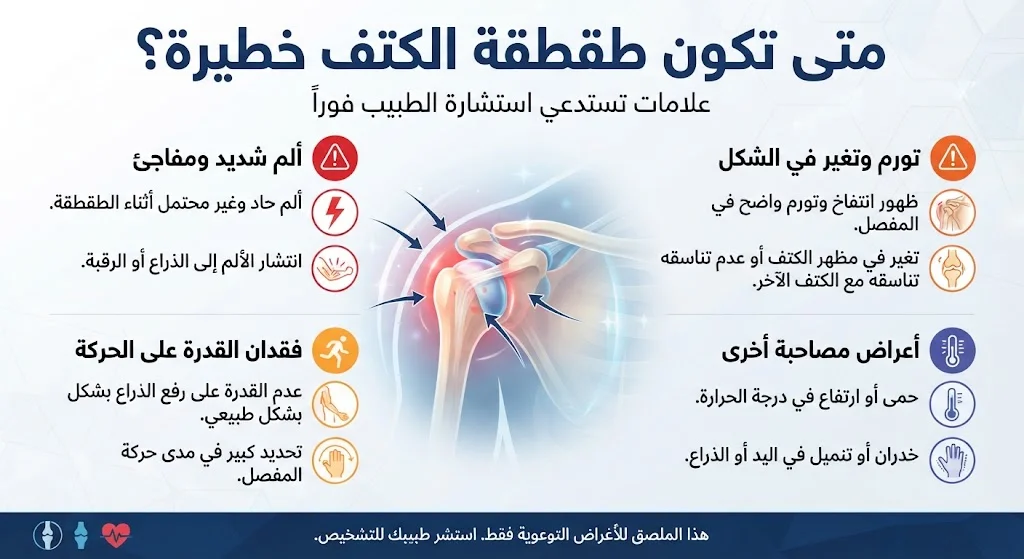
Shoulder clicking warrants prompt medical evaluation when paired with any of the following warning signs:
| Accompanying Warning Sign | Potential Pathological Cause | Required Medical Action |
| Clicking with persistent or escalating pain | Tendon impingement — partial tear — osteoarthritis | Medical consultation within a week |
| Clicking with noticeable weakness lifting the arm | Complete rotator cuff tendon tear | Urgent MRI scan |
| Sensation that the shoulder “slips out and goes back in” | Instability — labral tear (Bankart) | Specialized surgical evaluation |
| Clicking accompanied by swelling, heat, and redness | Septic arthritis — active inflammatory arthritis | Emergency room or immediate evaluation |
| Clicking with sudden joint locking during movement | Loose body inside the joint — cartilage tear | Urgent surgical evaluation |
| Clicking starting immediately after a direct fall or injury | Bone fracture — acute ligament tear | Immediate X-ray imaging |
What Exercises Help Treat Shoulder Crepitus?
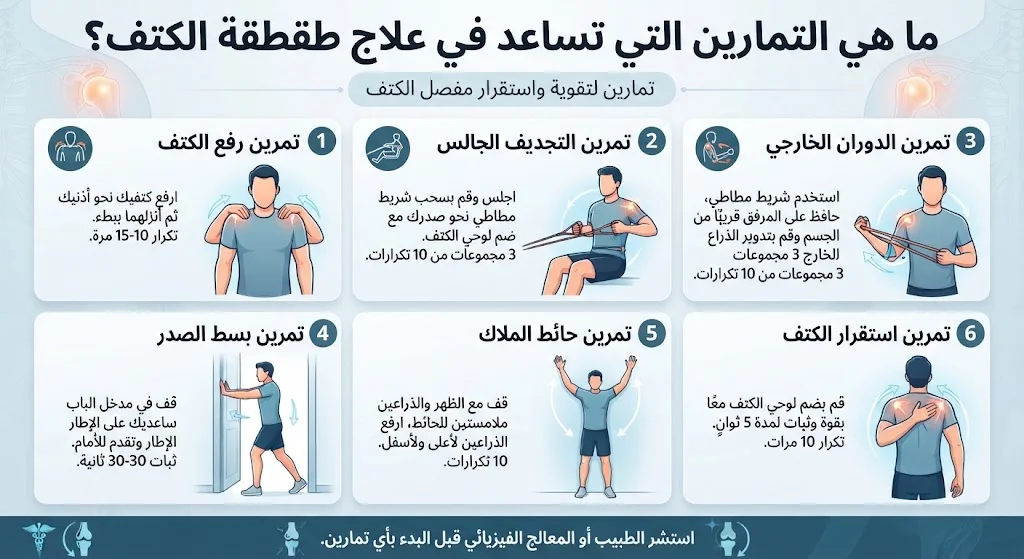
Exercises do not eliminate natural biological clicking, but they successfully reduce mechanical clicking caused by muscle weakness and poor joint mechanics by strengthening the rotator cuff and scapular muscles to offload joint stress:
- Pendulum Exercise:
- Lean forward at a 45–90° angle while supporting the healthy hand on a table. Let the affected arm hang completely loose and swing under its own weight (forward/backward, side-to-side, and in small circles).
- Repetitions: 10 times in each direction, twice daily (relaxes muscles and improves lubrication).
- Band External Rotation:
- Stand with elbows bent at 90° against the body, holding a resistance band (Theraband). Slowly rotate the forearm outward, then return with control.
- Repetitions: 3 sets × 15 reps, 3 weekly (strengthens the Infraspinatus and Teres Minor muscles).
- Scapular Retraction:
- Sit or stand with an upright back, pull the shoulder blades back and down, hold for 5 seconds, then relax.
- Repetitions: 3 sets × 15 reps daily (corrects forward shoulder posture that narrows the subacromial space).
- Wall Walk:
- Place fingertips on a wall and “walk” them gradually upward to the point of mild tension, then slowly back down.
- Repetitions: 10 times, twice daily (restores full range of motion and relieves joint tension).
- Scaption:
- Stand with thumbs pointing upward, elevating the arm forward at a 30° angle from the body’s axis up to shoulder level only.
- Repetitions: 3 sets × 12 reps (safely strengthens the supraspinatus muscle).
How is Shoulder Crepitus Treated?
The treatment protocol depends entirely on an accurate diagnosis of the underlying cause:
- Painless Crepitus: Requires no medication or intervention. Daily exercises to maintain range of motion, posture correction, and proper warm-up before physical activity are completely sufficient.
- Painful/Pathological Crepitus:
- Medications: Non-steroidal anti-inflammatory drugs (NSAIDs like Voltaren® or Celebrex®) for 2–4 weeks to relieve pain.
- Physical Therapy: Regular sessions for 6–12 weeks to correct mechanical deficits.
- Injections: Cortisone injections (for rapid relief in tendon impingement/bursitis) or hyaluronic acid injections (to improve joint lubrication in shoulder osteoarthritis).
- Arthroscopic Surgery: Indicated when conservative treatment fails for 4–6 months with persistent, disabling pain (such as subacromial decompression or tendon repair).

Book Your Appointment with Prof. Dr. Ibrahim Abdelmonem
If you are experiencing bothersome clicking accompanied by pain or swelling in your shoulder, you can consult Prof. Dr. Ibrahim Abdelmonem (Professor of Orthopedic and Joint Surgery at Ain Shams University and Visiting Professor at Ohio State University) for a precise evaluation to distinguish between normal physiological phenomena and conditions requiring specialized care.
Reception clinics are available in four main branches:
- Nasr City Branch
- Fifth Settlement Branch
- Mohandessin Branch
- Batal Ahmed Abdel Aziz Branch (Mohandessin)

Frequently Asked Questions: Shoulder Crepitus
What is shoulder crepitus and what causes those grinding or popping sounds?
When is shoulder crepitus considered completely normal and harmless?
How can you tell the difference between harmless joint popping and pathological crepitus?
What role does shoulder osteoarthritis play in causing grinding crepitus?
Can scapular dyskinesis (abnormal shoulder blade movement) cause crepitus?
What diagnostic evaluations are necessary to assess painful shoulder crepitus?
Can physical therapy help eliminate or reduce painful shoulder crepitus?
When does shoulder crepitus indicate a torn labrum or rotator cuff?
When does shoulder crepitus require arthroscopic surgical intervention?
When should you consult an orthopedic specialist about your shoulder crepitus?
references
- Shoulder Crepitus: Causes, Diagnosis & Treatment — Understanding Shoulder Cracking — GetLabTest
- Scapulothoracic Bursitis and Snapping Scapula Syndrome: A Critical Review of Current Evidence — Am J Sports Med (2015)
- Diagnosis and Treatment of Snapping Scapula Syndrome: A Scoping Review — Sports Health / PMC (2021)
- Arthroscopic Management of Snapping Scapula Syndrome: Systematic Review — Knee Surg Sports Traumatol Arthrosc (2018)
- Snapping Scapula Syndrome: Review Article — Dr. Millett (Brigham and Women’s Hospital)
- Shoulder Crepitus — Causes, Significance & Differential Diagnosis Including Rotator Cuff and Labral Pathology
- Shoulder Impingement Pain Syndrome: Pathophysiology, Diagnosis & Treatment — Cureus / PMC (2025)
- Systematic Review of Clinical Practice Guidelines on Diagnosis and Management of Shoulder Disorders — Arch Phys Med Rehabil (2024)
- Glenohumeral Osteoarthritis: Diagnosis & Treatment (Including Crepitus as a Symptom) — Physiotutors (2023)
- Comprehensive Approaches to Shoulder Impingement Syndrome: From Diagnosis to Rehabilitation — IJACT (2024)