
Rotator cuff tears are the most prevalent shoulder pathologies, affecting up to 40% of individuals over the age of 50 (Vanderbilt University Study). These tears result from either acute trauma or chronic age-related degeneration. According to the Cleveland Clinic, many partial-thickness tears improve with conservative management. However, full-thickness tears in young individuals or athletes typically mandate arthroscopic intervention.
Anatomy of the Rotator Cuff
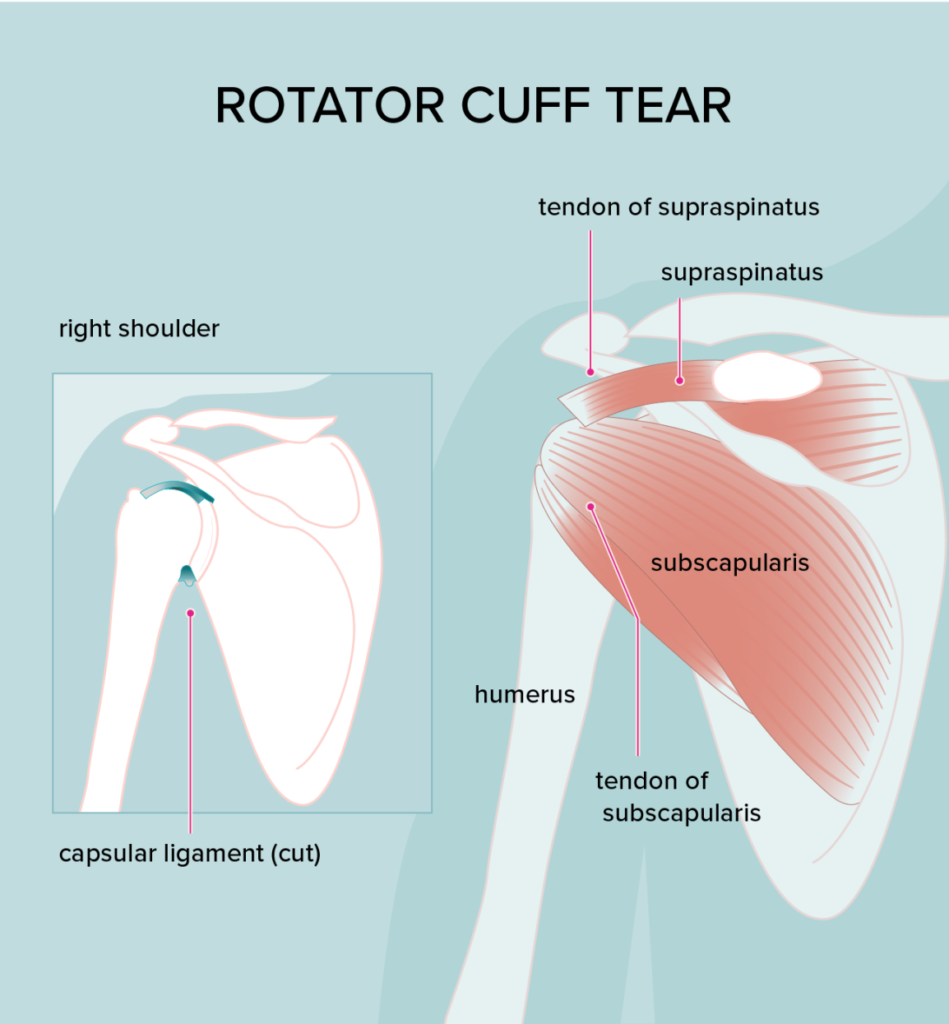
The rotator cuff consists of four muscles and their tendons that anchor the humeral head into the glenoid cavity:
- Supraspinatus: Passes beneath the acromion; most susceptible to friction and tearing.
- Infraspinatus: The second most commonly torn tendon; responsible for external rotation.
- Subscapularis: Responsible for internal rotation; tears are less frequent.
- Teres Minor: Stabilizes rotation; isolated tears are rare.
Classification of Tears
| Tear Type | Clinical Description | Prevalence / Onset |
| Partial-Thickness | Damaged/frayed tendon; structurally incomplete tear. | Most common |
| Full-Thickness | Complete detachment of the tendon from the bone. | Requires surgical review |
| Degenerative | Progressive attrition due to age and repetitive wear. | Predominant over 50 years |
| Traumatic | Acute disruption caused by direct impact or falls. | Occurs at any age |
Symptomatology & In-Home Screenings
Symptoms include a deep ache exacerbated by lifting the arm forward or laterally, severe night pain when sleeping on the affected side, localized muscle weakness (e.g., struggling to comb hair), and crepitus during movement.
Preliminary Structural Screenings
- Drop Arm Test: Lift the arm laterally and lower it slowly; a sudden drop indicates a full-thickness tear.
- Painful Arc Test: Severe pain elicited between 60° and 120° of lateral elevation points to supraspinatus pathology.
- Persistent Night Pain: A clinical hallmark indicating a structural tear.
- Note: These tests are strictly informational; final diagnosis requires an orthopedic evaluation and an MRI.
Treatment Modalities
1. Conservative Management
Indicated for partial, degenerative tears in older populations with manageable pain. In the multicenter MOON cohort, physical therapy was effective in about 75% of patients with atraumatic full-thickness tears over 2 years.
- Rest & Activity Modification: Avoiding overhead lifting and aggravating maneuvers.
- Pharmacology: NSAIDs to control pain and inflammation.
- Physical Therapy: Targeted periscapular strengthening for 6–12 weeks to compensate for the damaged tendon.
- Injections: Corticosteroid injections for temporary relief (4–8 weeks; maximum 3 annually) or Platelet-Rich Plasma (PRP) to stimulate cellular healing (effective for 6–12 months).
2. Arthroscopic Surgery
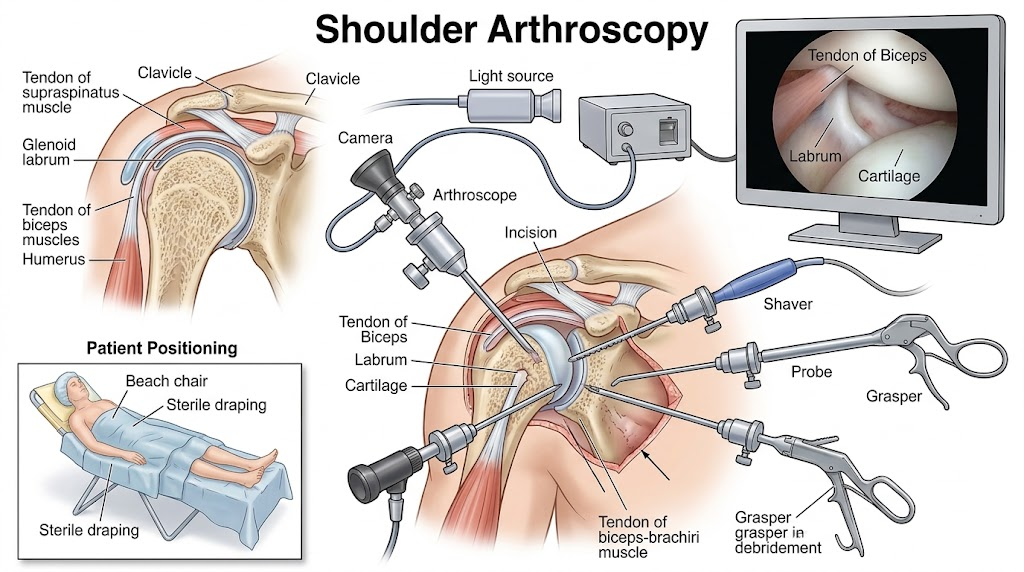
The gold standard for full-thickness or non-responsive tears. The surgeon re-anchors the tendon using suture anchors through 5–10 mm micro-incisions. Advanced “Suture Bridge” configurations maximize bone-to-tendon contact for superior biomechanical stability. Most patients are discharged within 24 hours.
- Success Rate: 90%–95% for small-to-medium tears; 80%–88% for massive, complex tears.
- Cost (Egypt 2026): EGP 35,000 to EGP 95,000, depending on tear size and anchor count.
Postoperative Guidelines & Rehabilitation Timeline
Tendons require 6–12 weeks for initial osseous integration. Premature loading can trigger a structural re-tear (incidence rate: 3%–15% based on baseline tear size).
- Weeks 1–4 (Protection): Constant sling immobilization (day/night); cryotherapy (15–20 mins every 2–3 hours); active wrist/finger motion to prevent thrombosis; sleep semi-reclined at 45°.
- Weeks 4–8 (Passive Motion): Wean from the sling; initiate physical therapy via passive range of motion (PROM); strictly no lifting or driving.
- Weeks 8–16 (Early Strengthening): Gradual active-assisted training; return to light activities of daily living (ADLs) and desk work (weeks 2–4).
- Months 4–6 (Advanced Strengthening): Progressive resistance exercises; return to full routine physical activity.
- Months 6–9 (Athletic Clearance): Gradual reintroduction to impact sports or heavy labor upon physician approval.
FREQUENTLY ASKED QUESTIONS
What are the main symptoms of a rotator cuff tear?
Key symptoms include a deep shoulder ache exacerbated by lifting the arm forward or laterally, severe night pain when sleeping on the affected side, localized muscle weakness (such as struggling to comb hair), and audible crepitus or snapping sounds during movement.
Can a torn rotator cuff tendon heal completely without surgery?
Partial-thickness and degenerative tears frequently recover without surgery; and in the multicenter MOON cohort of 452 patients with atraumatic full-thickness tears, a physical therapy program was effective in about 75% of patients over 2 years without surgery. However, full-thickness structural tears cannot re-anchor to the bone naturally and require arthroscopic repair.
What is the success rate of arthroscopic rotator cuff repair?
The clinical success rate ranges between 90% and 95% for small-to-medium structural tears. For massive, complex chronic tears involving muscle tissue degradation, the success rate ranges from 80% to 88%. This makes it a highly reliable and safe procedure with a low rate of serious complications.
What is the risk of a tendon re-tearing after arthroscopic surgery?
The incidence rate for a structural re-tear ranges from 3% to 15%. This risk is predominantly restricted to large, chronic tears or compromised tissue quality. It can be heavily minimized by adhering to the 6 to 12-week bone-integration timeline and avoiding premature mechanical loading or heavy lifting.
How long does physical therapy take after rotator cuff surgery?
In conservative management, targeted physical therapy spans 6 to 12 weeks. Following arthroscopic surgery, structured rehabilitation formally begins at week 4 with passive motion training, gradually advancing to active loading. Most patients achieve 90% to 100% functional return within 4 to 6 months, with full athletic discharge occurring at 6 to 9 months.
REFERENCES
- American Academy of Orthopaedic Surgeons (AAOS), OrthoInfo: Rotator Cuff Tears
- American Academy of Orthopaedic Surgeons (AAOS), OrthoInfo: Rotator Cuff Tears: Surgical Treatment Options
- Kukkonen J, et al. Treatment of non-traumatic rotator cuff tears. The Bone & Joint Journal. 2014;96-B:75-81. doi:10.1302/0301-620X.96B1.32168
- Yamamoto A, et al. Prevalence and risk factors of a rotator cuff tear in the general population. J Shoulder Elbow Surg. 2010;19(1):116-120. doi:10.1016/j.jse.2009.04.006
- Kuhn JE, et al. Effectiveness of physical therapy in treating atraumatic full-thickness rotator cuff tears: a multicenter prospective cohort study. J Shoulder Elbow Surg. 2013;22(10):1371-1379. doi:10.1016/j.jse.2013.01.026
- McElvany MD, et al. Rotator cuff repair: published evidence on factors associated with repair integrity and clinical outcome. Am J Sports Med. 2015;43(2):491-500. doi:10.1177/0363546514529644