
Adhesive Capsulitis (Frozen Shoulder), commonly known as “frozen shoulder,” is a painful condition characterized by progressive loss of shoulder range of motion. Affecting 2%–5% of the general population, it is several times more common in people with diabetes. The condition evolves through three distinct phases: Freezing (pain), Frozen (stiffness), and Thawing (gradual recovery). Although often described as self-limiting, frozen shoulder does not always resolve completely on its own.
Pathophysiology and Staging
Frozen shoulder involves inflammation and fibrosis of the joint capsule, leading to thickening and gradual constriction, which restricts movement—particularly external rotation and overhead elevation. The exact etiology remains multifactorial, primarily involving capsular inflammation and fibrotic changes.

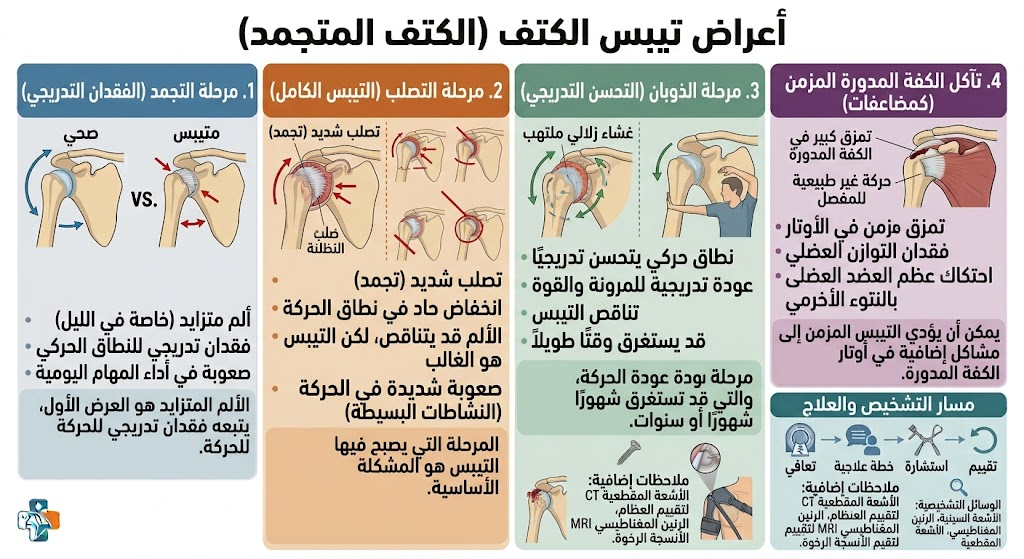
The Three Phases
| Phase | Name | Duration | Clinical Presentation |
|---|---|---|---|
| Phase 1 | Freezing | 2–9 months | Gradual onset of increasing pain with initial motion loss. |
| Phase 2 | Frozen | 4–12 months | Pain subsides, but stiffness reaches its peak; severe limitation. |
| Phase 3 | Thawing | 5–26 months | Gradual improvement in motion; may not return to 100% without therapy. |
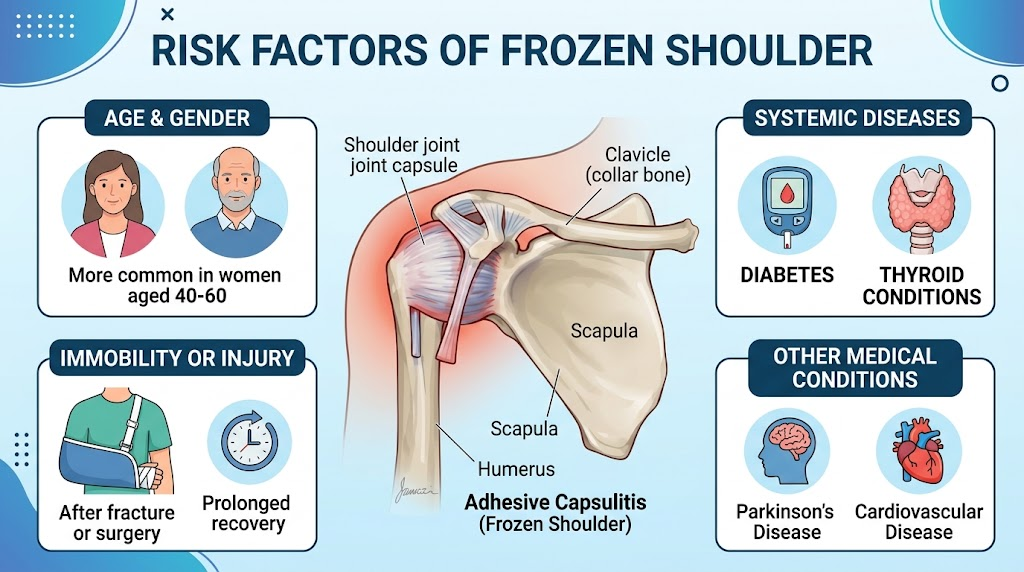
Risk Factors
- Diabetes: The strongest risk factor; patients exhibit a fivefold higher prevalence and often demonstrate reduced responsiveness to conservative treatment.
- Thyroid Disorders: Both hyperthyroidism and hypothyroidism increase susceptibility.
- Prolonged Immobilization: Secondary to fractures, surgery, or prior trauma.
- Demographics: Most prevalent in women aged 40–60.
- Prior Injury: History of shoulder dislocation, rotator cuff tears, or previous surgery.
Symptomatology and Differential Diagnosis
Symptoms include persistent, deep shoulder ache that intensifies at night, progressive limitation in active and passive ROM, and difficulty with ADLs like combing hair or reaching behind the back.
Differential Diagnosis
| Sign | Frozen Shoulder | Rotator Cuff Tear |
|---|---|---|
| Motion Loss | Global (Active and Passive) | Usually only Active motion |
| Night Pain | Severe (especially Phase 1) | Present, but typically less intense |
| Muscle Weakness | None (stiffness-based) | Observable weakness in elevation |
| Onset | Gradual (weeks to months) | Often acute after injury or gradual |
Treatment Modalities
1. Conservative Management (First-Line)
- Pharmacology: NSAIDs to mitigate inflammation and pain, particularly during the Freezing phase.
- Intra-articular Corticosteroid Injections: Highly effective for rapid inflammation reduction and motion improvement. Early injection yields superior outcomes compared to delaying intervention.
- Physical Therapy (PT): The foundation of recovery, focusing on ROM exercises followed by progressive strengthening.
2. Arthroscopic Capsular Release
For cases resistant to 6–12 months of conservative therapy, arthroscopic release involves surgically cutting the fibrotic capsule to restore mobility. Success rates are high (85%–92%).

Home-Based Management
While home exercises are essential, they do not replace clinical follow-ups. Exercises must focus on “comfortable stretch” rather than sharp pain.
- Pendulum: Small, gentle circular arm swings.
- Wall Walk: Finger-walking up a wall to a comfortable height.
- Towel Stretch: Using the healthy hand to pull the affected arm via a towel.
- Cross-body Stretch: Gently pulling the affected arm across the chest.
- Heat Therapy: Apply heat for 15 minutes prior to exercises to increase tissue compliance.
The Role of Physical Therapy
Physical therapy is the cornerstone of frozen shoulder recovery. The UK FROST trial—the largest clinical study on the condition—demonstrated the efficacy of structured PT in enhancing mobility and reducing pain. Programs typically include passive mobilization, followed by active-assisted and resistance training, occurring 2–3 times weekly for 3–6 months.
Frequently Asked Questions (FAQ)
What is frozen shoulder and why does it occur after surgery?
Frozen shoulder (adhesive capsulitis/arthrofibrosis) involves inflammation and thickening of the joint capsule. It is a recognized delayed complication occurring in 2%–5% of arthroscopic shoulder surgeries, typically triggered by delayed mobilization or failure to adhere to early post-operative range-of-motion rehabilitation protocols.
Who is at the highest risk for developing frozen shoulder?
High-risk populations include patients with diabetes (who face a fivefold increased prevalence), individuals with thyroid dysfunction, and women aged 40–60. Patients undergoing complex shoulder reconstructions who delay physical therapy are also significantly predisposed.
How can frozen shoulder be prevented after arthroscopy?
Prevention relies on strict adherence to a structured rehabilitation protocol. Initiating passive range-of-motion (PROM) exercises under professional guidance by the fourth post-operative week is essential to prevent the formation of fibrotic adhesions within the joint capsule.
What is the treatment for frozen shoulder if it occurs?
Treatment begins with aggressive physical therapy, anti-inflammatory medication, and targeted corticosteroid injections. If the condition remains resistant to 6–12 months of conservative management, arthroscopic capsular release is the gold standard surgical intervention to restore mobility.
references
- American Academy of Orthopaedic Surgeons (AAOS), OrthoInfo: Frozen Shoulder
- Challoumas D, et al. Comparison of treatments for frozen shoulder: a systematic review and meta-analysis. JAMA Netw Open. 2020;3:e2029581. doi:10.1001/jamanetworkopen.2020.29581
- Rangan A, et al. Management of adults with primary frozen shoulder in secondary care (UK FROST): a multicentre, pragmatic, three-arm, superiority randomised clinical trial. Lancet. 2020;396(10256):977-989. doi:10.1016/S0140-6736(20)31965-6