
Shoulder arthroscopy is a minimally invasive surgical procedure used to diagnose and treat joint pathologies through small (3–5 mm) incisions. The surgeon inserts a high-definition camera (arthroscope) and specialized micro-instruments, visualizing the joint anatomy on a magnified video monitor to perform precise repairs. This article discuss the cost of shoulder arthroscopic surgery
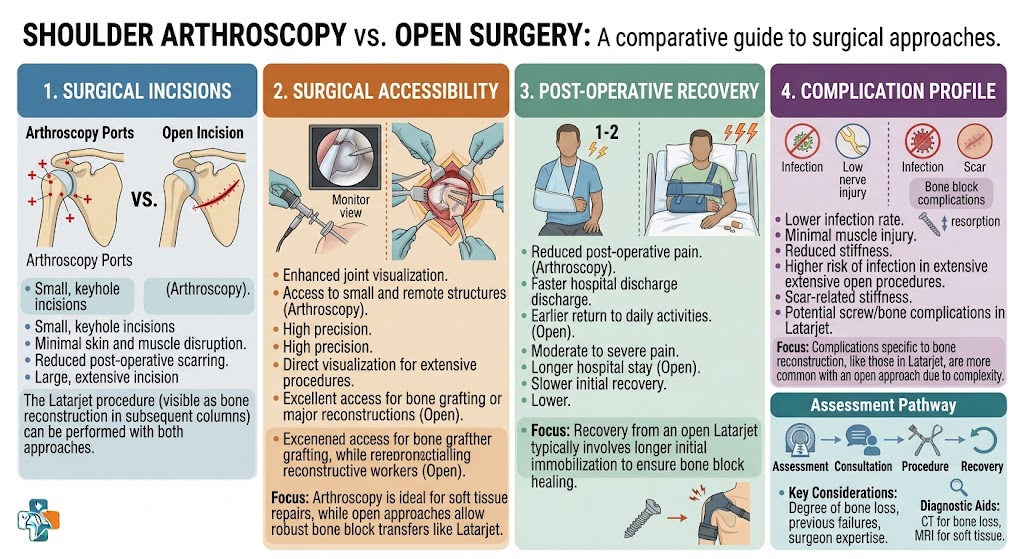
Shoulder Arthroscopy vs. Open Surgery
| Comparison | Arthroscopic Surgery | Traditional Open Surgery |
| Incision Size | 3–5 micro-incisions (< 1 cm) | Single large incision (8–15 cm) |
| Postoperative Pain | Significantly minimal | High; requires potent analgesics |
| Hospital Stay | Same-day discharge (within 24 hours) | 2–5 days |
| Physical Therapy | Initiated within days | Delayed for weeks |
| Full Recovery | 3–6 months | 6–12 months |
| Scarring | Virtually negligible | Prominent, visible scar |
| Complication Rate | < 1.2% | Significantly higher |
| Surgical Precision | Ultra-high (magnified visualization) | Limited to direct line-of-sight |
Cost of Shoulder Arthroscopy
The average cost of shoulder arthroscopy in Egypt for 2026 ranges between EGP 30,000 and EGP 100,000. The final price varies depending on the specific pathology, surgical complexity, surgeon’s fees, and hospital grading.
Shoulder Arthroscopy Surgery Cost Calculator
Estimate procedural costs based on pathology, patient age, and hospital tier
Cost Breakdown by Procedure Type
- Diagnostic Arthroscopy Only: EGP 25,000 – EGP 40,000
- Rotator Cuff Repair (Small Tear): EGP 35,000 – EGP 55,000
- Rotator Cuff Repair (Large/Complex Tear): EGP 50,000 – EGP 95,000
- Bankart Repair (Recurrent Instability): EGP 40,000 – EGP 70,000
- Latarjet Procedure (Bone Block): EGP 60,000 – EGP 100,000
- Calcific Tendonitis Debridement: EGP 30,000 – EGP 50,000
- Shoulder Cyst Excision: EGP 25,000 – EGP 45,000
- Capsular Release (Frozen Shoulder): EGP 30,000 – EGP 50,000
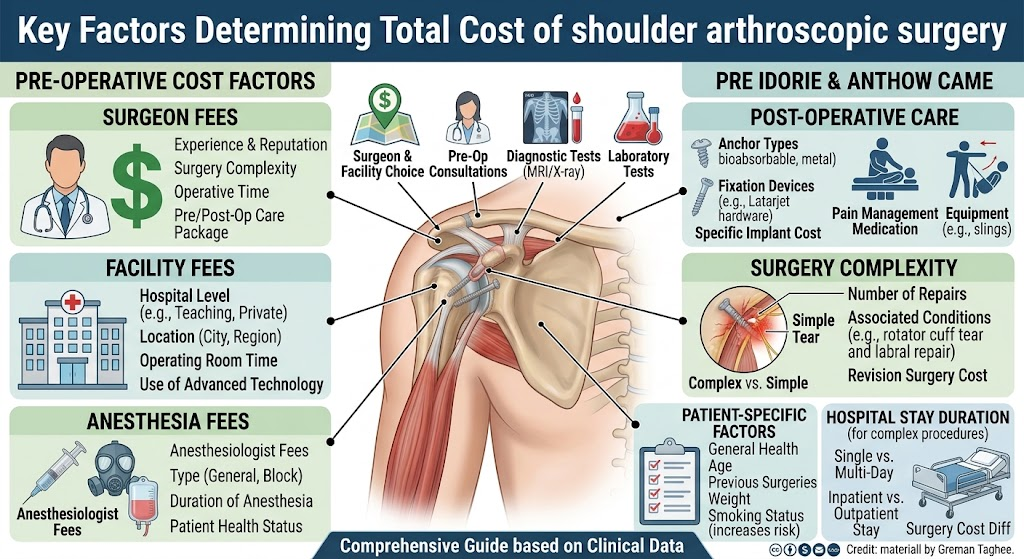
Key Factors Determining Total Cost
- Surgical Complexity: Major structural reconstructions (e.g., Latarjet or multi-tendon rotator cuff repairs) require extended operating room time and higher costs than simple diagnostic debridement.
- Surgeon’s Qualifications: Fees scale with the orthopedic specialist’s academic ranking, international fellowships, and surgical track record.
- Hospital & Equipment Facility: Premium centers utilizing cutting-edge 4K/HD arthroscopic towers and strict international sterilization protocols charge higher facility fees.
- Anesthesia Type: General anesthesia combined with regional nerve blocks involves higher clinical fees than basic sedation.
- Surgical Implants: High-grade imported suture anchors significantly impact the final price but provide superior biomechanical stability.
- Pre- and Post-operative Services: Includes mandatory pre-op lab work, MRI scans, post-op medications, and subsequent physical therapy sessions.
Success Rates of shoulder arthroscopic surgery
Indications & Operative Duration
Surgical intervention is indicated after 3 to 6 months of failed conservative management (medications and physical therapy).
- Diagnostic/Debridement protocols: 20–45 minutes.
- Complex Rotator Cuff or Latarjet reconstructions: 90–150 minutes.
Prognosis & Functional Return
The overall success rate of shoulder arthroscopy ranges between 85% and 95%. Most patients regain 90% to 100% of their baseline range of motion (ROM) within 4 to 6 months, achieving full clearance for daily living and athletic participation by months 6 to 9.
Postoperative Recovery Phases
- Phase 1 (Protection | Weeks 1–4): Strict immobilization via a shoulder sling. Focus shifts to pain/edema control and active range of motion for the hand, wrist, and fingers.
- Phase 2 (Early ROM | Weeks 4–8): Gradual weaning from the sling. Initiation of passive range of motion (PROM) exercises guided by a physical therapist.
- Phase 3 (Strengthening | Weeks 8–16): Progression to active-assisted and active exercises targeting the rotator cuff and periscapular stabilizers.
- Phase 4 (Advanced Functional Return | Months 4–6): Restoration of full strength for routine desk work and light non-impact activities.
- Phase 5 (Athletic Discharge | Months 6–9): Gradual reintroduction to high-demand impact sports and heavy physical labor.
Complications of shoulder arthroscopic surgery
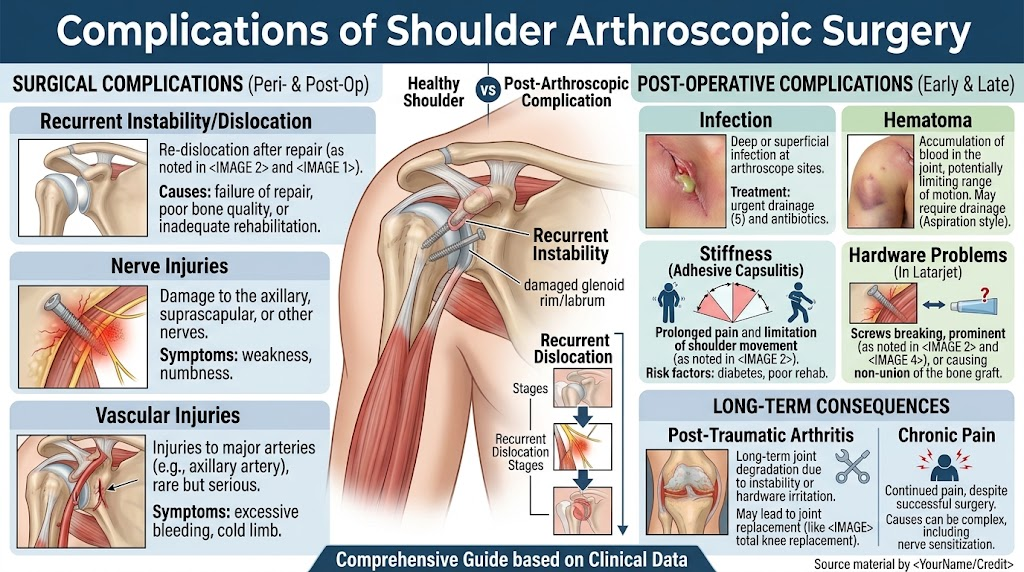
According to a large-scale study published in the British Medical Journal (BMJ) evaluating over 500,000 cases, the 90-day major complication rate following shoulder arthroscopy is extraordinarily low at 1.2%.
Potential Risks & Incidences
- Arthrofibrosis (Frozen Shoulder / Stiffness): 2% – 5%
- Superficial Surgical Site Infection: 0.1% – 0.2%
- Peripheral Nerve Injury (Transient Neuropraxias): < 0.5%
- Deep Vein Thrombosis (DVT): < 0.1%
- Structural Re-tear (Large Rotator Cuff Repairs): 5% – 15%
Protocols to Minimize Surgical Risk
- Select a dedicated fellowship-trained arthroscopic shoulder specialist rather than a general orthopedic surgeon.
- Complete a comprehensive pre-operative screening (ECG, complete blood counts, and chest radiographs).
- Disclose all routine pharmacology, specifically antiplatelets and anticoagulants, to adjust bleeding profiles.
- Strictly adhere to postoperative immobilization and physical therapy constraints.
- Monitor for early warning signs, including spikes in core temperature, localized erythema, or purulent drainage.
Frequently Asked Questions: Cost of Shoulder Arthroscopic Surgery
An authoritative guide to surgical pricing, implant expenditures, facility fees, health insurance coverage, and post-operative rehabilitation budgeting.
What is the average cost of shoulder arthroscopic surgery?
The total cost of shoulder arthroscopy depends heavily on the specific procedure performed, clinical complexity, and healthcare setting. Basic diagnostic arthroscopy or subacromial decompression sits at the entry-level price range. In contrast, complex reconstructive interventions—such as multi-anchor rotator cuff repairs, Bankart stabilization for recurrent shoulder dislocation, or superior labrum (SLAP) repairs—carry higher costs due to specialized biocomposite implants, prolonged operating suite usage, and advanced radiofrequency equipment.
What are the core components that make up the total surgical cost?
A comprehensive billing breakdown typically encompasses four primary categories:
• Surgeon & Assistant Fees: Professional compensation for the orthopedic shoulder specialist and surgical team.
• Anesthesia Services: General anesthesia combined with an ultrasound-guided interscalene brachial plexus nerve block for post-operative analgesia.
• Facility / Operating Room Fees: 4K arthroscopic tower systems, fluid pump irrigation units, motorized bone shavers, and recovery suite care.
• Implant & Hardware Costs: Pre-loaded bio-composite or PEEK suture anchors used to secure tendon or cartilage back to bone.
How do surgical suture anchors affect the cost of shoulder arthroscopy?
Surgical implants represent one of the most variable financial items on the final invoice. Repairing torn soft tissue requires anchor fixation into the humeral head or glenoid bone. Depending on tear size and tissue quality:
• A minor labral tear may require 2 to 3 anchors.
• A large or retracted rotator cuff tear treated with a modern double-row or suture-bridge construct often requires 4 to 6 anchors.
Modern bio-composite (osteoconductive) or all-suture anchors carry premium manufacturing costs that directly scale with the total number deployed.
Is shoulder arthroscopy cheaper at an Ambulatory Surgery Center (ASC) than a hospital?
Yes. Performing shoulder arthroscopy at an accredited specialized Ambulatory Surgery Center (ASC) or outpatient day-surgery center is generally 30% to 50% less expensive than at a major inpatient hospital. Because the overwhelming majority of arthroscopic procedures allow patients to return home the same day following recovery, ASCs offer substantial overhead savings on facility fees and administrative overhead without compromising surgical safety or sterility standards.
Does health insurance cover shoulder arthroscopic surgery?
Yes, standard health insurance plans, medical syndicates, and third-party administrators cover shoulder arthroscopy when determined to be medically indicated. Insurers generally mandate pre-authorization proving that:
1. Non-operative conservative management (dedicated physical therapy, activity modification, NSAIDs, and subacromial injections) was attempted for 6 to 12 weeks without adequate clinical improvement.
2. Diagnostic imaging (MRI or MR-arthrogram) demonstrates concrete anatomical pathology, such as a full-thickness rotator cuff tear or Bankart lesion.
What out-of-pocket expenses should insured patients anticipate?
Insured patients should review policy details regarding out-of-pocket exposure:
• Deductibles & Co-insurance: The policyholder’s annual deductible plus any remaining co-insurance percentage (often 10% to 20% of negotiated network rates).
• Specialist Co-pays: Pre- and post-operative surgical consultation fees.
• Durable Medical Equipment (DME): Specialized abduction shoulder slings or motorized cold-compression therapy units may have separate coverage limits or require direct patient copayments.
What pre-operative diagnostics are billed separately?
Pre-surgical diagnostic workups are itemized separately prior to surgical scheduling:
• Magnetic Resonance Imaging (MRI / MR-Arthrogram): The definitive study to assess tendon tear dimensions, muscle retraction, and cartilage integrity.
• Digital Shoulder Radiographs: True AP, axillary, and scapular Y-views to rule out acromial spurs, calcific deposits, or glenohumeral arthritis.
• Pre-Anesthesia Medical Clearance: Routine blood testing (CBC, coagulation profile, kidney functions) and an ECG/cardiology consultation for patients over 40 to 45 years old.
How much does post-operative physical therapy add to the overall cost?
Surgical repair accounts for half of recovery; the remainder depends on supervised physical rehabilitation. Post-operative protocols span 3 to 6 months (typically 2 to 3 sessions per week, totaling 24 to 36 sessions). The rehabilitation schedule moves systematically from passive range-of-motion protection to active periscapular and rotator cuff strengthening. Patients must account for insurance physical therapy visit limits, copayments, or self-pay per-session rehabilitation fees.
Why is arthroscopic rotator cuff repair more expensive than simple debridement?
Subacromial decompression (acromioplasty) or simple bursectomy involves clearing inflamed bursal tissue and shaving bony spurs with standard motorized shavers without requiring implants. In contrast, rotator cuff repair requires meticulous decortication of the greater tuberosity footprint, high-tensile braided sutures, multiple specialized suture anchors, specialized suture-passing instruments, and longer anesthesia time, significantly elevating overall procedural cost.
How can self-pay patients minimize the cost of shoulder arthroscopy?
Self-paying and medical tourism patients can optimize expenditures through several proactive strategies:
1. Negotiate Bundled Package Pricing: Request an all-inclusive single rate covering surgeon fees, anesthesia, facility charges, and baseline suture implants.
2. Opt for Day-Surgery Centers: Selecting an outpatient ambulatory facility over a high-tier inpatient hospital dramatically curbs room and admission overhead.
3. Verify Implant Itemization: Inquire about FDA/CE-certified anchor choices and ensure clear billing thresholds for additional implants should intraoperative complexity increase.
References
- https://turquoise.health/services/arthroscopy-shoulder-surgical/
- https://www.newchoicehealth.com/arthroscopic-shoulder-surgery/cost
- https://cost.sidecarhealth.com/ts/shoulder-arthroscopy-with-incision-cost-by-state
- https://biologyinsights.com/how-much-does-arthroscopic-shoulder-surgery-cost/
- https://www.medicare.gov/procedure-price-lookup/cost/29827/
- https://pubmed.ncbi.nlm.nih.gov/22959790/
- https://nhhealthcost.nh.gov/costs/medical/result/arthroscopic-shoulder-surgery