
Arthroscopic rotator cuff tear repair stands as the definitive surgical solution for full-thickness tears and partial-thickness tears that fail conservative management. The clinical success rate ranges between 80% and 95%, heavily influenced by tear dimensions, patient age, and the surgeon’s specialized expertise.
Why Does a Rotator Cuff Tear Require Surgery?
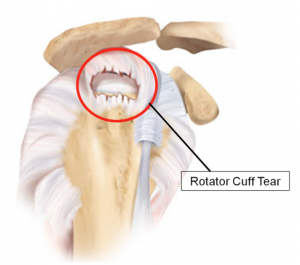
The rotator cuff comprises four structural tendons stabilizing the humeral head and governing shoulder kinematics. The supraspinatus tendon is highly susceptible to injury and is the most commonly involved rotator cuff tendon. When a complete tear occurs, spontaneous biological healing is structurally impossible due to the hypovascular nature of the tendinous tissue.
Early surgical intervention is strongly indicated for young individuals and athletes. Prolonged delay risks tendon retraction and irreversible muscle atrophy. A longitudinal study by UC Davis Health (2025) confirmed that full-thickness tears inevitably progress over time; muscle degeneration beyond six months of chronic neglect can compromise final repair viability.
- Partial tear <50% with mild symptoms: Primary Conservative Management
- Full-thickness tear in active/young patients: Early Surgical Intervention
- Full tear in patients >65 without muscle atrophy: Individualized Case Evaluation
- Radiological evidence of muscle atrophy: Urgent Surgery to Prevent Progression
- Failed conservative therapy (3–6 months): Surgical Conversion Indicated
Surgical Technique & Repair Protocols
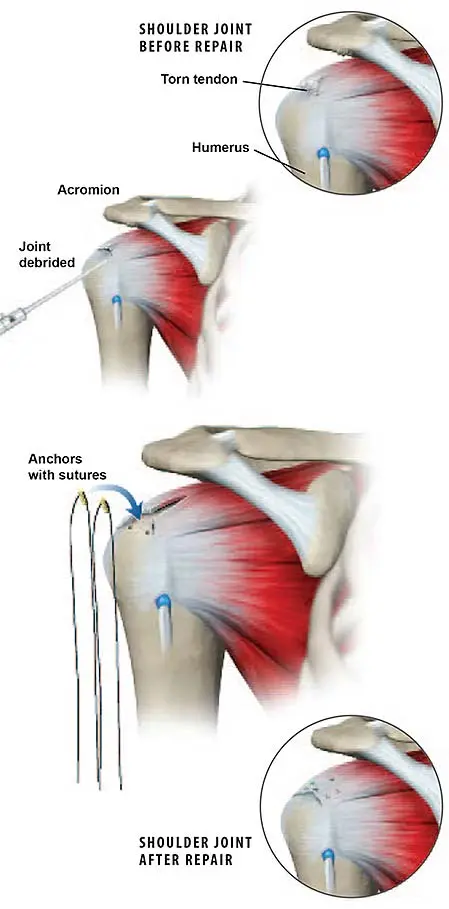
The procedure is performed minimally invasively using 5mm to 10mm portals. High-definition arthroscopic cameras provide dynamic visualization, allowing instruments to debride tissues and re-anchor the tendon to the greater tuberosity using specialized bio-composite Suture Anchors. The procedure lasts between 45 minutes and 2 hours under general anesthesia paired with an interscalene nerve block for optimal postoperative analgesia. Patients are positioned in a beach-chair configuration, and a protective shoulder immobilizer sling is placed immediately after wound closure.
- Small (<1 cm): Double-Row Anchor Repair (2–3 Anchors)
- Medium (1–3 cm): Suture Bridge / Double-Row (3–4 Anchors)
- Large (3–5 cm): Double-Row with Advanced Tensioning (4–6 Anchors)
- Massive (>5 cm): Partial Repair / Patch Augmentation (Variable)
Prognosis, Risks, and Financial Metrics
While clinical efficacy is outstanding, large tears demonstrate an increased risk of structural failure, and the average retear rate in published studies is about 27% (analysis of more than 8,000 shoulders), and it rises with larger tears, older age and fatty atrophy. Modifiable factors that significantly optimize success include early mobilization, active smoking cessation for 6 weeks pre-operatively, tightly controlled HbA1c levels, and selecting an experienced shoulder surgeon.
In Egypt, the projected cost for the procedure in 2026 spans between EGP 35,000 and EGP 95,000. This range varies according to hospital tier, surgical experience, and the volume of premium anchor implants required. Overall complication rates remain under 10%, with stiffness occurring in 2–5% and transient nerve injury in fewer than 0.5% of cases.
Postoperative Rehabilitation Timeline
Biological integration takes time; a repaired tendon regains approximately 80% of its native tensile strength at 6 months.
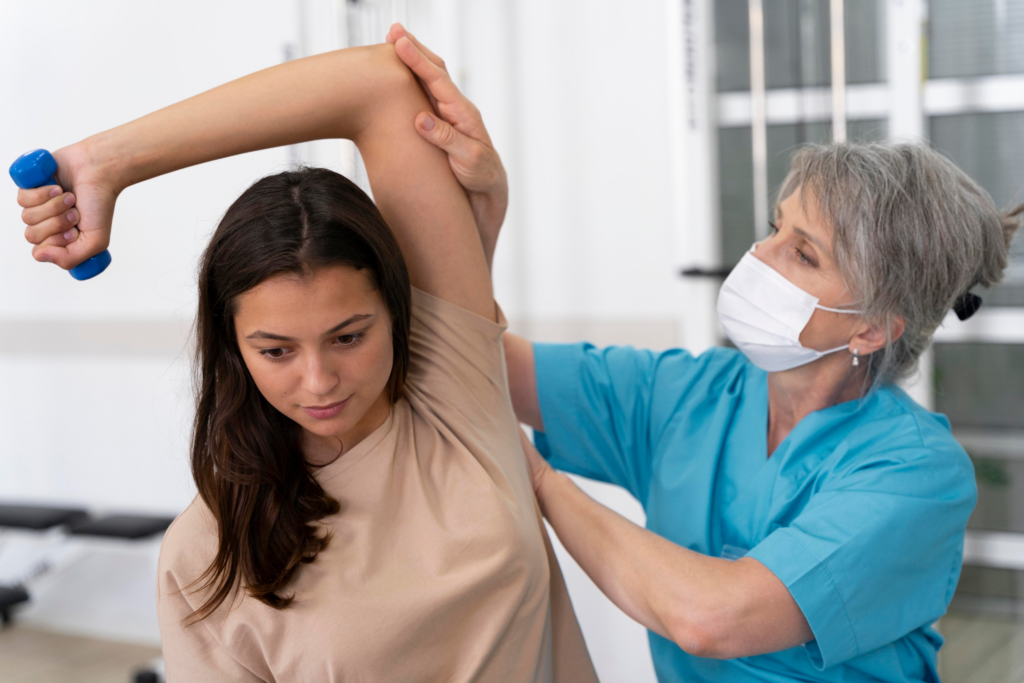
- Weeks 1–4 (Protection): Strict sling immobilization; active hand, wrist, and elbow movements only.
- Weeks 4–8 (Passive Motion): Guided passive range-of-motion to restore shoulder mechanics safely.
- Weeks 8–16 (Early Strengthening): Gradual introduction of light isometric and isotonic resistance exercises.
- Months 4–6 (Advanced Strengthening): Full integration of activities of daily living and functional training.
- Months 6–9 (Return to Sport): Resumption of high-impact or athletic activities subject to orthopedic clearance.
Frequently Asked Questions
1. Can a completely torn rotator cuff tendon heal on its own without surgery? +
No. Full-thickness rotator cuff tears cannot heal spontaneously. The poor intrinsic blood supply (hypovascularity) of the tendon prevents structural tissue regeneration, meaning surgical reattachment is required to restore function.
2. What are the primary signs that a partial tear has failed conservative treatment? +
Failure is indicated by persistent, unremitting night pain, lack of strength improvement, and structural progression of the tear on follow-up MRI scans after 3 to 6 months of dedicated physical therapy.
3. Why is muscle atrophy considered an urgent indication for shoulder surgery? +
When a tendon remains detached, the muscle belly undergoes fatty infiltration and structural wasting (atrophy). If left longer than 6 months, these changes become irreversible, rendering later surgical repairs highly prone to failure.
4. How does a “Double-Row” repair differ from a “Single-Row” technique? +
A double-row repair utilizes two lines of bone anchors to compress the tendon against its anatomical footprint. This maximizes contact area, provides superior mechanical stability, and optimizes biological healing compared to a single-row configuration.
5. What type of anesthesia is utilized during arthroscopic rotator cuff repair? +
The surgery is performed under general anesthesia combined with a regional nerve block (interscalene block). The nerve block provides profound localized pain relief for 12 to 24 hours post-surgery.
6. What is the structural re-tear rate, and who is most vulnerable to it? +
Across published studies, the average retear rate in published studies is about 27% (analysis of more than 8,000 shoulders), and it rises with larger tears, older age and fatty atrophy.
7. How long must I continuously wear the shoulder sling after an arthroscopic repair? +
A protective sling must be worn continuously for the first 4 weeks post-surgery, including while sleeping. It should only be removed briefly for authorized hand/wrist exercises and basic personal hygiene.
8. Why does smoking negatively impact the success rate of a rotator cuff repair? +
Nicotine induces peripheral vasoconstriction and compromises microvascular circulation. This directly deprives the healing tendon of oxygen and critical cellular nutrients, significantly increasing the risk of construct failure.
9. What factors determine the overall cost of rotator cuff surgery in Egypt? +
The total cost is determined by the tear size (which dictates the number of premium suture anchors needed), the choice of hospital facility, the complexity of the repair technique, and the surgeon’s specialized clinical standing.
10. When can an athlete safely return to overhead throwing sports following surgery? +
Athletes can typically expect to return to light competitive overhead activities between 6 and 9 months. This timeline requires strict compliance with advanced physical therapy and explicit approval from the orthopedic surgeon.
references
- American Academy of Orthopaedic Surgeons (AAOS), OrthoInfo: Rotator Cuff Tears
- American Academy of Orthopaedic Surgeons (AAOS), OrthoInfo: Rotator Cuff Tears: Surgical Treatment Options
- Kukkonen J, et al. Treatment of non-traumatic rotator cuff tears. The Bone & Joint Journal. 2014;96-B:75-81. doi:10.1302/0301-620X.96B1.32168
- Yamamoto A, et al. Prevalence and risk factors of a rotator cuff tear in the general population. J Shoulder Elbow Surg. 2010;19(1):116-120. doi:10.1016/j.jse.2009.04.006
- Kuhn JE, et al. Effectiveness of physical therapy in treating atraumatic full-thickness rotator cuff tears: a multicenter prospective cohort study. J Shoulder Elbow Surg. 2013;22(10):1371-1379. doi:10.1016/j.jse.2013.01.026
- McElvany MD, et al. Rotator cuff repair: published evidence on factors associated with repair integrity and clinical outcome. Am J Sports Med. 2015;43(2):491-500. doi:10.1177/0363546514529644
Pingback: Postoperative Complications Of Rotator Cuff Repair - American Center For Knee And Shoulder Surgeries 2026