
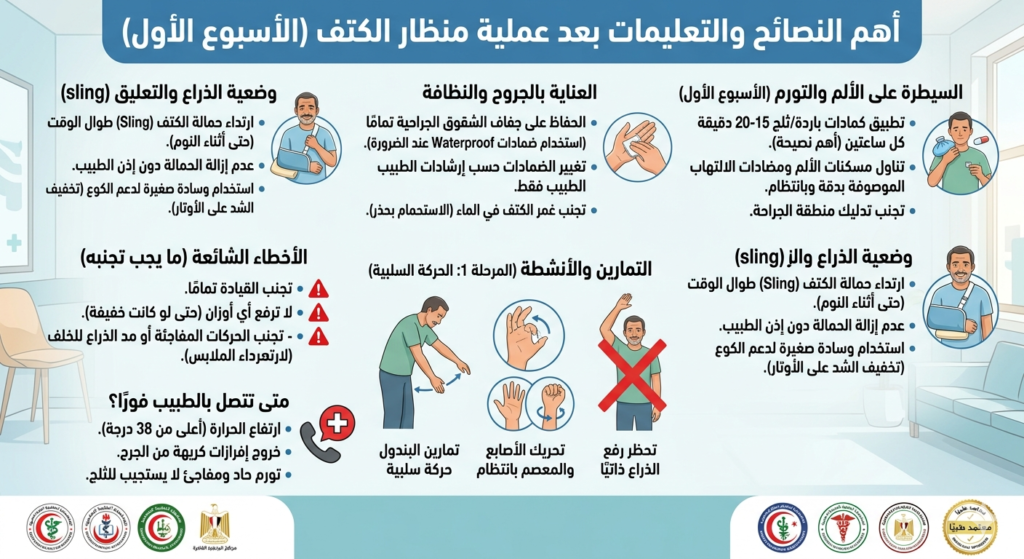
Adhering to specific instructions after shoulder arthroscope is critical for optimization of surgical outcomes and risk mitigation. This comprehensive clinical guide delineates standard recovery phases, active wound care, core kinetic restrictions, and early warning markers following arthroscopy.
Phase 1: Immediate Postoperative Guidelines (Days 1–3)
- Wound Protocol: Leave the primary surgical dressings intact for 48 hours. Secure Steri-Strips across the micro-incisions; these should remain until spontaneous shedding occurs or surgical removal at the 10–14 day follow-up.
- Analgesic Management: Administer prescribed analgesics systematically. The intraoperative interscalene nerve block yields targeted analgesia for 12–24 hours; introduce oral analgesics immediately upon sensory return to prevent rebound pain.
- Cryotherapy: Apply targeted cryotherapy for 15–20 minutes every 2–3 hours for the first 14 days to reduce soft-tissue edema. Ensure a protective barrier is placed between the ice reservoir and skin.
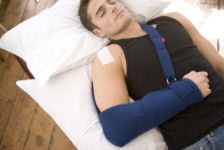
- Immobilization: Maintain continuous sling immobilization (diurnal and nocturnal), removing it strictly for bathing and distal joint mobility. Wear-time spans 2–3 weeks for simple debridement and 4–6 weeks for structural rotator cuff or labral repairs.
- Distal Mobilization: Execute active wrist, finger, and elbow motion daily to promote venous return and mitigate deep vein thrombosis (DVT) risks.
Core Kinetic Restrictions (Weeks 1–6)
Violating these restrictions risks premature construct mechanical loading, construct structural failure, and potential revision surgery.
| Restriction | Duration | Clinical Rationale |
| Mechanical Weight-Bearing | 6 Weeks | Protects anchoring suture configurations. |
| Vehicular Operation | 6–8 Weeks | Requires baseline muscular stabilization. |
| Ipsilateral Lateral Decubitus Sleeping | 4–6 Weeks | Eliminates direct articular compression. |
| Hyper-Elevation & Extension | 6 Weeks | Prevents structural tendon stress. |
| Axial Pushing or Pulling | 6 Weeks | Minimizes eccentric intra-articular forces. |
Postoperative Positioning & Activity Guidelines
Sleep semi-reclined at a 45-degree angle for 4–6 weeks using a wedge pillow or recliner. Place a small pillow between the torso and the ipsilateral arm to maintain joint neutral alignment. Avoid sleeping flat or on the operated shoulder.
When dressing during sling immobilization, insert the ipsilateral (operated) arm into the sleeve first, followed by the contralateral arm. Reverse this exact sequence when undressing.
Rehabilitation Timeline & Milestone Progressions
The baseline success profile for shoulder arthroscopy ranges from 85% to 97% (BMJ, 2022), heavily dependent on patient physical therapy adherence.
- Phase 1 (Protection | Weeks 1–4): Sling immobilization, standard cryotherapy, and active distal joint exercises.
- Phase 2 (Passive Motion | Weeks 4–8): Gradual sling weaning and introduction of passive range of motion (PROM) with a therapist to counter arthrofibrosis (stiffness incidence: 2%–5%). Desk work may resume.
- Phase 3 (Early Strengthening | Weeks 8–16): Gradual introduction of active resistance and light activities of daily living (ADLs).
- Phase 4 (Advanced Resistance | Months 4–6): Advanced resistance loading, full occupational integration, and non-contact swimming.
- Phase 5 (Functional Athletic Discharge | Months 6–9): Gradual return to contact sports (e.g., football, basketball) following definitive clinical testing. Most athletes return to sport.
Critical Clinical Warnings & Red Flags
Evaluate immediately if any of the following signs present, which indicate rare 1.2% but significant complications:
- Core body temperature 38.5
- Advancing localized erythema, heat, or purulent drainage (suggesting a surgical site infection).
- Refractory pain unresponsive to oral narcotics after 60 minutes.
- Persistent paresthesia or total sensory loss down the upper extremity exceeding 48 hours.
- Acute dyspnea, chest pain (pulmonary embolism risk: 0.07%), or sudden unilateral calf edema.
frequently asked questions
How long do I need to wear the sling after shoulder arthroscopy?
Sling immobilization must be maintained continuously, day and night. For simple joint debridement or calcification removal, it is typically worn for 2 to 3 weeks. However, for structural repairs like rotator cuff or labral reconstructions, the sling must be worn for 4 to 6 weeks to protect the tissues during initial osseous integration.
What is the correct sleeping position after shoulder arthroscopy?
Patients should sleep in a semi-reclined position at a 45-degree angle using a wedge pillow or a reclining chair for the first 4 to 6 weeks. It is critical to place a small pillow between the torso and the operated arm to maintain neutral joint alignment. Sleeping flat on your back or on the operated shoulder is strictly prohibited.
What are the strict kinetic restrictions during the first 6 weeks post-op?
During the first 6 weeks, mechanical weight-bearing, lifting any objects, pushing or pulling doors, and reaching behind the back are completely prohibited to prevent structural failure. Active arm elevation above shoulder level is restricted, driving must be avoided for 6 to 8 weeks, and the surgical wounds must be kept dry using waterproof coverings when bathing.
When does physical therapy begin and why is it mandatory?
Formal rehabilitation begins at post-operative week 4 with structured Passive Range of Motion (PROM) exercises led by a therapist. Physical therapy is mandatory because it prevents arthrofibrosis (joint stiffness), which is the most common delayed complication (2%–5% incidence rate). Dedicated adherence allows patients to regain 90% to 100% of baseline mobility within 4 to 6 months.
What clinical warning signs require immediate medical attention?
You must contact your physician immediately if you experience a persistent fever over 38.5°C past day 3, advancing redness, swelling, or purulent discharge from the incisions, or acute severe pain unresponsive to narcotics. Immediate emergency care is required for sudden shortness of breath, chest pain, or sudden unilateral calf swelling.
references
- American Academy of Orthopaedic Surgeons (AAOS), OrthoInfo: Shoulder Arthroscopy
- American Academy of Orthopaedic Surgeons (AAOS), OrthoInfo: Shoulder Pain and Common Shoulder Problems
- American Academy of Orthopaedic Surgeons (AAOS), OrthoInfo: Rotator Cuff and Shoulder Conditioning Program
- Rees JL, et al. Serious adverse event rates and reoperation after arthroscopic shoulder surgery: population based cohort study. BMJ. 2022;378:e069901. doi:10.1136/bmj-2021-069901