
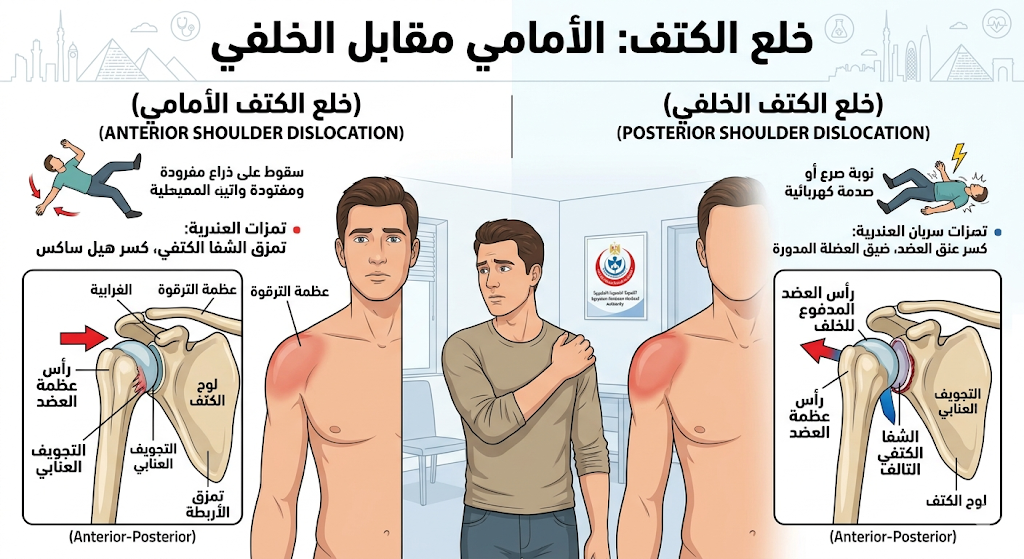
A shoulder dislocation occurs when the humeral head dissociates from the glenoid cavity. The shoulder is the most frequently dislocated joint in the human body, accounting for 50% of all joint dislocations. International data indicates an annual incidence rate of 24 cases per 100,000 individuals, with anterior dislocations comprising 98% of all presentations. The primary clinical concern is the high recurrence rate—particularly in patients under the age of 20, where recurrence reaches up to 72%.
Anatomy & Associated Pathologies
The shoulder’s extensive range of motion (ROM) inherently sacrifices mechanical stability, making it highly susceptible to displacement. Severe or recurrent dislocations frequently cause significant structural damage:
- Bankart Lesion: A tear of the fibrocartilaginous glenoid labrum, present in most anterior dislocations.
- Hill-Sachs Lesion: A compression fracture on the posterolateral aspect of the humeral head caused by impact against the glenoid rim.
- Glenoid Bone Loss: Progressive attrition of the anterior glenoid rim resulting from recurrent instability.
- Axillary Nerve Injury: Can occur, presenting as deltoid weakness and localized paresthesia.
- Rotator Cuff Tears: Commonly observed in patients older than 40.
Classification of Shoulder Dislocations
| Dislocation Type | Prevalence | Clinical Description |
| Anterior | 98% | The humeral head shifts anteriorly and inferiorly. Most common mechanism. |
| Posterior | 2% – 4% | Rare; typically induced by epileptic seizures or high-voltage electrical shocks. |
| Inferior | Rare | The humeral head is displaced downward; highly uncommon. |
Etiology & Symptomatology
Dislocations are primarily driven by sports injuries (e.g., football, basketball, martial arts) involving direct impact or a fall onto an outstretched hand (FOOSH). Hyperlaxity (generalized ligamentous laxity) increases the risk of multidirectional instability.
Clinical signs include sudden, excruciating pain, complete loss of active arm movement, rapid edema, and a visible “squared-off” deformity of the shoulder profile. Paresthesia down the arm indicates secondary axillary nerve compression.
Recurrence Risk & Non-Operative Limitations
While older, sedentary patients may successfully recover with conservative management, relying on non-operative care in young, active cohorts introduces a severe risk of chronic instability. A landmark 25-year follow-up study by Hovelius demonstrates that the recurrence rate reached 72% in patients aged 12–22.
Studies suggest that non-operative management after a primary dislocation carries a significantly higher risk of chronic instability compared to early surgical stabilization. Each subsequent dislocation accelerates glenoid bone loss, stretches the joint capsule, and increases the structural complexity of future revision surgeries.
Recurrence Rates Following Non-Operative Management
- Age < 20: 72% (ages 12–22)
- Age 20–29: 56% (ages 23–29)
- Age 30–40: 27% (ages 30–40)
- Age > 50: Lower
Management Protocols
Immediate Emergency Care
Acute dislocations require immediate orthopaedic reduction. Following diagnostic radiographs to rule out concurrent fractures, a closed reduction is performed under localized anesthesia or intravenous sedation. The arm is then immobilized in a sling, and an MRI is ordered to evaluate labral tearing and bone loss. Manual self-reduction at home is strictly prohibited to prevent secondary neurovascular or articular damage.
Surgical Interventions & Success Benchmarks
Surgical stabilization is indicated for recurrent instability, young athletic cohorts, or cases presenting with significant glenoid bone loss.
| Procedure | Clinical Indications | Success Rate | Recurrence Rate |
| Arthroscopic Bankart Repair | < 20% glenoid bone loss; intact tissue. | 85% – 93% | 15.1% |
| Open Bankart Repair | Minimal bone loss; high-demand athletes. | 95% – 99% | < 1% |
| Latarjet Procedure | > 20% glenoid bone loss; chronic re-tears. | 93% – 97% | 2.7% |
Financial Projections (Egypt 2026): Arthroscopic Bankart repairs average EGP 40,000 to EGP 75,000, while complex bone reconstructions like the Latarjet procedure range from EGP 60,000 to EGP 110,000, scaling by hospital tier and surgical implant requirements.
Rehabilitation & Milestones
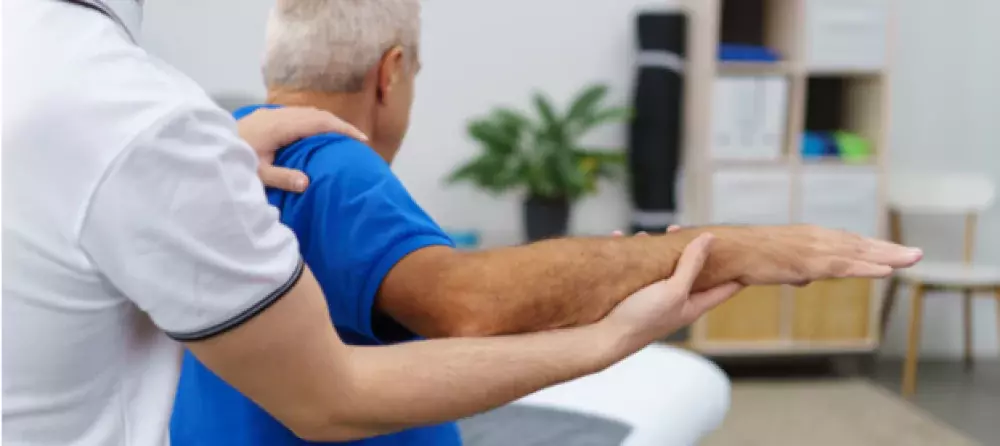
Meticulous physical therapy targeting the rotator cuff and deltoid musculature is mandatory across all treatment pathways to restore dynamic stability and joint proprioception.
Recovery Timeline Comparison
- Conservative Care: Immobilization for 3–6 weeks; immediate physical therapy upon sling removal; return to sports in 3–4 months (high chronic recurrence risk).
- Arthroscopic Bankart: Immobilization for 4–6 weeks; passive physical therapy begins at week 4; active strengthening at weeks 8–16; full athletic clearance in 6–9 months.
- Latarjet Procedure: Immobilization for 4–6 weeks; structured physical therapy begins at week 4; advanced functional resistance training by months 4–6; full sports discharge in 6–9 months.
FREQUENTLY ASKED QUESTIONS
Why does a shoulder dislocation become recurrent after the first incident?
Recurrence is caused by structural damage sustained during the primary dislocation, most notably a Bankart lesion (torn glenoid labrum) and stretched capsular ligaments. If these structures fail to heal tightly, the joint loses its baseline mechanical stability, allowing the humeral head to slip out repeatedly with minimal force.
Can a shoulder dislocation be cured permanently without surgery?
Non-operative cure rates depend heavily on patient age and activity level. Older, lower-demand patients can achieve permanent stability via immobilization and intensive physical therapy. However, in patients aged 12–22, the non-operative recurrence rate reached 72% (Hovelius study), making early surgical repair the highly preferred long-term solution.
What is the difference between an arthroscopic Bankart repair and a Latarjet surgery?
An arthroscopic Bankart repair is a minimally invasive procedure that uses suture anchors to re-stitch the torn labrum when glenoid bone structures are intact. In contrast, the Latarjet procedure is an open bone reconstruction required when chronic dislocations cause greater than 20% glenoid bone loss, relocating a piece of the coracoid bone to restore structural stability.
What are the correct emergency first-aid protocols during an acute dislocation?
The arm must be immediately immobilized in its presenting position using a sling or makeshift wrap, and cryotherapy should be applied to minimize swelling. Unqualified individuals must never attempt to manually force the joint back into place, as improper reduction techniques can cause fractures, severe labral tearing, or permanent axillary nerve damage.
How much does surgical shoulder dislocation stabilization cost in Egypt for 2026?
In 2026, the estimated cost for an arthroscopic Bankart repair in Egypt ranges between EGP 40,000 and EGP 75,000. For complex, chronic instability cases presenting with significant bone loss, open Latarjet reconstructions range from EGP 60,000 to EGP 110,000, scaling based on implant specifications and hospital tiering.
references
- American Academy of Orthopaedic Surgeons (AAOS), OrthoInfo: Shoulder Dislocation
- American Academy of Orthopaedic Surgeons (AAOS), OrthoInfo: Chronic Shoulder Instability
- Peckston, et al. A comparison of arthroscopic Bankart repair and the Latarjet procedure in contact athletes with anterior shoulder instability: a systematic review and meta-analysis. Am J Sports Med. 2026. doi:10.1177/03635465261441255
- Hovelius L, et al. Nonoperative treatment of primary anterior shoulder dislocation in patients forty years of age and younger: a prospective twenty-five-year follow-up. J Bone Joint Surg Am. 2008;90(5):945-952. doi:10.2106/JBJS.G.00070
- Zacchilli MA, et al. Epidemiology of shoulder dislocations presenting to emergency departments in the United States. J Bone Joint Surg Am. 2010;92(3):542-549. doi:10.2106/JBJS.I.00450
- Griesser MJ, et al. Complications and re-operations after Bristow-Latarjet shoulder stabilization: a systematic review. J Shoulder Elbow Surg. 2013;22(2):286-292. doi:10.1016/j.jse.2012.09.009
- Murphy AI, et al. Long-term outcomes of the arthroscopic Bankart repair: a systematic review of studies at 10-year follow-up. J Shoulder Elbow Surg. 2019;28(11):2084-2089. doi:10.1016/j.jse.2019.04.057
- Hurley ET, et al. Return to play after the Latarjet procedure for anterior shoulder instability: a systematic review. Am J Sports Med. 2019;47(12):3002-3008. doi:10.1177/0363546519831005
- Imam MA, et al. Bankart repair versus Latarjet procedure for recurrent anterior shoulder instability: a systematic review and meta-analysis of 3275 shoulders. Am J Sports Med. 2021;49(7):1945-1953. doi:10.1177/0363546520962082