
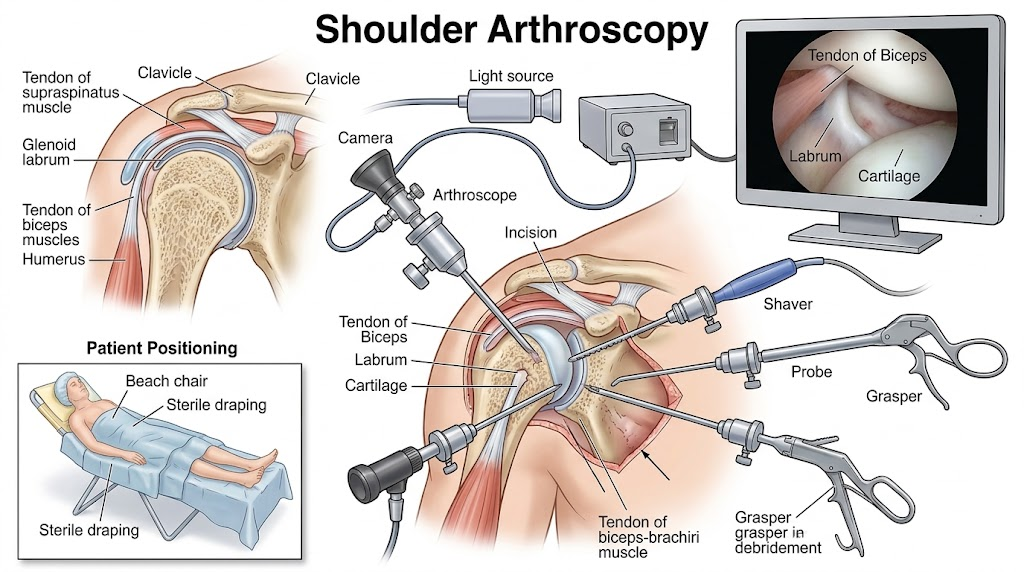
Shoulder arthroscopy is a minimally invasive surgical procedure that follows a systematic protocol: anesthesia administration, patient positioning, establishing 5–10 mm micro-incisions, portal diagnostic exploration, therapeutic repair, and closure. In this article we discuss Steps of Shoulder Arthroscopy.
Preoperative Preparation & Anesthesia
- Preparation: Patients undergo a comprehensive medical workup, including standard lab screens, ECG, chest radiographs, and an MRI review. Anticoagulants are discontinued 7 days pre-op, and a strict 6–8 hour fasting window is enforced. The operative shoulder is clearly marked pre-operatively.
- Anesthesia: Performed under general anesthesia or a regional nerve block. In Egypt, surgeons routinely combine general anesthesia with an interscalene nerve block. This block provides targeted analgesia for 12–24 hours post-surgery, significantly reducing immediate postoperative pain.
Intraoperative Protocol
1. Patient Positioning & Sterilization
Patients are positioned using either the Beach Chair (semi-reclined at 30°–40°) or Lateral Decubitus (side-lying with arm traction) setup. A Mayo Clinic study (Meta et al., 2024) confirms the Beach Chair configuration is preferred globally for its natural anatomical orientation. Meticulous local antiseptic scrubbing minimizes deep joint infection risks to less than 0.2%.
2. Micro-Incision Portals & Diagnostic Examination
The surgeon establishes 2–4 micro-incision portals (5–10 mm). A high-definition (HD/4K) arthroscope is inserted alongside sterile saline to expand the joint volume. The surgeon executes a systematic diagnostic sweep of the tendons, ligaments, cartilage, labrum, and joint capsule. This direct visualization regularly uncovers secondary pathologies missed by pre-operative MRI scans.
3. Therapeutic Repair & Closure
Micro-instruments are introduced through adjacent portals to treat the underlying pathology:
- Rotator Cuff Tears: Suture anchors are used to secure torn tendons back to the bone.
- Recurrent Dislocations: Bankart repair stabilizes the torn glenoid labrum.
- Bone Loss: The Latarjet procedure relocates the coracoid process.
- Debridement: Removal of painful calcifications, inflamed bursae, or synovial cysts.Following repair, the saline is evacuated, and incisions are closed with cosmetic sutures or steri-strips. A sterile dressing and a shoulder sling are applied immediately.
Postoperative Recovery & Guidelines
Postoperative Care & Sleeping Positions
The procedure itself is painless due to anesthesia, with mild-to-moderate postoperative pain managed via oral analgesics. For the first 4–6 weeks, patients must sleep semi-reclined at a 45° angle (using a recliner or a wedge pillow) with a stabilizing pillow placed between the arm and torso. Sleeping flat on the back or directly on the operated shoulder is strictly prohibited.
Core Restrictions (First 6 Weeks)
- Strictly avoid lifting any objects, pushing or pulling doors, and reaching behind the back.
- No active arm elevation above shoulder height.
- Driving is restricted for 6–8 weeks until the sling is removed and physician clearance is granted.
- Keep surgical incisions dry during bathing using waterproof covers.
Rehabilitation, Success Rates, and Costs
The Crucial Role of Physical Therapy
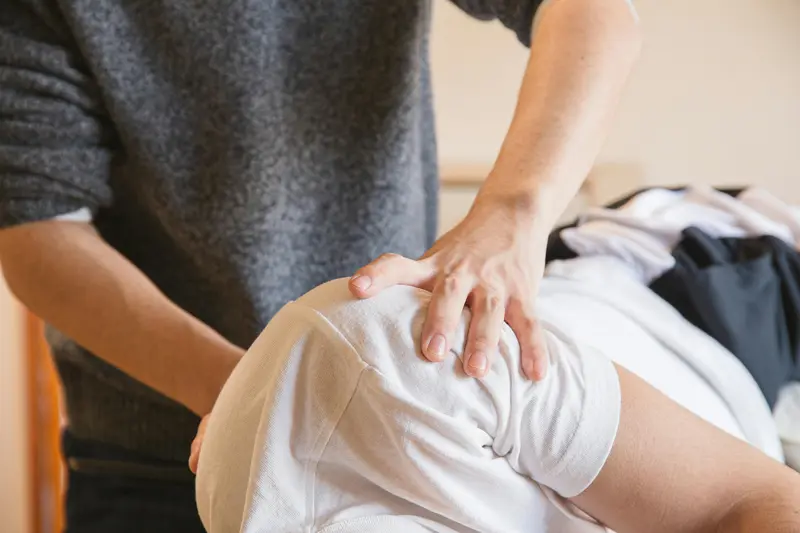
Structured physical therapy represents the most critical factor for a successful outcome. Formal rehabilitation begins at week 4 using passive range of motion (PROM) exercises to protect structural integrity while preventing arthrofibrosis (joint stiffness), which is the most common delayed complication (2%–5%). Dedicated adherence allows patients to regain 90%–100% of baseline mobility within 4–6 months.
Clinical Metrics & Cost Projections (Egypt 2026)
- Overall Success Rates: Range from 85% to 97%. The Latarjet procedure demonstrates a 97% success rate; simple rotator cuff repairs range from 90% to 95%; and Bankart stabilization achieves 85%–93%.
- Surgical Risks: The major 90-day complication rate is remarkably low at 1.2% (BMJ, 2022). This includes joint stiffness (2%–5%), tendon re-tearing in massive chronic defects (5%–15%), secondary revision within one year (3.8%), peripheral nerve neuropraxia (<0.5%), pneumonia (0.3%), and superficial wound inflammation (0.1%–0.2%).
- Financial Projections (Egypt 2026): Total costs range between EGP 30,000 and EGP 100,000, scaling based on pathology complexity, required anchor implants, and hospital tiering. Basic cuff repairs start at EGP 35,000, while complex bony reconstructions like the Latarjet procedure can reach up to EGP 110,000.
FREQUENTLY ASKED QUESTIONS
Is shoulder arthroscopy painful, and what anesthesia is used?
The surgical procedure itself is completely painless as it is performed under general or regional anesthesia. In Egypt, surgeons routinely combine general anesthesia with an interscalene nerve block, which provides targeted numbing to the joint and guarantees 12 to 24 hours of immediate postoperative pain relief.
How should I sleep after a shoulder arthroscopy procedure?
Patients are strongly advised to sleep in a semi-reclined position at a 45-degree angle (using a recliner or a specialized wedge pillow) for the first 4 to 6 weeks. A small pillow should be placed between the torso and the arm, and sleeping flat on your back or directly on the operated shoulder is strictly prohibited to protect the surgical repair.
What are the strict restrictions during the first 6 weeks post-surgery?
During the first 6 weeks, patients must avoid lifting any objects, pushing or pulling doors, and reaching behind the back. Active arm elevation above shoulder height is restricted, driving is prohibited for 6 to 8 weeks until the sling is removed, and incisions must be kept dry using waterproof coverings when bathing.
What is the recovery timeline and success rate of shoulder arthroscopy in Egypt?
Overall clinical success rates range from 85% to 97%, depending on the pathology (e.g., 97% for Latarjet, 90%-95% for rotator cuff repairs). Full recovery spans from 6 weeks up to 9 months. Patients can generally return to desk work in 2 to 4 weeks, regain 90% to 100% of baseline mobility via physical therapy in 4 to 6 months, and return to sports or heavy labor within 6 to 9 months.
How much does a shoulder arthroscopy cost in Egypt for 2026?
In 2026, the total cost for shoulder arthroscopy in Egypt ranges between EGP 30,000 and EGP 100,000. Basic rotator cuff repairs typically start around EGP 35,000, whereas complex bone reconstructions, such as the Latarjet procedure, can scale up to EGP 110,000 based on surgical complexity, required implants, and hospital tiering.
REFERENCES
- American Academy of Orthopaedic Surgeons (AAOS), OrthoInfo: Shoulder Arthroscopy
- American Academy of Orthopaedic Surgeons (AAOS), OrthoInfo: Shoulder Pain and Common Shoulder Problems