
Shoulder dislocation occurs when the humeral head dissociates from the glenoid cavity. The shoulder is the most frequently dislocated joint in the human body, accounting for 50% of all joint dislocations. Understanding the classification—Anterior (95–98%), Posterior (2–4%), and Inferior/Luxatio Erecta (<1%)—is critical for tailoring shoulder dislocation treatment, as clinical management varies significantly based on the direction of displacement.
Classification and Etiology
1. Anterior Dislocation (95–98%)
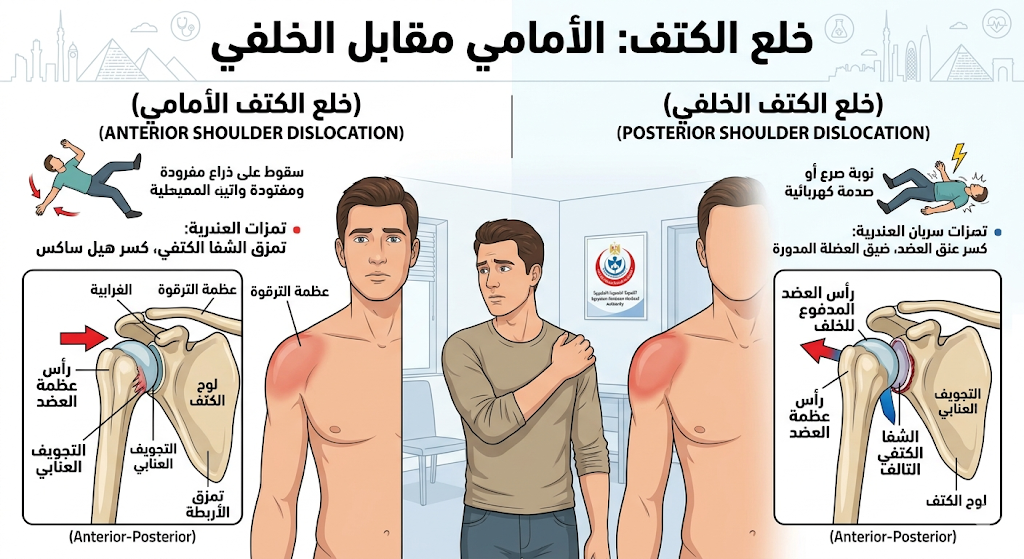
The humeral head shifts anteriorly and inferiorly, typically caused by a fall on an outstretched hand (FOOSH) or forceful external rotation.
- Subtypes: Subcoracoid (most common), Subglenoid, and rare Subclavicular.
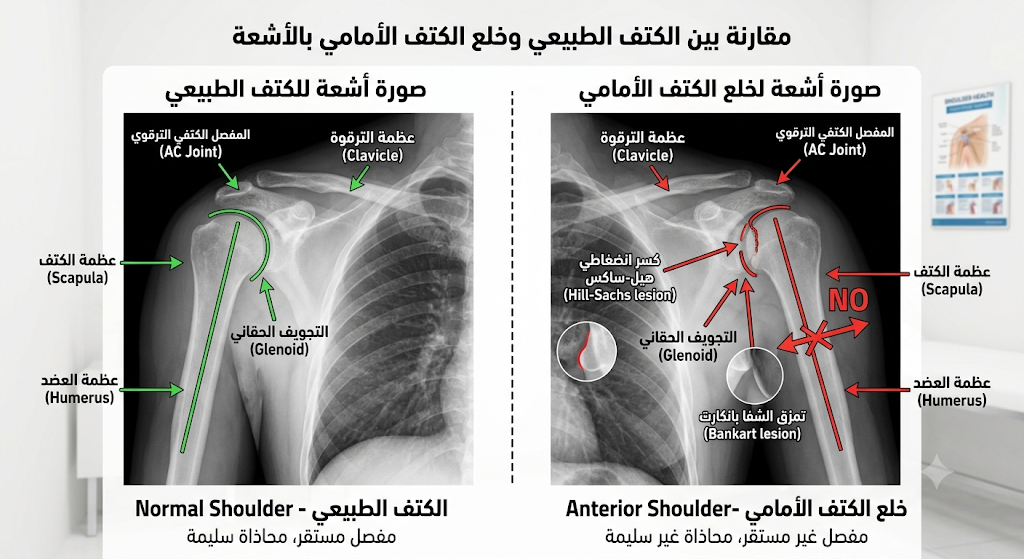
- Associated Injuries: Bankart lesions (labral tears), Hill-Sachs defects (compression fractures), and axillary nerve injuries.

2. Posterior Dislocation (2–4%)
Often missed during initial emergency evaluation, this typically results from epileptic seizures or high-voltage electrical shocks. The violent internal rotation force drives the humeral head posteriorly. Patients present with restricted external rotation and an inability to rotate the arm outward.
3. Inferior Dislocation (Luxatio Erecta) (<1%)
A rare, high-energy injury where the humeral head is locked inferiorly. Patients present with the arm fixed in an abducted position above the head. It carries the highest risk of neurovascular complications.
Clinical Presentation and Diagnosis
A dislocated shoulder is clinically distinct:
- Deformity: The shoulder loses its rounded profile, appearing “squared-off” or flattened.
- Pain: Excruciating pain, preventing any active movement.
- Sensation: Potential numbness or tingling in the hand (axillary nerve involvement).
- Diagnosis: Radiographic imaging is mandatory. Posterior dislocations often require an “Axillary View” X-ray, as standard AP views can appear deceptive.
Management Protocols
Emergency Care
Immediate closed reduction under sedation is required at an emergency department. Self-reduction or attempts by non-professionals are strictly prohibited, as they risk fractures and neurovascular injury.
Conservative vs. Surgical Treatment
While elderly patients with a primary dislocation may achieve stability through immobilization and physical therapy, young, active patients face high recurrence rates. A Hovelius 25-year follow-up study confirms that recurrence reached 72% in patients aged 12–22 without surgery.
| Management Strategy | Indications |
| Conservative | First dislocation in sedentary patients >40 years. |
| Surgical (Arthroscopic) | Young athletes; Bankart lesions; <20% bone loss. |
| Surgical (Open/Latarjet) | Chronic recurrence; >20% glenoid bone loss. |
Arthroscopic vs. Open Surgery
Arthroscopic Bankart repair is the gold standard for most, offering less pain and faster recovery, though about 16% of patients redislocate at 10+ years. The Latarjet procedure (bone transfer) is the preferred solution for severe bone loss, with a recurrent dislocation rate of about 3%.

Rehabilitation and Recovery
Recovery is a phased process:
- Immobilization: 3–6 weeks in a sling.
- Physical Therapy: Starts after sling removal to restore range of motion (ROM) and stabilize the rotator cuff.
- Return to Sport: 6–9 months depending on the procedure and sport requirements.
frequently asked questions
Why does the shoulder become chronically unstable after the first dislocation?
Chronic instability is caused by structural damage sustained during the primary dislocation, most notably a Bankart lesion (torn glenoid labrum) and stretched capsular ligaments. If these tissues fail to heal securely, the joint loses its mechanical stability, allowing the humeral head to slip out repeatedly with minimal force.
Can a shoulder dislocation be cured permanently without surgery?
Conservative management is often effective for older, sedentary patients or those experiencing a primary dislocation. However, in patients aged 12–22, the non-operative recurrence rate reached 72%. In these cases, early surgical stabilization is highly preferred to prevent long-term joint degradation.
What is the difference between an arthroscopic Bankart repair and a Latarjet procedure?
An arthroscopic Bankart repair is a minimally invasive technique that uses suture anchors to re-stitch the torn labrum when glenoid bone structures remain intact. Conversely, the Latarjet procedure is an open bone reconstruction used when chronic dislocations cause significant glenoid bone loss (typically >20%), where a portion of the coracoid bone is relocated to restore stability.
What are the correct first-aid steps during an acute shoulder dislocation?
Immediately immobilize the arm in its current position using a sling or makeshift wrap, apply cold packs to manage edema, and proceed to the nearest emergency department. Never attempt manual reduction (pushing the joint back in) as an unqualified person; professional intervention is required to avoid fractures, vascular damage, or nerve injury.
What is the estimated cost of shoulder stabilization surgery in Egypt for 2026?
As of 2026, an arthroscopic Bankart repair in Egypt typically ranges from EGP 40,000 to EGP 75,000. Complex bone reconstructions, such as the Latarjet procedure, range from EGP 60,000 to EGP 110,000, depending on the surgical implant specifications and hospital tiering.
references
- American Academy of Orthopaedic Surgeons (AAOS), OrthoInfo: Shoulder Dislocation
- American Academy of Orthopaedic Surgeons (AAOS), OrthoInfo: Chronic Shoulder Instability
- Peckston, et al. A comparison of arthroscopic Bankart repair and the Latarjet procedure in contact athletes with anterior shoulder instability: a systematic review and meta-analysis. Am J Sports Med. 2026. doi:10.1177/03635465261441255
- Hovelius L, et al. Nonoperative treatment of primary anterior shoulder dislocation in patients forty years of age and younger: a prospective twenty-five-year follow-up. J Bone Joint Surg Am. 2008;90(5):945-952. doi:10.2106/JBJS.G.00070
- Zacchilli MA, et al. Epidemiology of shoulder dislocations presenting to emergency departments in the United States. J Bone Joint Surg Am. 2010;92(3):542-549. doi:10.2106/JBJS.I.00450
- Griesser MJ, et al. Complications and re-operations after Bristow-Latarjet shoulder stabilization: a systematic review. J Shoulder Elbow Surg. 2013;22(2):286-292. doi:10.1016/j.jse.2012.09.009
- Murphy AI, et al. Long-term outcomes of the arthroscopic Bankart repair: a systematic review of studies at 10-year follow-up. J Shoulder Elbow Surg. 2019;28(11):2084-2089. doi:10.1016/j.jse.2019.04.057
- Hurley ET, et al. Return to play after the Latarjet procedure for anterior shoulder instability: a systematic review. Am J Sports Med. 2019;47(12):3002-3008. doi:10.1177/0363546519831005
- Imam MA, et al. Bankart repair versus Latarjet procedure for recurrent anterior shoulder instability: a systematic review and meta-analysis of 3275 shoulders. Am J Sports Med. 2021;49(7):1945-1953. doi:10.1177/0363546520962082