
Shoulder arthroscopy is a safe and shoulder arthroscope complications is low, minimally invasive procedure with a low 90-day major complication rate of 1.2% (1 in 81 patients), according to a landmark British Medical Journal (BMJ, 2022) study of over 500,000 cases
What is Shoulder Arthroscopy?
It is a minimally invasive technique accessing the shoulder joint via 2–4 micro-incisions (5–10 mm) using an arthroscope and micro-instruments. According to a US study (Burkhart, 2026) of 191,549 patients, it is among the world’s most common orthopedic procedures, with rotator cuff repairs comprising 65.1% of all cases. Furthermore, an AAOS 2025 report confirms that the vast majority of its 23,267 registered rotator cuff repairs were performed arthroscopically.
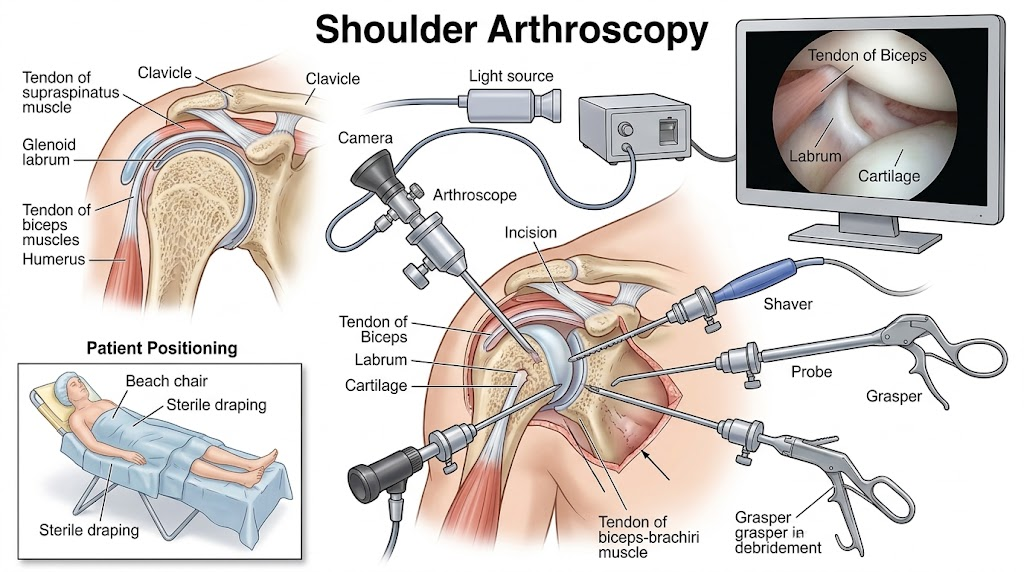
Key Clinical Advantages
- Diagnostic: Magnified visualization identifies lesions missed by MRI.
- Therapeutic: Precise repair of tears, calcifications, and inflamed tissue.
- Reduced Morbidity: Minimal postoperative pain, faster recovery, minimal scarring, and same-day discharge.
Statistical Complication Profiles
Surgical risks correlate with patient age, comorbidities, and procedure type. Stabilization (Bankart) repairs carry the lowest risk at 0.6%.
Complication Rates & Observations
| Complication | Incidence Rate | Clinical Notes / Risk Factors |
| Arthrofibrosis (Stiffness) | 2% – 5% | Most common late complication; linked to physical therapy non-compliance. |
| Pneumonia | 0.3% | Most common acute major medical complication. |
| Superficial Surgical Site Infection (SSI) | 0.1% – 0.2% | Managed successfully via targeted antibiotics. |
| Deep Joint Infection | 0.09% | Rises slightly to 0.2% post-rotator cuff repair. Cutibacterium acnes causes 50.4% of deep infections (Healthcare, 2024). |
| Peripheral Nerve Injury | < 0.5% | Typically transient neuropraxias. |
| Pulmonary Embolism | 0.07% | Mitigated via early postoperative mobilization. |
| Structural Re-tear | 5% – 15% | Observed almost exclusively in massive/large tears. |
| Secondary Revision Surgery | 3.8% within 1 year | Ranges from 2.7% (Bankart) up to 5.7% (Capsular Release). |
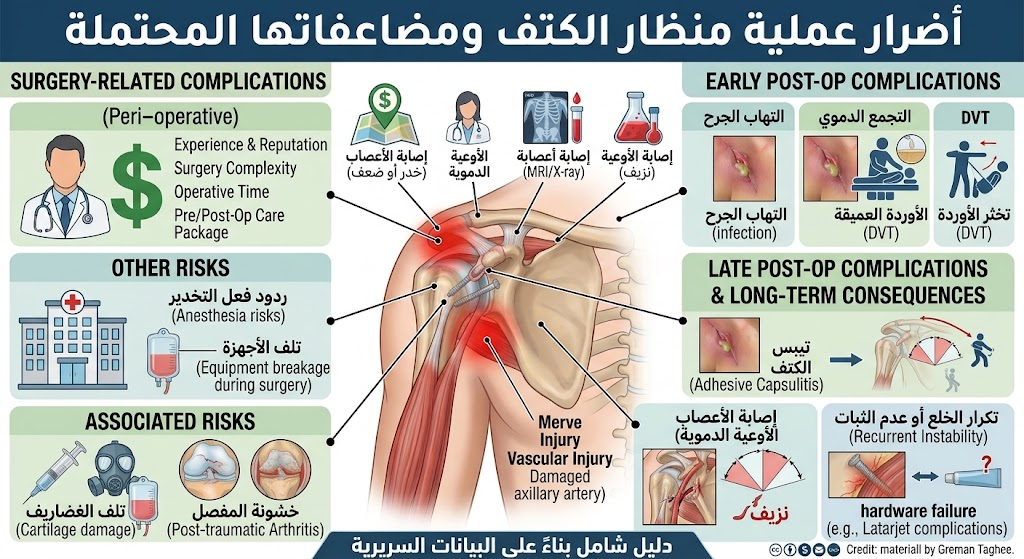
Risk Factors & Warning Signs
- Risk Escalators: Smoking (delays tendon healing), uncontrolled diabetes (weakens immunity), morbid obesity (AAOS 2025), and premature mechanical loading.
- Red Flags (Immediate Medical Evaluation Required): Core temperature $> 38.5^\circ\text{C}$ past day 3, purulent drainage, advancing erythema, or unmanageable pain.
Prevention Protocols & Rehabilitation
Most complications are preventable through proper surgical center selection, smoking cessation 2 weeks pre-op, strict glycemic control, and meticulous perioperative sterilization.
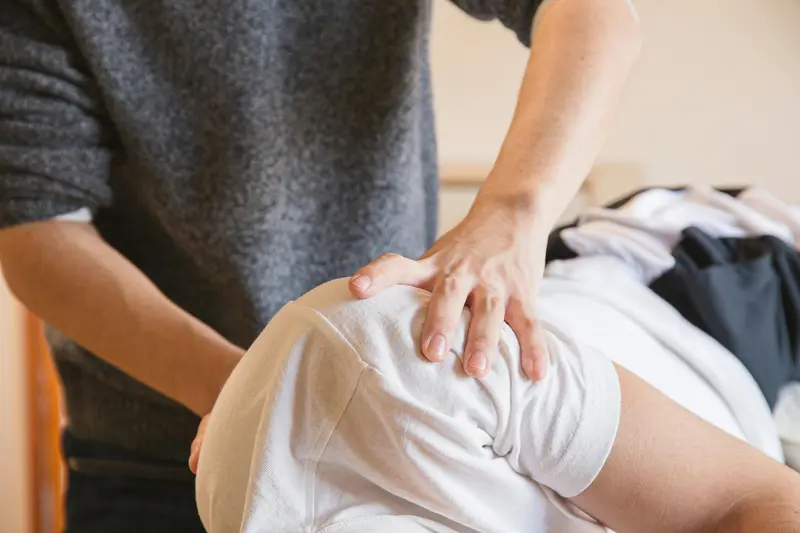
Postoperative Timeline & Milestone Recovery
- Phase 1 (Protection | Weeks 1–4): Sling immobilization, cryotherapy, edema management, and active hand/wrist/finger exercises.
- Phase 2 (Passive Motion | Weeks 4–8): Gradual sling weaning and introduction of passive range of motion (PROM).
- Phase 3 (Early Strengthening | Weeks 8–16): Progression to active exercises and light activities of daily living (ADLs).
- Phase 4 (Advanced Strengthening | Months 4–6): Resistance training and clearance for sedentary/desk work.
- Phase 5 (Athletic/Labor Discharge | Months 6–9): Gradual reintroduction to impact sports and heavy labor.
Clinical Success Rates
| Procedure Type | Success Rate | Complication Rate |
| Latarjet Procedure | 93% – 97% | Relatively higher |
| Rotator Cuff Repair (Simple) | 90% – 95% | 1.2% |
| Calcific Tendonitis Debridement | 90% – 95% | < 1% |
| Bankart Repair | 85% – 93% | 0.6% |
| Rotator Cuff Repair (Complex) | 80% – 88% | Elevated |
Conclusion: The clinical benefits of shoulder arthroscopy drastically outweigh its risks when performed by a subspecialized surgeon, combined with strict adherence to a structured physical therapy protocol.

Shoulder Arthroscopy Complications FAQ
1. What is the overall complication rate for arthroscopic shoulder surgery?
The overall complication rate for arthroscopic shoulder surgery is low, safely remaining under 10% across major clinical data reviews[cite: 1]. The vast majority of these complications are minor, transient, and highly manageable with early orthopedic tracking[cite: 1].
2. What is the risk of a tendon re-tearing after an arthroscopic repair?
The structural re-tear rate of a fixed tendon ranges from 3% to 20%[cite: 1]. This statistical variance correlates heavily to the initial size of the tear, the biological healing capacity of the native tissue, and adherence to postoperative sling protocols[cite: 1].
3. Who is most vulnerable to structural failure or a re-tear after surgery?
Patients older than 65 years who possess reduced bone quality are structurally more vulnerable[cite: 1]. Additionally, individuals undergoing repairs for massive, retracted tears greater than 5 cm face an elevated re-tear risk[cite: 1].
4. How common is permanent joint stiffness (frozen shoulder) after arthroscopy?
Postoperative stiffness or adhesive capsulitis occurs in roughly 2% to 5% of cases[cite: 1]. It is most frequently secondary to a lack of commitment to early structured physical therapy or extended, unauthorized joint immobilization[cite: 1].
5. What are the chances of developing a deep joint infection after the procedure?
Deep infection pathways are exceptionally rare in arthroscopic interventions, presenting in only 0.1% to 0.2% of patients[cite: 1]. The risk profile is marginally higher in populations with poorly managed systemic diabetes[cite: 1].
6. Can arthroscopic shoulder surgery cause nerve damage?
Transient neurological irritation or traction praxias present in fewer than 0.5% of cases[cite: 1]. Permanent, major neurological deficits are structurally protected against via the precision placement of modern arthroscopic portals[cite: 1].
7. What is anchor failure, and how frequently does it happen?
Suture anchor pull-out or failure stays under a 1% incidence threshold[cite: 1]. It usually results from compromised local bone density (severe regional osteoporosis) or catastrophic premature loading before tissue integration occurs[cite: 1].
8. Why does smoking negatively impact the structural success of the repair?
Nicotine causes significant microvascular vasoconstriction, limiting the delivery of essential oxygenated blood flow to the localized tendon footprint[cite: 1]. This compromises biological healing and directly elevates re-tear statistics[cite: 1].
9. How does specialized surgical volume affect complication rates?
Clinical data shows that selecting a dedicated shoulder specialist who performs a high annual volume (exceeding 25 cases per year) correlates with a 30% reduction in overall postoperative complications[cite: 1].
10. What can patients do to actively mitigate their postoperative complication risks?
Modifiable risk mitigation includes active smoking cessation for at least 6 weeks before surgery, tight metabolic control of blood sugar levels, strict compliance with the early sling immobilization timeline, and accurate following of physical rehabilitation phases[cite: 1].
References
https://pubmed.ncbi.nlm.nih.gov/11828349/
https://pubmed.ncbi.nlm.nih.gov/24966247/
https://pubmed.ncbi.nlm.nih.gov/42027329/
https://pmc.ncbi.nlm.nih.gov/articles/PMC11787983/
https://pmc.ncbi.nlm.nih.gov/articles/PMC13241291/
https://www.sciencedirect.com/science/article/abs/pii/S0749806302800081
https://link.springer.com/chapter/10.1007/978-3-031-81389-4_27
https://www.ncbi.nlm.nih.gov/pmc/articles/PMC9750654/