
Prof. Dr. Ibrahim Abdelmonem is a Professor of Orthopedic Surgery at Ain Shams University, specializing in knee arthroscopy and joint replacement. He has clinics in Nasr City, Fifth Settlement, and Mohandessin, and is considered the best orthopedic doctor specializing in the knee.
Who is the best orthopedic doctor specializing in the knee?
An orthopedic knee specialist is an orthopedic surgeon who has completed advanced training in arthroscopic knee surgery and joint replacement. They diagnose and treat ligament and cartilage injuries, as well as knee osteoarthritis, through both surgical and non-surgical techniques. They differ from a general orthopedic doctor by focusing almost exclusively on the knee joint and its diseases.
Why is Prof. Dr. Ibrahim Abdelmonem the best orthopedic knee specialist in Egypt?
Academic Qualifications and Surgical Training
Prof. Dr. Ibrahim Abdelmonem is a Professor of Orthopedics and Joint Surgery at Ain Shams University, and a Visiting Professor at Ohio State University. His surgical training fully covers arthroscopic surgery: anterior and posterior cruciate ligaments, meniscus, and patellar prominence, in addition to total and partial knee replacement, and bone and soft tissue tumors using minimally invasive resection techniques. Combining an academic position with private surgical practice allows for continuous familiarity with the latest scientific protocols and applying them directly to patients.

Surgical Volume and Clinical Experience
His extensive surgical experience across Ain Shams University hospitals and private sector clinics in four areas of Cairo means case diversity and a surgical volume that is directly linked to the quality of outcomes in knee surgery. Studies show that a surgeon who performs more than 50 knee replacements annually achieves statistically significantly lower complication rates.
When does knee pain become a danger sign?
Knee pain requires immediate medical evaluation in the event of: sudden swelling within hours of an injury, an inability to bear body weight, a sensation of locking or slipping inside the joint, night pain that wakes you from sleep, or a palpable mass around the knee. These signs indicate a ligament or cartilage tear, or a bone tumor that requires an emergency diagnosis.
Danger signs that should not be ignored:
- Sudden swelling within 2–6 hours (indicates bleeding into the joint — hemarthrosis)
- A popping sound accompanied by an inability to stand (Anterior Cruciate Ligament tear in 80% of cases)
- Continuous night pain that wakes the patient (a sign of a tumor until proven otherwise)
- A warm, red knee accompanied by a fever (septic arthritis — a surgical emergency)
- Obvious deformity in the limb axis after an accident

Most common knee diseases treated by Prof. Dr. Ibrahim Abdelmonem
| Condition | Most Affected Category | First-Line Treatment Option |
| Knee Osteoarthritis | Over 50 years old, overweight | Injections + physical therapy ← Joint replacement |
| Anterior Cruciate Ligament (ACL) Tear | Youth and sports injuries | Arthroscopic reconstruction |
| Meniscus Tear | All ages | Arthroscopic repair or partial excision |
| Baker’s Cyst | Middle-aged | Treating the underlying cause + arthroscopic excision if necessary |
| Patellar Tendinitis (Jumper’s Knee) | Jumping athletes | Conservative treatment + PRP injections |
| Bone and Soft Tissue Tumors around the knee | All ages | Minimally invasive resection + reconstruction |
Knee surgeries and treatments offered by Prof. Dr. Ibrahim Abdelmonem
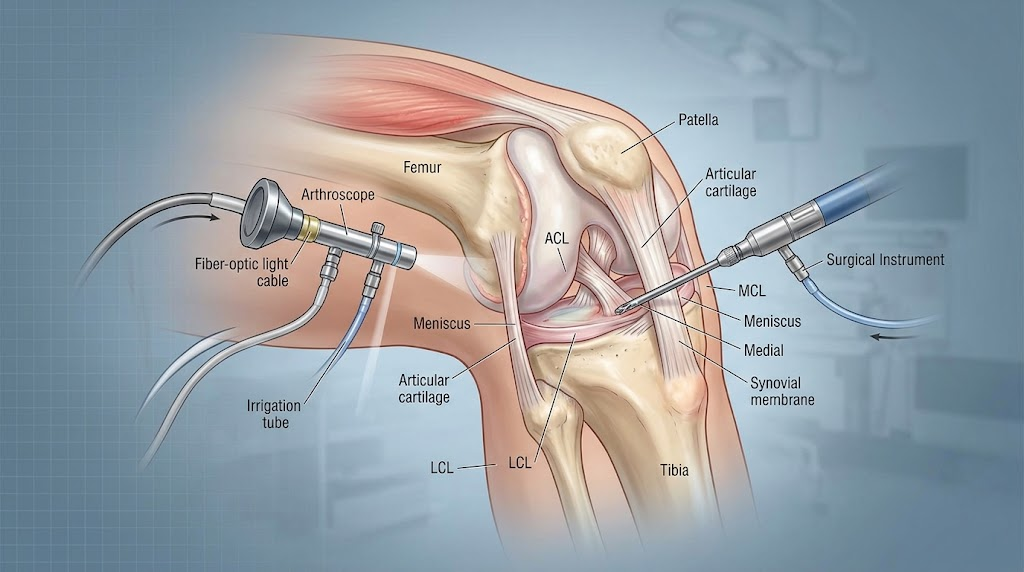
Arthroscopy is a surgical technique utilizing small incisions not exceeding 0.5 cm. It allows for the diagnosis and treatment of internal injuries in a single session, with hospital discharge on the same or the following day. Procedures performed by Prof. Dr. Ibrahim Abdelmonem via arthroscopy include:
- Anterior Cruciate Ligament (ACL) Reconstruction
- Posterior Cruciate Ligament (PCL) Reconstruction
- Meniscal Repair / Partial Meniscectomy
- Knee joint debridement and removal of loose bodies
- Treatment of articular cartilage damage (Microfracture / Chondroplasty)
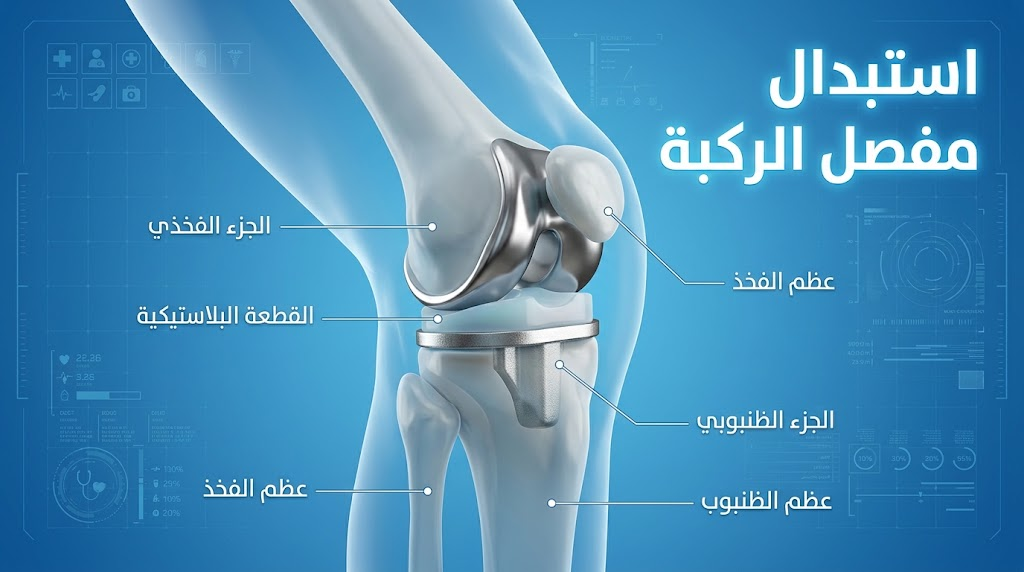
Knee Joint Replacement Surgery (TKA)
Total Knee Arthroplasty is used for severe, Grade IV osteoarthritis that has not responded to conservative treatments. It restores the natural axis of the limb and eliminates pain by over 90% after two years. Partial (Unicompartmental) replacement is an option for osteoarthritis confined to one compartment, preserving the ligaments and speeding up recovery.
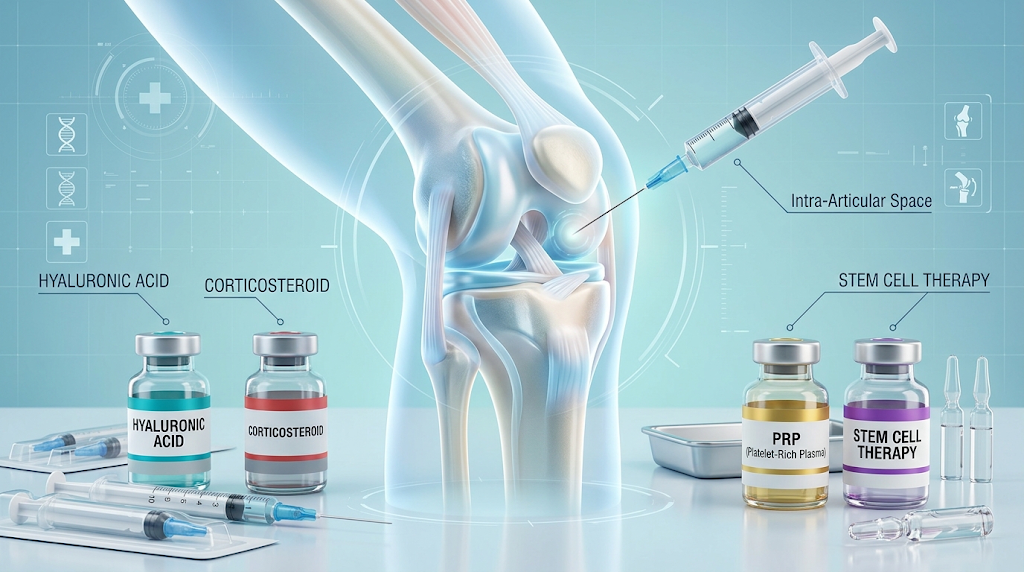
Non-Surgical Interventional Treatments
- Cortisone injections for acute inflammation
- Hyaluronic acid injections (gel/oil injections) to lubricate the joint and delay surgery
- Platelet-Rich Plasma (PRP) injections for mild-to-moderate osteoarthritis
- Ultrasound-guided injections to ensure precise access to the joint
How to choose the best orthopedic knee specialist in Egypt?
The best orthopedic knee specialist should combine: an academic affiliation with a university hospital, specialized training in arthroscopic surgery, a documented annual surgical volume, and experience in both treatment pathways: conservative and surgical.
Objective Selection Criteria:
- Academic Affiliation: A university professor is subject to constant academic oversight regarding the quality of their results.
- Subspecialty: Look for a specific specialization in the knee, not just orthopedics in general.
- Surgical Technique: Arthroscopy is better than open surgery for most soft tissue injuries.
- Availability of a non-surgical pathway: A good doctor does not resort to surgery until all other options have been exhausted.
- International training: A fellowship at specialized centers outside Egypt adds a different clinical approach and methodology.
Prof. Dr. Ibrahim Abdelmonem’s Clinics in Cairo
| Branch | Area | Note |
| Nasr City Clinic | Nasr City | Closest to Ain Shams University Hospitals |
| Fifth Settlement Clinic | Heliopolis – Settlement | Serves East Cairo and the Administrative Capital |
| Mohandessin Clinic | Mohandessin | Serves West Cairo and Giza |
| Batal Ahmed Abdel Aziz Clinic | Mohandessin |
(Note: The provided Arabic text ended abruptly here and did not include the FAQ or References sections listed in the Table of Contents. If you have the remaining text, please provide it and I will translate it as well!)
Frequently Asked Questions: Choosing the Best Knee Specialist
How do I choose the best orthopedic doctor specializing in knee care?
Key criteria to evaluate include:
- Subspecialty Fellowship: Formal post-residency fellowship training in sports medicine, knee arthroscopy, or joint replacement.
- Procedure Volume: High annual caseloads for your specific diagnosis (e.g., ACL reconstruction or knee arthroplasty).
- Facility Quality: Access to accredited surgical centers with advanced imaging and sterile laminar-flow theaters.
- Transparent Outcomes: Documented track record of low infection and revision rates alongside verifiable patient reviews.
When should I consult a knee specialist instead of a general doctor?
You should see a dedicated specialist when presenting with:
- A distinct “pop” followed by immediate effusion after a twisting sports injury.
- Knee locking, clicking, or inability to achieve terminal extension.
- A feeling of subjective instability or the joint giving way during pivots.
- Persistent knee pain and stiffness that fails to improve after 4–6 weeks of primary care.
What is the difference between a general orthopedic surgeon and a knee specialist?
A general orthopedic surgeon manages traumatic fractures and musculoskeletal conditions across the whole body. A knee specialist focuses their ongoing clinical research, continuous training, and surgical operating time solely on knee joint preserving strategies, multi-ligament balance, biological restorations, and complex corrective alignment.
Do top knee surgeons always recommend surgery first?
No. Reputable knee experts employ an algorithmic step-ladder treatment protocol. Unless dealing with complete ligament ruptures in high-demand individuals, displaced bucket-handle meniscus tears, or acute fractures, conservative therapies—such as structured physical therapy, kinetic kinetic adjustments, weight optimization, and guided injections—are exhaustive steps before any operative indication.
What advanced diagnostic tools do top knee doctors use?
Beyond standard physical examinations, advanced knee diagnostics include:
- Weight-Bearing Digital Radiographs: Rosenberg and full-leg alignment views to evaluate joint space narrowing and mechanical axis varus/valgus deviation.
- High-Resolution MRI (1.5T or 3T): Visualizing meniscal morphology, chondral defects, and ligament fiber continuity.
- Point-of-Care Ultrasound: Dynamic bedside scanning to pinpoint collateral sprains, patellar tendinopathy, and joint effusion.
What common surgical procedures are performed by a knee specialist?
Depending on pathology, key procedures include:
- Arthroscopic Knee Surgery: Minimally invasive inside-out or all-inside meniscus repairs and loose-body extractions.
- Ligament Reconstructions: Primary or revision ACL, PCL, and anterolateral ligament (ALL) reconstructions with autografts.
- Joint Preservation: High Tibial Osteotomy (HTO) or Distal Femoral Osteotomy (DFO) to offload damaged compartments.
- Arthroplasty: Unicondylar (partial) knee replacement and robotic-assisted total knee arthroplasty (TKA).
Why does surgical volume matter when choosing a knee surgeon?
Studies consistently reveal an inverse relationship between surgeon volume and adverse outcomes. High-volume orthopedic surgeons demonstrate lower rates of surgical site infections, significantly reduced 30-day hospital readmissions, shorter anesthesia exposure times, and more accurate component positioning in joint replacements.
What non-surgical injections can a knee specialist offer?
In-office interventional options include:
- Platelet-Rich Plasma (PRP): Delivers autologous growth factors to reduce intra-articular inflammation and modulate mild-to-moderate cartilage degeneration.
- Hyaluronic Acid: Replenishes synovial fluid viscosity to reduce friction and improve shock absorption.
- Corticosteroids: Provides rapid, short-term anti-inflammatory suppression during acute joint effusions.
What role does rehabilitation play after knee surgery?
Surgical intervention corrects mechanical architecture, but post-operative physical rehabilitation dictates functional recovery. A dedicated specialist collaborates closely with physical therapists to execute criterion-based rehabilitation—focusing on early extension, quadriceps reactivation, proprioception, and progressive plyometric loading before clearance for full return to sports.
What key questions should I ask during my first knee consultation?
Essential questions to clarify your treatment plan include:
- What is the precise structural cause of my knee symptoms?
- Am I a viable candidate for conservative therapies or joint-preserving techniques?
- How many of these specific procedures do you perform each year?
- What are the expected recovery milestones, physical therapy demands, and realistic return-to-activity timelines?
references
- American Academy of Orthopaedic Surgeons — ACL Injuries
- Arthroscopy Association of North America — Knee Arthroscopy outcomes
- The Journal of Arthroplasty 2025 — PRP vs CS single injection RCT
- https://www.placidway.com/search-medical-centers/Orthopedic-Knee-Surgery/Egypt/1
- https://www.placidway.com/search-medical-centers/knee-surgery+orthopedic-knee-surgery/egypt/1
- https://www.boneartclinic.com/en/blog/best-orthopedic-doctors-cairo-egypt