
Repeated shoulder dislocation is a frequent and serious condition. According to a 25-year follow-up study by Hovelius (JBJS, 2008), the recurrence rate following non-operative treatment reaches 72% in patients under 20. Every subsequent dislocation causes cumulative damage, including progressive bone loss, ligamentous laxity, and extensive labral tearing. Eventually, the shoulder may dislocate during minor daily activities or even while sleeping.
Why Does Recurrent Dislocation Occur?
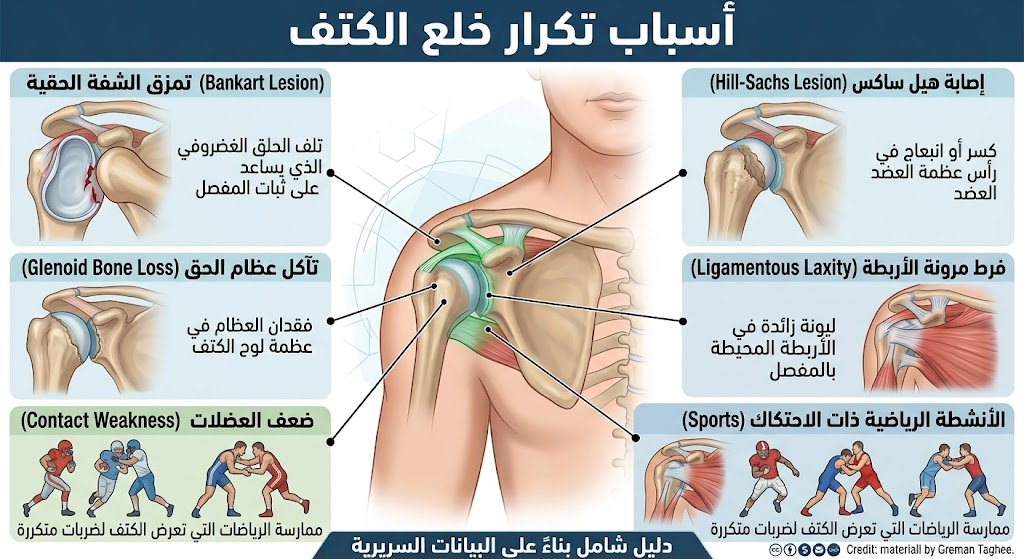
The primary driver of recurrence is structural damage sustained during the initial dislocation that fails to heal spontaneously, specifically a Bankart Lesion (a tear of the glenoid labrum) and stretching of the joint capsule and ligaments. This damage compromises joint stability, leaving the humeral head vulnerable to displacement.
Factors Increasing Recurrence Risk
- Age: The most significant factor. Recurrence rates are 68–72% for those under 20, decreasing to 14–22% for those over 50.
- Bankart Lesion: A labral tear that rarely heals without surgical intervention.
- Glenoid Bone Loss: Each dislocation erodes the glenoid rim, weakening the “wall” that holds the humeral head in place.
- Hill-Sachs Defect: A compression fracture on the humeral head that acts like a “key,” facilitating dislocation during specific movements.
- Physical Activity: High-impact sports or overhead activities increase risk.
- Hyperlaxity: Individuals with naturally flexible ligaments inherently have lower joint stability.
Is Recurrent Dislocation Harmful?
Yes, recurrent dislocation causes irreversible, cumulative joint damage. Delaying surgery often leads to more complex procedures and poorer functional outcomes.
Consequences of Chronic Instability
- Progressive Bone Loss: After five dislocations, a joint may lose over 25% of the glenoid rim.
- Capsular Stretching: Loss of the natural tension required to hold the joint in place.
- Early-Onset Arthritis: Chronic instability and friction lead to premature cartilage wear.
- Neurological Injury: Approximately 3% of cases involve damage to the axillary nerve, causing numbness or deltoid weakness.
- Psychological Impact: Chronic apprehension leads to the avoidance of social and physical activities.

Diagnosis
Specialized orthopaedic evaluation includes:
- Clinical Examination: Tests such as the Apprehension Test and Relocation Test to assess instability.
- MRI: To evaluate labral tears and soft tissue integrity.
- 3D CT Scan: Essential for measuring glenoid bone loss. If bone loss exceeds 20%, procedures like the Latarjet are required instead of standard Bankart repairs.
Are Shoulder Braces Effective?
Braces provide temporary support, but they do not prevent recurrence or repair structural damage. Relying on them can create a false sense of security, leading to muscle atrophy, joint stiffness, and delayed definitive treatment.
Emergency Protocols
Never attempt to reduce a dislocated shoulder at home. Unprofessional attempts can fracture the humerus or damage neurovascular structures. Immediately immobilize the arm, apply ice, and proceed to the nearest emergency department for professional reduction under sedation.
Definitive Treatment
Surgery is the definitive solution for recurrent instability.
- Arthroscopic Bankart Repair: Fixes the labral tear and tightens the capsule; suitable for patients with <20% bone loss.
- Latarjet Procedure: An open surgery that transfers a bone block to compensate for significant bone loss; it offers superior stability for complex cases.

Frequently Asked Questions: Repeated Shoulder Dislocation
An authoritative clinical guide covering Bankart lesions, glenoid bone loss, Hill-Sachs pathology, arthroscopic repair, and Latarjet stabilization.
Why does a shoulder joint dislocate repeatedly after the initial injury?
The shoulder joint resembles a golf ball sitting on a shallow tee, relying on soft tissues for stability. During a traumatic anterior dislocation:
• The fibrocartilaginous labrum and inferior glenohumeral ligament complex tear from the glenoid rim (Bankart lesion).
• The posterosuperior humeral head collides against the anterior glenoid, creating an indentation compression fracture (Hill-Sachs lesion).
Because torn intra-articular capsulolabral tissues rarely heal with physiological tension, the joint capsule remains permanently stretched, leaving the humeral head free to slip out with minimal provocation.
Why are young athletes at such a high risk for recurrent shoulder dislocations?
Age at primary dislocation is the single greatest predictor of recurrence:
• Under 20 to 25 Years Old: Experience re-dislocation rates between 70% and 90% due to greater baseline tissue elasticity, elevated sports activity, and vigorous overhead mechanics.
• Over 40 Years Old: Re-dislocation rates fall below 20%, but these patients face high rates of concomitant rotator cuff tendon ruptures and axillary nerve traction injuries during the initial episode.
What are the long-term clinical risks of untreated repeated shoulder dislocations?
Neglecting recurrent shoulder instability leads to cumulative joint breakdown:
1. Glenoid Bone Loss: Each episode chips or grinds down the anterior bony glenoid rim, converting what could have been a simple arthroscopic repair into a complex bone-grafting procedure.
2. Instability Arthropathy: Repeated shear stresses erode articular cartilage, accelerating painful post-traumatic osteoarthritis in young adulthood.
3. Loss of Functional Independence: Dislocations progress from high-impact sports collisions to mundane activities like rolling over in bed, reaching into the backseat, or sneezing.
What diagnostic imaging is required to evaluate recurrent shoulder instability?
Accurate surgical decision-making requires multi-modal imaging:
• Plain Radiographs: True AP, axillary lateral, and West Point views to screen for rim fractures and Hill-Sachs defects.
• 3D-CT Scan: The gold standard for measuring bone loss; digital humeral head subtraction calculates glenoid defect percentage and assesses whether a Hill-Sachs lesion is ‘on-track’ or ‘off-track’.
• High-Field MRI / MR-Arthrography: Evaluates soft-tissue pathology, including capsular stripping, labral tears (Bankart/ALPSA), and rotator cuff tears.
Can repeated shoulder dislocations be resolved with physical therapy alone?
Physiotherapy alone is rarely sufficient for traumatic anterior dislocations in active individuals:
• When PT Works: Effective in non-traumatic, multidirectional instability (MDI) caused by generalized ligamentous hyperlaxity, where periscapular and rotator cuff strengthening can dynamically compensate for capsular slack.
• When PT Fails: In structural, traumatic Bankart tears, torn fibrocartilage cannot biologically reattach through exercise. Without surgical repair, muscular compensation frequently breaks down during athletic deceleration or rotational arm movements.
When is arthroscopic Bankart repair the procedure of choice?
Arthroscopic Bankart repair is the preferred treatment when instability is primarily soft-tissue driven, defined by:
• Subcritical glenoid bone loss (less than 13% to 15%).
• An ‘on-track’ Hill-Sachs lesion that does not engage the glenoid rim during abduction and external rotation.
• Non-collision, recreational, or occupational activity levels.
Through 3 small puncture incisions, the surgeon re-anchors the torn labrum and tensions the anterior capsule back to the bone using bio-composite or PEEK suture anchors with minimal disruption to the subscapularis muscle.
When does the open Latarjet procedure become mandatory over arthroscopy?
Attempting soft-tissue arthroscopy in the presence of substantial bone loss yields failure rates exceeding 40% to 50%. The Latarjet procedure is mandatory in:
• Glenoid bone loss exceeding 13% to 15%.
• An engaging, ‘off-track’ Hill-Sachs lesion.
• Revision surgery after a failed previous Bankart repair.
• Young collision or contact athletes (rugby, wrestling, martial arts).
It transfers the coracoid process with its attached conjoint tendon to the anterior glenoid rim, creating a robust bony extension and a dynamic muscular sling that permanently prevents dislocation.
What immediate first-aid mistakes should be avoided during a shoulder dislocation?
Critical errors during acute dislocations include:
1. Aggressive On-Field Reductions: Pulling the arm forcefully without muscle relaxants or medical training can fracture the humeral head, tear the subscapularis tendon, or permanently damage the axillary nerve.
2. Skipping Radiographs: Reductions should always be preceded and followed by X-rays to rule out concomitant fractures.
3. Discarding the Sling Prematurely: Removing immobilization too early compromises primary scar-tissue formation, drastically increasing the likelihood of recurrent episodes.
What is the expected success rate of surgical stabilization?
When surgical technique matches the anatomical pathology:
• Arthroscopic Bankart Repair: Achieves a 90% to 92% success rate in properly selected patients with robust bone stock and good compliance with rehabilitation.
• Latarjet Procedure: Considered the gold standard for high-risk shoulders, achieving 95% to 98% long-term joint stability with re-dislocation rates under 2% to 4%, even in elite collision athletes.
What is the rehabilitation timeline and return-to-sport protocol?
Phased rehabilitation progresses through structured milestones:
• Weeks 1–4: Sling immobilization to protect the repaired labrum or bone graft; only gentle wrist, hand, and elbow exercises are permitted.
• Weeks 5–8: Discontinue sling; initiate active-assisted range-of-motion exercises, avoiding aggressive external rotation in abduction.
• Weeks 9–12: Progressive rotator cuff, deltoid, and periscapular strengthening with resistance bands.
• Months 4–6: Return to full overhead and collision sports once objective criteria are met: 100% radiographic bone fusion (for Latarjet), absence of apprehension on exam, and ≥ 90% strength symmetry compared to the healthy shoulder.
references
- https://pubmed.ncbi.nlm.nih.gov/25900943/
(Meta-analysis — recurrence rate 39% after first dislocation; risk: young age, male, hyperlaxity) - https://pmc.ncbi.nlm.nih.gov/articles/PMC12788762
(Risk factors for recurrence after Bankart repair — age, ALPSA lesion, bone loss — 2026) - https://www.sciencedirect.com/science/article/abs/pii/S1058274624004075
(Systematic review — risk factors for recurrence: bone loss, Hill-Sachs, young athletes) - https://www.ncbi.nlm.nih.gov/pmc/articles/PMC12368457/
(Bankart repair + Remplissage for recurrent dislocation in manual workers — 2025) - https://www.ncbi.nlm.nih.gov/pmc/articles/PMC12277762/
(Arthroscopic reverse Remplissage for recurrent posterior dislocation — 2025) - https://www.ncbi.nlm.nih.gov/pmc/articles/PMC12007311/
(Dynamic anterior stabilization using biceps tendon for recurrent dislocation — 2025) - https://pmc.ncbi.nlm.nih.gov/articles/PMC13455169/
(Multidisciplinary guideline — recurrence 8.9% surgical vs 49% conservative — 2026)
- https://www.sciencedirect.com/science/article/abs/pii/S0749806318302779
(Risk factors under age 30 — surgical delay & number of dislocations increase recurrence)