
Learn about the types of knee injections in Egypt (Cortisone – Hyaluronic – PRP), available drug names, their prices in Egyptian Pounds, and their results in treating knee osteoarthritis.
What are knee injections?
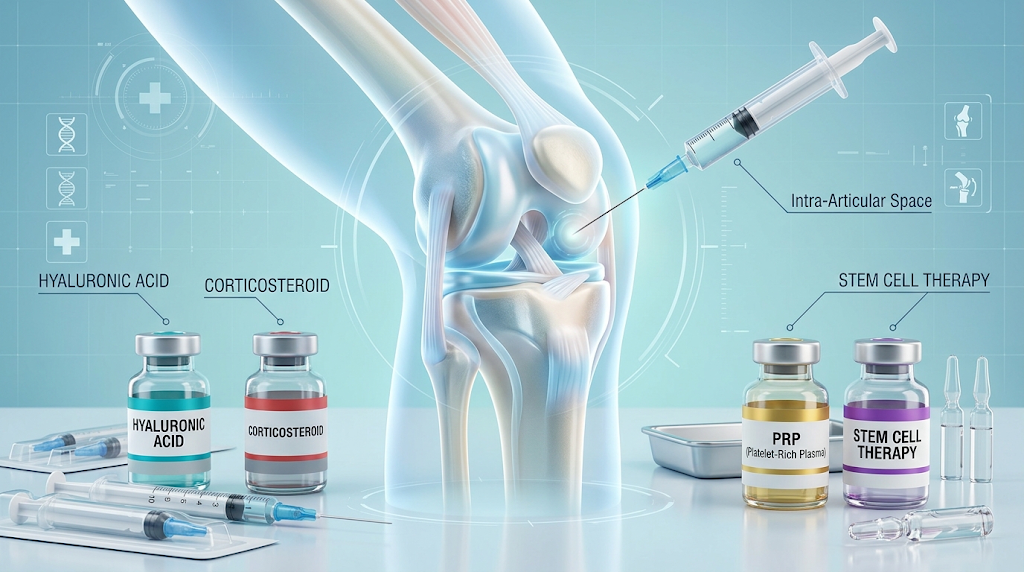
A knee injection is a therapeutic procedure directed directly into the knee joint to relieve pain and inflammation or to stimulate cartilage regeneration. There are four main types: Cortisone, Hyaluronic Acid (gel/oil injections), Platelet-Rich Plasma (PRP), and Stem Cells. Cortisone is the fastest acting, while PRP provides an effect that lasts up to 12 months in mild to moderate knee osteoarthritis.
Comparison of Knee Injection Types
| Type | Mechanism of Action | Duration of Effect | Number of Sessions | Best Suited For |
| Cortisone | Direct anti-inflammatory | 4–12 weeks | 1–3 per year | Acute inflammation |
| Hyaluronic Acid | Lubrication and cartilage protection | 3–6 months | 3–5 doses | Grade I–III osteoarthritis |
| PRP | Growth factor stimulation | 6–12 months | 1–3 sessions | Grade I–II osteoarthritis |
| Stem Cells (BMAC) | Cartilage tissue regeneration | > 12 months | Single session | Advanced osteoarthritis rejecting surgery |
Types of Knee Injections and Their Names in Egypt
Cortisone Injections
Cortisone is the oldest and fastest-acting knee injection, directly suppressing acute inflammation inside the joint. Commercial names circulating in Egypt include: Depo-Medrol (Methylprednisolone), Kenacort (Triamcinolone), and Diprospan (Betamethasone). It is administered in an outpatient clinic within minutes. Repeating the dose more than 3 times annually causes progressive damage to the cartilage and is not recommended.
Hyaluronic Acid Injections (Gel/Oil Injections)
Hyaluronic acid is a natural substance in joint fluid that decreases as osteoarthritis progresses. The injection restores its lubricating properties and slows down cartilage wear. Circulating names in Egypt include: Synvisc, Ostenil, Hyalgan, Durolane, and Fermathron. A study of 15,000 patients proved that these injections delay the need for a knee replacement by an average of 8.7 months. It is administered in 3–5 consecutive weekly doses, with single-dose formulations like Durolane available for those who do not wish to repeat visits.
Platelet-Rich Plasma (PRP) Injections
PRP is prepared from the patient’s own blood by separating platelets via a centrifuge, which is then injected into the joint. It contains growth factors that stimulate tissue repair and reduce synovial inflammation. A 2022 systematic review from the Benha Medical Journal proved that PRP maintains its effect for up to 12 months compared to 6 months for hyaluronic acid, with the possibility of extending up to 18 months when injected intra-osseously. It is not recommended for Grade IV osteoarthritis (KL IV). It is administered over 1–3 sessions spaced two weeks apart.
Stem Cell Injections
Cells are extracted from pelvic bone marrow (BMAC) or adipose tissue and injected into the joint in a single session. They aim to regenerate cartilage rather than merely relieve symptoms. Evidence is still accumulating; this option is typically used for advanced osteoarthritis cases that do not qualify for or refuse replacement surgery.
Prices of Knee Injections in Egypt 2026
| Type | Price Range (EGP) | Note |
| Cortisone | 300 – 1,000 | Depends on the commercial brand and facility |
| Hyaluronic Acid | 1,500 – 6,000 | Depends on the brand and number of doses |
| PRP (Single Session) | 3,000 – 8,000 | Prepared from the patient’s blood on the same day |
| Stem Cells (BMAC) | 15,000 – 40,000 | Includes the cost of sample extraction |
حاسبة أسعار حقن الركبة في مصر (تحديث 2026)
تقدير تقريبي لتكلفة جلسات وحقن مفصل الركبة بحسب المادة الفعالة ونوع المستشفى
- تكلفة المادة العلاجية / الأنبوبة المعتمدة: حوالي 65% – 75%
- أتعاب الحقن والفحص السريري والتوجيه السوناري: حوالي 20% – 25%
- مستهلكات التعقيم والتخدير الموضعي: حوالي 5% – 10%
Results of Knee Injections for Knee Osteoarthritis
Knee injections improve pain and motor function in Grades I–III according to the Kellgren-Lawrence classification, but they do not rebuild lost cartilage. Cortisone provides relief within 24–48 hours, but its effect is temporary. Hyaluronic acid takes 4–8 weeks to reach its peak. PRP requires patience for 6–8 weeks before noticeable improvement appears. Factors determining the result include: the degree of osteoarthritis, body weight, age, and activity level. Patients under 50 with mild osteoarthritis respond better to PRP than cortisone in the long term.
Side Effects and Contraindications of Knee Injections
Cortisone Side Effects:
- Cumulative cartilage damage when doses are repeated more than 3 times annually.
- Elevated blood sugar in diabetic patients 48–72 hours after injection.
- Risk of joint infection (sepsis) if sterilization is not observed.
- Localized skin atrophy if cortisone leaks outside the joint.
Hyaluronic Acid Side Effects:
- Temporary swelling and pain for 2–3 days post-injection.
- Rare inflammatory reaction (Pseudo-gout) that responds to rest and painkillers.
PRP Side Effects:
- Pain at the injection site for 24–48 hours (acceptable).
- Extremely low risk of infection as it is derived from the patient’s own blood.
Absolute Contraindications:
- Active infection inside or around the joint.
- Bleeding disorders or the use of anticoagulants (relative).
- Documented allergy to the active substance.
- Presence of a prosthesis (artificial joint) inside the knee (relative for cortisone).

When Do You Need a Knee Injection?
The ideal candidate is someone who has exhausted conservative options (painkillers, physical therapy, weight loss) and still suffers from pain that limits their daily activity, with Grade I–III osteoarthritis. Grade IV with complete bone-on-bone wear does not respond sufficiently to injections, and a joint replacement should be evaluated. Injections are also used to delay surgery in patients who have contraindications to general anesthesia or who refuse surgery.

Frequently Asked Questions: Knee Injections
What are the main types of knee injections for osteoarthritis and pain?
The primary non-operative injectable options include:
- Corticosteroids: Potent anti-inflammatory agents delivering rapid pain relief during acute inflammatory flares and effusion.
- Hyaluronic Acid (Viscosupplementation): Gel preparations that replenish synovial viscoelasticity, reducing friction and restoring intra-articular shock absorption.
- Platelet-Rich Plasma (PRP): Autologous centrifuged blood therapy delivering high concentrations of growth factors that modulate synovial inflammation and promote cellular homeostasis.
- Cellular Biologics (Bone Marrow Aspirate / Adipose): Regenerative matrix therapies utilized in selected clinical protocols for progressive symptomatic joint preservation.
How long does relief last from a hyaluronic acid (gel) knee injection?
A complete viscosupplementation regimen generally provides symptomatic relief and improved joint kinematics for 6 to 12 months. Duration varies with the grade of chondral loss, mechanical axis alignment, body mass index (BMI), and adherence to quadriceps-strengthening exercises.
Can repeated cortisone injections cause joint damage?
Frequent, unmonitored corticosteroid use (exceeding 3 to 4 injections within a 12-month period in the same knee) is associated with chondrotoxicity, accelerated cartilage loss, and localized subchondral bone weakening. Orthopedic guidelines advocate using corticosteroids primarily for episodic inflammatory flare-ups rather than indefinite maintenance.
What is the difference between PRP and hyaluronic acid injections?
Hyaluronic Acid: Operates primarily through mechanical lubrication and boundary protection, temporarily restoring the fluid rheology of the arthritic joint.
Platelet-Rich Plasma (PRP): An active biologic formulation derived from the patient’s own peripheral blood. Concentrated platelets release growth factors (such as TGF-β, PDGF, and IGF-1) that downregulate inflammatory cytokines (IL-1β, TNF-α) and alter intra-articular microenvironments over several months.
Is a knee injection painful, and is anesthesia used?
The procedure causes minimal discomfort and takes approximately 2 to 3 minutes. A topical vapocoolant spray or a localized subcutaneous anesthetic (such as 1% lidocaine) numbs the entry tract, making the injection comparable to a standard blood draw accompanied by a temporary sensation of fullness inside the joint capsule.
What are the recommended post-injection care guidelines?
- Relative Rest: Avoid high-impact activities, running, heavy lifting, or prolonged stair climbing for 24 to 48 hours.
- Cryotherapy: Apply a wrapped ice pack to the knee for 15 minutes at a time to minimize post-injection soreness.
- Site Hygiene: Keep the injection site clean and dry, avoiding full immersion in baths, hot tubs, or pools for 24 hours.
- Rehabilitation: Resume low-impact range of motion and prescribed physical therapy after 48 hours.
Can knee injections reverse severe bone-on-bone (Grade 4) osteoarthritis?
No injection can regenerate lost hyaline cartilage or correct structural bony deformity in end-stage (Kellgren-Lawrence Grade 4) osteoarthritis. However, injections can offer palliative pain reduction and functional support for patients who are medically compromised, working through rehabilitation, or postponing total joint replacement.
What are the potential risks and complications of knee injections?
Knee injections have an excellent safety profile. Minor adverse reactions include self-limiting post-injection flare (mild synovitis resolving within 24 to 48 hours) and minor bruising. Septic arthritis is extremely rare (incidence < 0.01%) when performed with sterile clinical prep and aseptic technique.
How quickly do knee injections take effect?
Onset timing depends entirely on the agent administered:
- Corticosteroids: Rapid onset, with pain relief beginning within 24 to 72 hours.
- Hyaluronic Acid: Progressive improvement with peak efficacy attained between 2 and 4 weeks post-injection.
- PRP: Biologically mediated mechanism; benefits accrue gradually, showing measurable clinical improvement at 3 to 6 weeks.
Why is ultrasound guidance recommended for intra-articular knee injections?
High-resolution musculoskeletal ultrasound increases needle-entry accuracy into the intra-articular joint space to >95–99%, compared to anatomical palpation alone (which carries a blind error rate of 15% to 20%). Ultrasound allows real-time needle visualization, immediate decompression/aspiration of joint effusions, and protection of adjacent soft tissue structures.
references
- https://orthoinfo.aaos.org/en/diseases–conditions/shoulder-pain-and-common-shoulder-problems/
- https://my.clevelandclinic.org/health/diseases/8291-rotator-cuff-tear
- https://jointpainauthority.com/blog/best-knee-injection-for-osteoarthritis/
- https://jointpainauthority.com/blog/three-injections-for-knee-pain/
- https://alleviatepainclinic.com/blog/types-of-injections-for-knee-pain/
- https://scienceinsights.org/what-are-the-newest-injections-for-knee-pain/
- https://drrizio.com/2025/07/15/prp-vs-gel-ha-vs-steroid-injection-for-knee-arthritis/
- https://regencoremethod.com/post/comparing-arthritis-shots-for-knees-cortisone-hyaluronic-acid-prp/
- https://www.ncbi.nlm.nih.gov/pmc/articles/PMC1201002