
Shoulder tendon impingement, or subacromial impingement syndrome, is the leading cause of shoulder pain — accounting for up to 65% of all shoulder complaints. It occurs when the rotator cuff tendons and subacromial bursa become repeatedly compressed between the humeral head and the acromion, triggering pain, inflammation, and progressive tendon damage if left untreated. This comprehensive medical guide explains the exact causes of subacromial impingement, how the shape of the acromion determines your risk, the clinical signs and diagnostic tests used to confirm it, and the full range of treatment options — from targeted exercises and corticosteroid injections to arthroscopic subacromial decompression surgery — so you can make an informed decision about your shoulder health.
What is Shoulder Tendon Impingement?
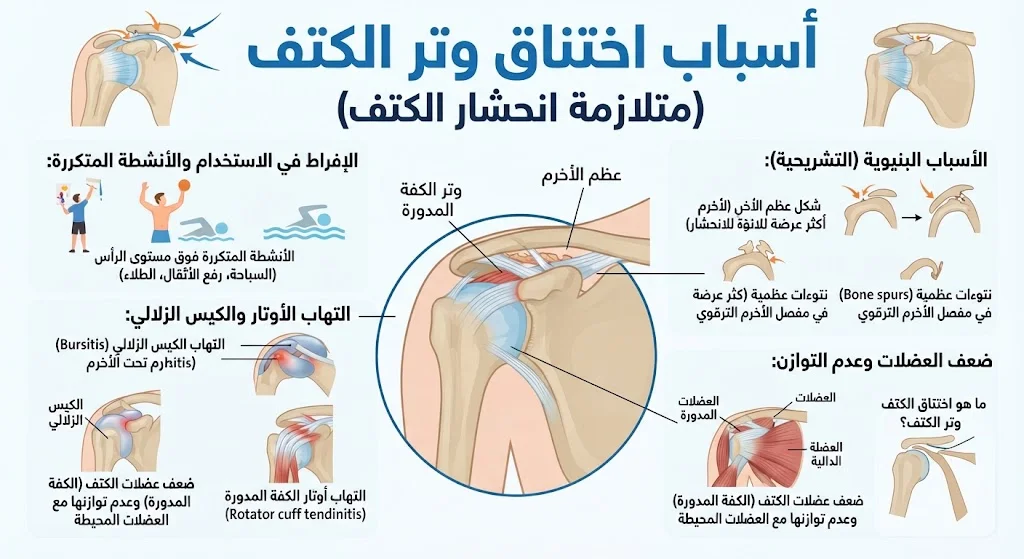
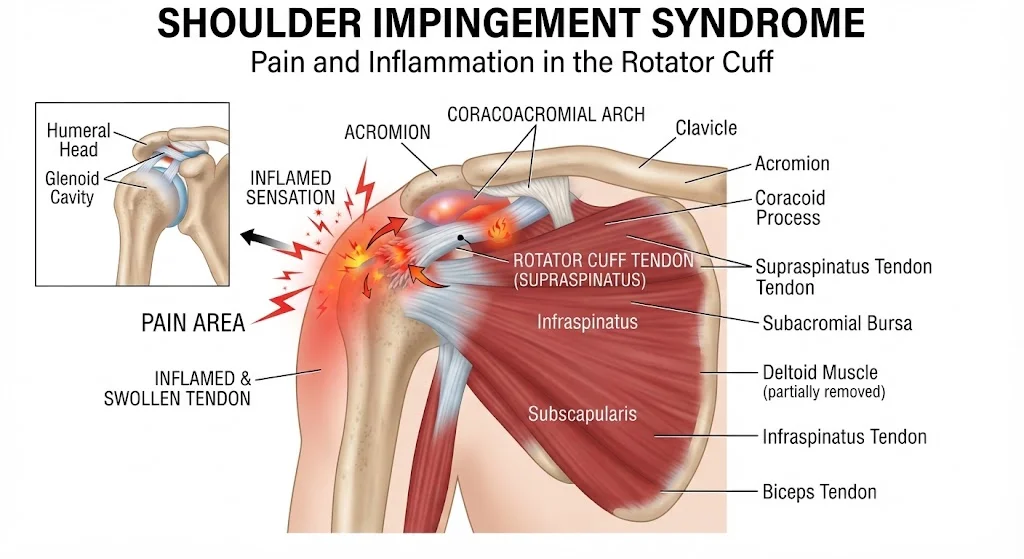
Shoulder tendon impingement—medically known as Subacromial Impingement Syndrome—occurs when there is repetitive pressure and pinching of the rotator cuff tendons and bursa within the narrow space between the head of the humerus and the “acromion” (the bony prominence on top of the shoulder).
This condition is the single most common cause of shoulder pain, accounting for 44% to 65% of all shoulder-related problems seen in clinics.
Normally, the subacromial space measures between 7 to 14 mm. When lifting or internally rotating the arm, this space narrows, causing the supraspinatus tendon and bursa to collide with the undersurface of the acromion. Over time and with repeated friction, a pathological cascade begins—starting with inflammation and swelling, and potentially progressing to tendon wear or complete tearing if left untreated.

Causes of Shoulder Tendon Impingement
Shoulder tendon impingement does not stem from a single cause; rather, it results from a combination of anatomical, mechanical, and functional factors that narrow the subacromial space:
| Cause | Details and Mechanism | Most Affected Category |
| Hooked Acromion (Type III) | A downward-curving acromion bone permanently narrows the space mechanically. | Any age group (congenital anatomical factor) |
| Subacromial Bone Spurs | Calcium deposits or acromioclavicular (AC) joint degeneration form bone spurs. | Patients over 50 years old |
| Repetitive Overhead Activities | Continuous arm elevation exhausts tendons, leading to swelling and friction. | Athletes (swimmers, volleyball players), manual laborers, and painters |
| Weak Rotator Cuff Muscles | Allows the humeral head to migrate upward during movement and press against the acromion. | Individuals over 50 or those with sedentary lifestyles |
| Scapular Dyskinesia | Poor coordination between the shoulder blade and humerus reduces the functional space. | Young athletes |
| Rounded Shoulders Posture | Forward and internal shoulder rotation due to poor, sustained sitting posture. | Long-term computer and desk workers |
Acromion Shape Classification (Bigliani Classification)
The shape of the acromion determines vulnerability to impingement:
- Type I (Flat): Low risk of injury.
- Type II (Curved): Moderate risk of injury.
- Type III (Hooked): Very high risk of injury (most strongly associated with tendon tears).
Symptoms of Shoulder Tendon Impingement
Impingement syndrome presents with specific symptoms that set it apart from other shoulder injuries:
- Painful Arc: Pain begins when raising the arm sideways, typically clearly between an angle of 60° and 120°, and subsides outside this range.
- Anterolateral Pain: Concentrated in the front and side of the shoulder, sometimes radiating down to the mid-arm (though rarely reaching the wrist or fingers).
- Troublesome Night Pain: Worsens significantly when lying directly on the affected shoulder, waking the patient from sleep.
- Progressive Weakness: The patient notices difficulty carrying items or lifting the arm forward and overhead.
- Difficulty with Daily Activities: Such as combing hair, dressing, or reaching for a back pocket.
Clinical Examination Tests in the Clinic
The orthopedic consultant relies on precise clinical maneuvers to confirm the diagnosis:
- Neer Test: Passively elevating the arm forward while stabilizing the scapula (pain manifests in the front of the shoulder).
- Hawkins-Kennedy Test: Flexing the elbow to 90 degrees and rapidly internally rotating the shoulder.
- Neer Diagnostic Injection: Injecting a local anesthetic into the subacromial bursa; if pain subsides by more than 50% within minutes, the diagnosis is confirmed.
Treatment of Shoulder Tendon Impingement
More than 70% of shoulder impingement cases recover completely with conservative (non-surgical) treatment, provided the program is followed for 4 to 6 months.
1. Medical and Conservative Treatment
- Activity Modification: Temporarily avoiding repetitive overhead movements and carrying heavy loads away from the body.
- Non-Steroidal Anti-Inflammatory Drugs (NSAIDs): Such as Diclofenac or Celecoxib to reduce inflammation and pain for 2–4 weeks.
- Cold Compresses: For 15–20 minutes 2–3 times daily after light activity during the first 72 hours of acute pain.
2. Cortisone Injection and Physical Therapy
- Subacromial Bursa Injection: Cortisone (such as Kenacort® or Depo-Medrol®) is an excellent option to break the cycle of acute inflammation and provide relief lasting 4 to 12 weeks, paving the way for the patient to engage comfortably in physical therapy.
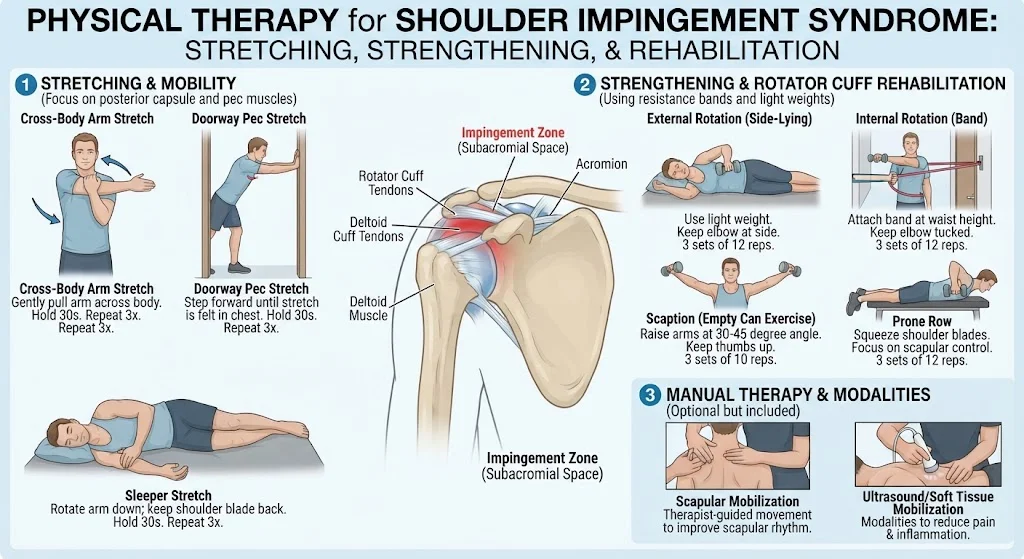
- Physical Therapy Program (8–12 Weeks):
- Phase One: Pendulum exercises and stretches to reduce stiffness.
- Phase Two: Restoring full range of motion and strengthening the rotator cuff muscles.
- Phase Three: Correcting scapular posture and strengthening upper back and posterior shoulder muscles.
When Does Shoulder Tendon Impingement Require Surgery?
Surgical intervention is indicated in the following cases:
- Failure of Conservative Treatment: Persistence of pain that disrupts daily life despite adherence to physical therapy and injections for 4 to 6 months.
- Presence of a Type III (Hooked) Acromion: Which cannot be widened except surgically.
- Presence of a Deep Partial Tear (> 50% of tendon thickness) or a complete tear of the rotator cuff tendons.
Surgical Procedure: Arthroscopic Subacromial Decompression
Arthroscopic surgery is the definitive and safest solution, performed through tiny portals (no larger than 0.5 cm) without the need to fully open the shoulder:
- A small portion of the anteroinferior surface of the acromion (about 1.5 to 2 cm) is resected, and any bone spurs and inflamed bursa are removed to expand the space and relieve pressure on the tendon.
- If the surgeon discovers a tendon tear during the arthroscopy, it is repaired and reconstructed in the same session.
- The procedure is performed as a Day Case, and the patient undergoes a full recovery period lasting 3 to 6 months, which includes a temporary sling for a few weeks followed by rehabilitation programs.
Book Your Appointment with Prof. Dr. Ibrahim Abdelmonem
If you suffer from chronic shoulder pain or difficulty lifting your arm, you can consult Prof. Dr. Ibrahim Abdelmonem (Professor of Orthopedic and Joint Surgery at Ain Shams University and Visiting Professor at Ohio State University, specializing in advanced shoulder and knee arthroscopic surgeries).
Reception clinics are available in four main branches across Greater Cairo:
- Nasr City Branch
- Fifth Settlement Branch
- Mohandessin Branch
- Batal Ahmed Abdel Aziz Branch (Mohandessin)

Frequently Asked Questions: Shoulder Tendon Impingement
What is shoulder tendon impingement (subacromial impingement syndrome)?
What are the primary causes of subacromial impingement syndrome?
What are the common clinical symptoms of shoulder tendon impingement?
How is shoulder impingement syndrome diagnosed clinically and radiologically?
What role does physical therapy play in treating shoulder impingement?
When are corticosteroid injections recommended for shoulder impingement?
What is the role of Platelet-Rich Plasma (PRP) therapy in chronic tendon impingement?
When does arthroscopic surgery (subacromial decompression) become necessary?
What is the recovery timeline following arthroscopic subacromial decompression?
How can individuals prevent shoulder tendon impingement or recurrent flare-ups?
References
Cureus (Sep 2025) — Shoulder Impingement Pain Syndrome: Pathophysiology, Diagnosis, and Treatment Review- Orthobullets — Subacromial Impingement: Classification, Diagnosis & Surgical Indications (Updated Feb 2025)
- MSK Doctors — Subacromial Impingement Syndrome: Symptoms, Causes & Exercises
- Kaiser Permanente PT Residency — Acromioplasty: Surgical Indications and Rehabilitation Protocol
- East Sussex Healthcare NHS — Subacromial Impingement Patient Guide (Reviewed Feb 2024)
- Shoulder Impingement Pain Syndrome: Pathophysiology, Diagnosis & Current Treatment Strategies — Cureus / PMC (2025)
- Comprehensive Approaches to Shoulder Impingement Syndrome: From Diagnosis to Rehabilitation — IJACT (2024)
- Systematic Review of Clinical Practice Guidelines on Diagnosis and Management of Shoulder Disorders — Arch Phys Med Rehabil (2024)
- Clinical Tests Accuracy in Diagnosing Subacromial Impingement Syndrome: Systematic Review — JPMA (2023)
- Shoulder Impingement Syndrome: Systematic Review of Clinical Trial Participant Selection Criteria — PMC (2016)
- Effect of Scapular Stabilization Exercises on Subacromial Impingement Syndrome: Systematic Review & Meta-Analysis — Frontiers in Neurology (2024)
- Active Treatments Outperform Minimal Intervention for Rotator Cuff Tendinopathy: Systematic Review with Network Meta-Analysis (2026)
- NSAIDs & Corticosteroid Injections for Shoulder Impingement Syndrome: Systematic Review & Meta-Analysis — Sports Health (2023)
- Outcomes of Arthroscopic Surgery (Acromioplasty) for Shoulder Impingement Syndrome: Systematic Review — Orthopedic Reviews (2025)
- Corticosteroid Injection vs Physiotherapy for Rotator Cuff Tendinopathy / Impingement: Systematic Review (2023)