
Shoulder injections prices in Cairo 2026: cortisone , hyaluronic acid & PRP — procedure steps, side effects, contraindications. Book with Prof. Ibrahim Abdelmonem.
What are shoulder injections and when are they necessary?
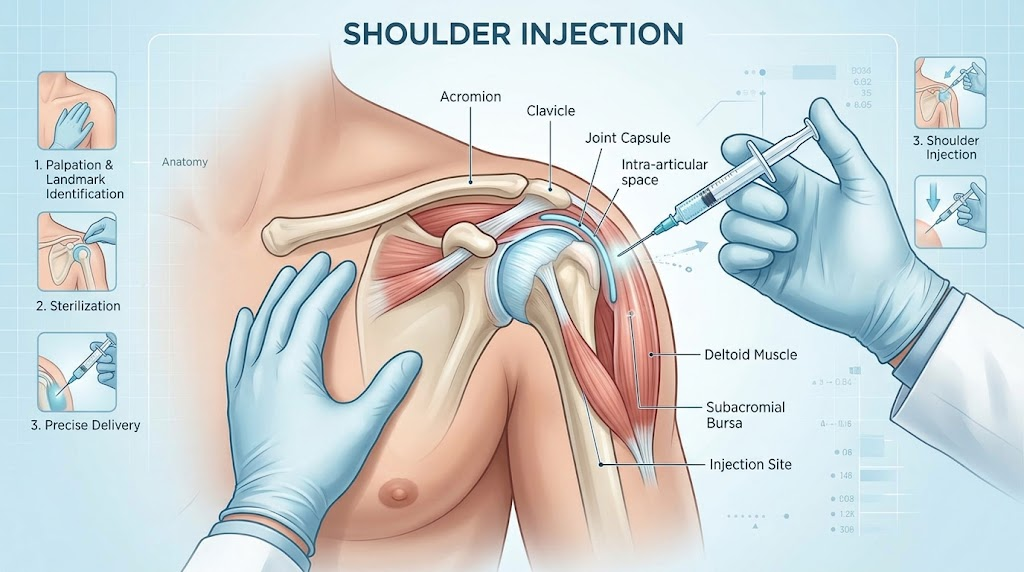
A shoulder injection is a precise therapeutic procedure in which medication is injected directly into the shoulder joint, the bursa (subacromial bursa), or around the targeted tendons, aiming to relieve acute pain, reduce inflammation, or improve joint lubrication. This procedure is considered the second line of defense when oral painkillers and traditional physical therapy programs fail.
When should shoulder injections be given and when should they be avoided?
| When to Give Shoulder Injections | When NOT to Give Shoulder Injections |
| • Chronic shoulder pain for more than 4 weeks with no response to painkillers | • Active infection in the shoulder area or systemic body infection |
| • Shoulder osteoarthritis (Glenohumeral OA) | • Documented allergy to the injection substance |
| • Painful bursitis | • Complete tendon tear requiring immediate surgical intervention |
| • Adhesive capsulitis (Frozen Shoulder) | • Uncontrolled diabetes (considered a relative contraindication for cortisone) |
| • Rotator cuff tendinitis | • Failure of more than 3 previous cortisone injections in the same joint |
| • Desire to relieve severe pain before surgical intervention | • Patient undergoing treatment with strong anticoagulants (relative contraindication) |
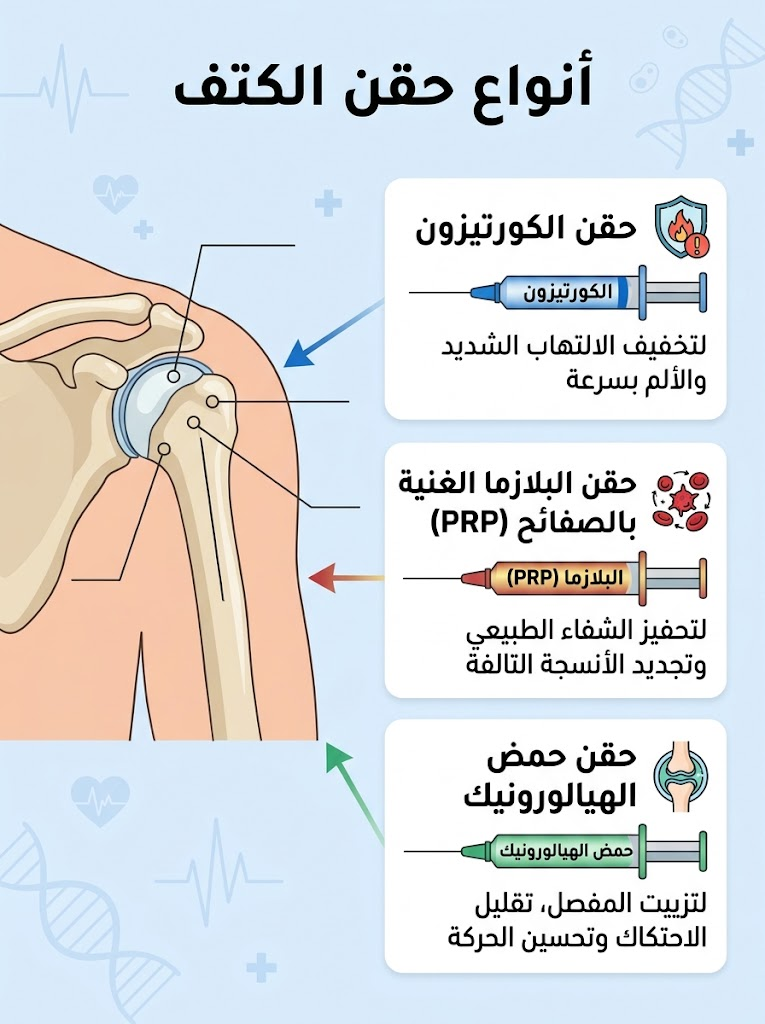
Comparison of Shoulder Injection Types
The choice of the appropriate injection type is determined based on an accurate diagnosis, the degree of inflammation, the patient’s age, and associated health conditions.
| Criterion | Cortisone (Corticosteroid) | Hyaluronic Acid | Platelet-Rich Plasma (PRP) |
| Mechanism of Action | Strong anti-inflammatory that suppresses the immune response | Mechanical lubrication + mild inflammation relief | Tissue regeneration via autologous growth factors |
| Onset of Action | Very fast (2–5 days) | Moderate (1–3 weeks) | Slow (4–6 weeks) |
| Duration of Effect | 4–12 weeks | 3–6 months | 6–12 months |
| Best Suited For | Acute inflammation and frozen shoulder | Moderate shoulder joint osteoarthritis | Tendon injuries and mild-to-moderate osteoarthritis |
| Scientific Evidence | Very strong in the short term | Moderate | Promising and effective in the long term |
| Effect on Cartilage | Negative with repeated injections | Neutral to positive | Positive (stimulates cellular regeneration) |
| Maximum Annually | Maximum 3 injections in a single joint | No strict limit | 1–3 rehabilitation sessions |
| Suitable for Diabetics | With extreme caution (temporarily raises blood sugar) | Yes | Yes (the optimal drug-free choice) |
Types of Shoulder Injections and Their Brand Names in Egypt
1. Cortisone Injections
Considered the first choice for controlling acute inflammation and painful shoulder osteoarthritis due to their rapid effect and low cost. Their effect begins within days and lasts for several weeks.
- Brand names in Egypt:
- Triamcinolone Acetonide: Kenacort 40 mg/ml (Usual dose: 20–40 mg).
- Methylprednisolone Acetate: Depo-Medrol 40–80 mg/ml.
- Betamethasone: Diprospan (1–2 ml).
- Note: Corticosteroids are often mixed with a local anesthetic (such as Lidocaine) to provide immediate pain relief in the first few minutes while the cortisone takes effect.
2. Hyaluronic Acid Injections (Lubrication and Viscosupplementation)
A natural substance mimicking the synovial fluid of the joint, which works to reduce mechanical friction and relieve pain for periods ranging from 3 to 6 months.
- Brand names and dosages in Egypt:
- Synvisc / Synvisc-One: Concentrated dose (single 6 ml injection) or a course of 3 weekly injections.
- Durolane: A single high-molecular-weight concentrated injection (characterized by convenience and prolonged effect).
- Ostenil & Hyalgan: Available options in various concentrations for multiple injection courses.
3. Platelet-Rich Plasma (PRP) Injections
A fully autologous therapeutic procedure based on drawing the patient’s blood and centrifuging it to extract a high concentration of growth factors (PDGF, TGF-β, VEGF). It is the ideal choice for diabetic patients, hypertension patients, and those resistant to cortisone. Recent studies (such as the review by Valencia et al.) have demonstrated the superiority of PRP over cortisone in long-term functional outcomes for shoulder injuries.
Shoulder Injection Prices in Egypt 2026
| Injection Type | Price Range in Cairo (EGP) | What the Price Includes |
| Cortisone | 500 – 1,500 EGP | Consultation + injection fees + medication |
| Hyaluronic Acid (Single Injection) | 2,500 – 6,000 EGP | Consultation + single-dose injection |
| Hyaluronic Acid (Course of 3 Injections) | 6,000 – 15,000 EGP | Consultation + therapeutic sequence sessions |
| PRP Plasma (Single Session) | 3,500 – 8,000 EGP | Consultation + blood draw + preparation + injection |
| PRP Plasma (Course of 3 Sessions) | 10,000 – 22,000 EGP | Comprehensive treatment program for tendon injuries |
Note: Costs vary depending on the level of the medical center and the consultant’s experience. Furthermore, Ultrasound-Guided Injections add extreme precision, eliminating the risks of blind or misdirected injections.
حاسبة أسعار حقن مفصل الكتف في مصر (تحديث 2026)
تقدير تقريبي لتكلفة جلسات الحقن العلاجي للكتف بحسب المادة، والموضع التشريحي، ومستوى المستشفى
- المادة العلاجية / أنابيب الفصل والتحضير الطبية: حوالي 60% – 70%
- الفحص الإكلينيكي واستخدام السونار التداخلي (إن وجد): حوالي 25% – 30%
- مستهلكات التعقيم والمخدر الموضعي: حوالي 5% – 10%
Results of Shoulder Injuries / Osteoarthritis Injections
Patient response depends directly on the stage of osteoarthritis and tissue wear:
- Mild Osteoarthritis (Grade 1–2): High improvement rate ranging from 70% to 80% lasting up to a full year with Hyaluronic Acid or PRP.
- Moderate Osteoarthritis (Grade 3): Provides good comfort and better function for 3 to 9 months.
- Advanced Osteoarthritis (Grade 4): Injections serve as a temporary palliative measure to relieve symptoms and do not replace surgical intervention (joint replacement).
Side Effects and Contraindications of Shoulder Injections
Potential Complications (Especially for Cortisone):
- Temporary rise in blood sugar: Lasts from 24 to 72 hours and requires careful monitoring by diabetic patients.
- Temporary flare-up of pain: Occurs in 10-15% of patients during the first two days due to drug crystallization (resolves with cold compresses and simple painkillers).
- Subcutaneous fat atrophy or skin discoloration: Rare, resulting from improper superficial injection.
- Joint infection (Septic Arthritis): Extremely rare (less than 1 in 10,000) provided strict surgical sterilization is maintained.
Absolute Contraindications:
- Active infection inside or around the joint.
- Documented hypersensitivity to the injected medication.
When Do You Need a Shoulder Injection? (Medical Decision Map)
Golden Rule: No shoulder injection should be given without an accurate clinical diagnosis supported by X-rays, MRI, or ultrasound.
- Acute bursitis: Start with a cortisone injection for rapid anti-inflammatory action.
- Chronic shoulder tendinitis: Preferable to resort to PRP or re-evaluate the tendons surgically.
- Mild-to-moderate shoulder osteoarthritis: Use Hyaluronic Acid to lubricate the joint and reduce friction.
- Diabetic patients with tendinitis: Preferable to avoid cortisone and rely on Hyaluronic Acid or PRP.
- Frozen Shoulder: May require Hydrodilatation sessions under ultrasound with cortisone to release adhesions.
For Reservations and Inquiries:
Prof. Dr. Ibrahim Abdelmonem receives patients for precise examination and ultrasound-guided injections at his Cairo clinics:
- Nasr City Branch
- Fifth Settlement Branch (Heliopolis/Settlement)
- Mohandessin Branch
- Batal Ahmed Abdel Aziz Branch (Mohandessin)
Frequently Asked Questions: Shoulder Injections
What are the main types of therapeutic injections used for shoulder pain?
What is the difference between corticosteroid and PRP (Platelet-Rich Plasma) shoulder injections?
Why is ultrasound guidance recommended for shoulder injections?
How quickly do shoulder injections work and how long do the effects last?
What is the maximum number of corticosteroid injections allowed in a shoulder joint?
What is a ‘steroid flare’ and how should it be managed?
What post-injection care instructions should patients follow?
When is hydrodilatation indicated for a frozen shoulder?
Can a corticosteroid shoulder injection affect blood sugar levels in diabetic patients?
When do shoulder injections become insufficient, necessitating arthroscopic surgery?
references
- J Orthop Surg Res (2023) — Comparison of Corticosteroid, Hyaluronic Acid & PRP for Rotator Cuff Tears
- AAPM&R / Valencia et al. (2025) — PRP vs HA vs Corticosteroid in Adhesive Capsulitis Meta-analysis
- HCPLive — Use and Misuse of Injectable Corticosteroids for the Painful Shoulder
- MSK Doctors — When a Cortisone Shot Helps Shoulder Pain (2024 Review)
- Royal Berkshire NHS — Cortisone Injections Patient Guide (Jan 2024)
- Comparison of Corticosteroid, PRP & Hyaluronic Acid Injections for Rotator Cuff Tears: Systematic Review & Network Meta-Analysis — J Orthop Surg Res (2023)
- Effectiveness of Sub-Acromial Injections in Rotator Cuff Injuries: Systematic Review & Network Meta-Analysis — World J Orthop (2025)
- Intra-Articular Injections for Shoulder Arthritis (Corticosteroid, HA, PRP, BMAC, Stem Cells): Systematic Review — PMC (2025)
- Clinical Efficacy of Different Shoulder Joint Drug Injections for Rotator Cuff Injuries: Network Meta-Analysis — Medicine (2022)
- Corticosteroids vs PRP for Rotator Cuff Injuries — Short-Term vs Long-Term Efficacy: Systematic Review — J Shoulder Elbow Surg (2023)
- PRP vs Hyaluronic Acid vs Corticosteroid for Adhesive Capsulitis: Systematic Review & Meta-Analysis — PM&R (2025)
- Corticosteroid Injection vs Physiotherapy for Rotator Cuff Tendinopathy: Systematic Review (2023)
- Platelet-Rich Plasma for Rotator Cuff Tendinopathy: Systematic Review & Meta-Analysis — PLOS ONE (2021)
- Viscosupplementation (Hyaluronic Acid) for Shoulder Osteoarthritis — Evidence Summary — MSK Medicine