
Post-operative shoulder surgeries rehabilitation by Prof. Dr. Ibrahim Abdelmonem: The four phases, shoulder strengthening exercises, the importance of the shoulder sling, and the complete recovery schedule.
Why Does Rehabilitation Determine the Success or Failure of Surgery?
Rehabilitation after shoulder surgery is not an optional supplement to the operation—it is the second half of the treatment. Surgery repairs the anatomical damage, while rehabilitation rebuilds strength, range of motion, and function. Neglecting or cutting rehabilitation short invalidates the results of even the most successful surgeries.
| Variable | Without Regular Rehabilitation | With Regular Rehabilitation (8–12 Weeks) |
| Restoring full range of motion | 30–40% of patients | 85–90% of patients |
| Rate of return to daily activity | 4–8 months | 3–5 months |
| Risk of shoulder stiffness | Very high | Low with proper protocol |
| Risk of re-tear or failure | High due to premature incorrect use | Low with compliance to protection phases |
Progression between phases depends on objective criteria—not just the passage of time. Pain during exercise, movement quality, and the surgeon’s decision are the final arbiters.
The Importance of the Shoulder Sling After Surgery
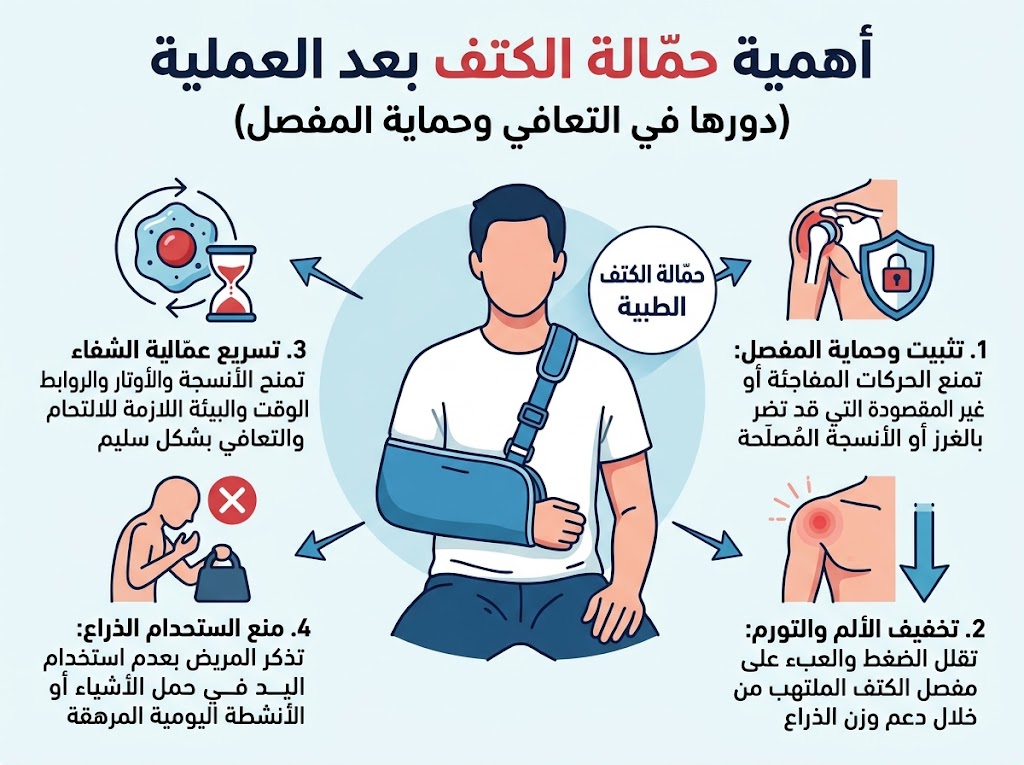
The shoulder sling after surgery is not just a pain relief device—it is a mechanical protection device that prevents tension on the new surgical repair during the first weeks of tendon or ligament healing.
| Type of Surgery | Recommended Sling Type | Wearing Duration |
| Rotator cuff repair < 3 cm | Standard sling with 15–30° abduction pillow | 4–6 weeks day and night |
| Rotator cuff repair > 3 cm | Sling with 30–45° abduction pillow | 6–8 weeks day and night |
| Bankart repair (shoulder dislocation) | Standard sling or with slight external rotation | 4 weeks day and night |
| Total shoulder replacement | Standard sling | 3–4 weeks |
| AC Joint injury (Weaver-Dunn) | Sling with special clavicular support | 4–6 weeks |
The Abduction Pillow — the triangular cushion that fixes the arm at a 15–45° angle away from the body — reduces tension on the surgical repair by up to 60% compared to a sling that holds the arm against the body. 80% of American shoulder surgeons recommend it after rotator cuff repair.
Sling Wearing Rules: Worn day and night in the first phase, removed only for showering and authorized exercises, and not allowed to be removed for driving or work during the specified period.
Phase One (0–6 weeks): Protection and Guided Rest
The sole goal of this phase is to protect the surgical repair and allow the tendon or ligament to heal without pressure. Uncontrolled early movement in this phase is the primary cause of surgical failure.
| Week | Permitted Range of Motion | Authorized Exercises | Strictly Forbidden |
| 0–3 | No active shoulder movement | Grip exercises — wrist and elbow movement | Any active shoulder movement — lifting anything |
| 3–6 | Guided passive movement only (PROM) | Pendulum — passive forward elevation up to 90° | Active movement — pulling — pushing |
Permitted Exercises for Phase One:
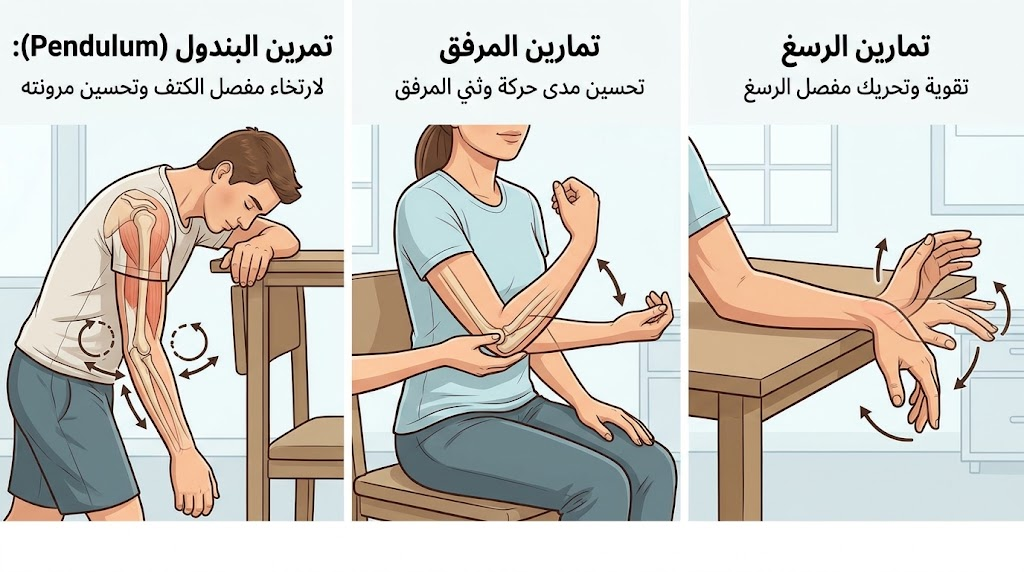
- Elbow and Wrist Exercises: Sitting in the sling, open and close the grip 10 times, bend and extend the wrist up and down, and rotate the elbow from the side. These exercises keep circulation active in the limb without any pressure on the shoulder.
- Pendulum Exercise: Begins at week 3 only with the surgeon’s permission. Lean forward 90° while allowing the arm to swing under its natural weight in small circles for 30 seconds, without any active shoulder movement. Repeat 3–4 times daily.
Phase Two (6–12 weeks): Restoring Range of Motion
In this phase, the tendon or ligament begins to gain sufficient strength for controlled active movement. Goal: reach 135° forward elevation and 120° side elevation by the end of week 12, without compensation from the shoulder or back.
| Week | Range of Motion Goal | Authorized Movement Type |
| 6–8 | Forward elevation up to 90° | Active-Assisted Range of Motion (AAROM) — lying on the back |
| 8–10 | Forward elevation up to 120° | Full active movement (AROM) below the horizon |
| 10–12 | Forward elevation up to 135° — external rotation up to 40° | Full active movement + beginning of light resistance exercises |
Shoulder Strengthening Exercises in Phase Two:
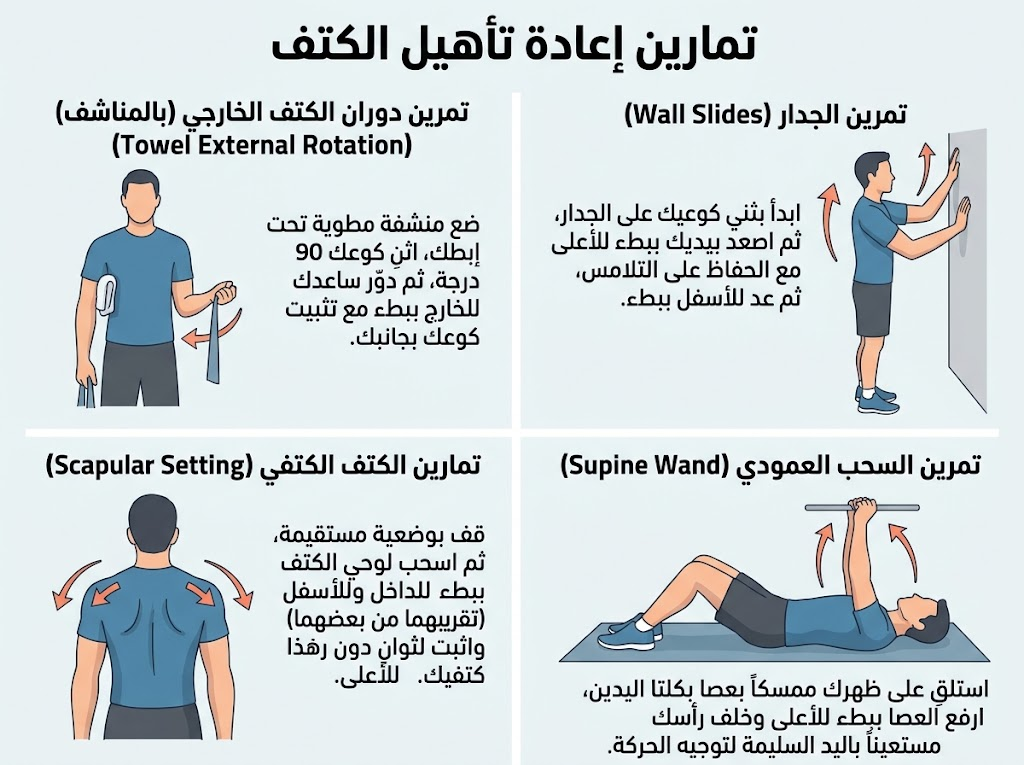
- Wall Slides: Stand facing a smooth wall, place both hands on it, and gradually raise them upward while keeping fingers on the wall. This exercise improves range of motion with wall assistance without sudden strain on the tendons.
- External Shoulder Rotation (with towels): Sit, elbow bent at 90°, hold a rolled towel under the armpit, and gradually rotate the arm outward to the permitted limit. Repeat 10 times, 3 sets.
- Supine Wand Exercise: Lie on your back, hold a horizontal stick with both hands, and use the healthy arm to help the recovering arm lift forward gradually. It reduces gravity and allows greater range of motion with less effort.
- Scapular Setting: Sit upright and pull shoulder blades backward and downward while keeping them in this position for 5 seconds. This exercise restores the natural rhythm of movement shared between the shoulder and the shoulder blade (Scapulohumeral Rhythm).
Phase Three (3–6 months): Progressive Strength Building
The governing rule for this phase: do not increase more than one variable per week — either weight, number of repetitions, or range of motion. Increasing more than one variable at a time strains the tendon and puts the repair at risk.
| Exercise | Position | Repetitions | Note |
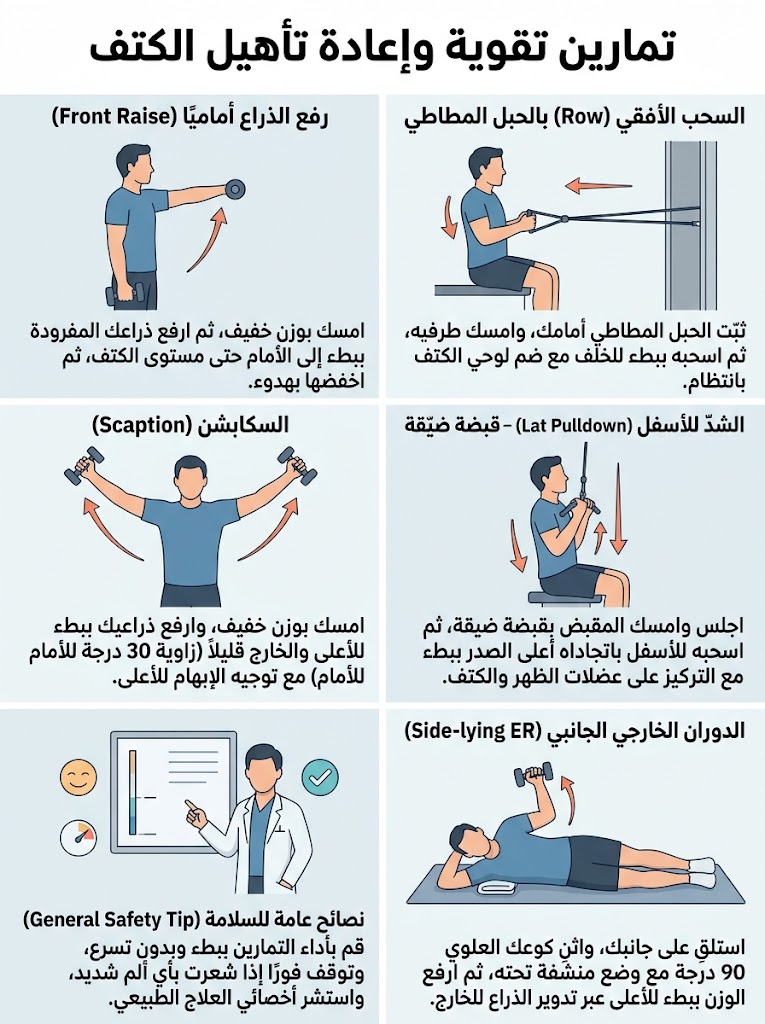
| Side-lying External Rotation (Side-lying ER) | Lying on side, elbow 90° | 3×15 | Strengthens Infraspinatus and Teres Minor |
| Scaption | Standing, lift arm 30° forward from shoulder axis | 3×12 | Mimics the most physiological shoulder position |
| Lat Pulldown — narrow grip | Sitting, pull down in front of chest only | 3×10 | Do not pull behind the head — dangerous for tendons |
| Forward Arm Raise | Standing, lift thumb up to shoulder level | 3×12 | Do not exceed shoulder level before week 16 |
| Horizontal Row with resistance band | Sitting, pull back with bent elbow | 3×15 | Strengthens posterior shoulder and surrounding muscles |
Resistance exercises begin with a light resistance band (Theraband) before moving on to free weights. Any pain lasting more than two hours after exercise requires reducing the load and returning to the physical therapist.
Phase Four (more than 6 months): Return to Activity and Sports
Time alone is not relied upon to allow a return to sports. The objective criterion is achieving 90% of the healthy arm’s strength in external/internal rotation and elevation, with the absence of pain across all levels of movement.
| Activity | Minimum Time Limit After Rotator Cuff Repair | Time Limit After Bankart Repair |
| Driving a car (healthy arm) | After removing the sling | 4–6 weeks |
| Light office work | 6–8 weeks | 6 weeks |
| Non-contact sports (swimming — tennis) | 5–6 months | 5–6 months |
| Throwing and overhead exercises | 6–9 months | 5–6 months |
| Contact sports (soccer — wrestling) | 9–12 months | 5–6 months |
Rehabilitation Schedule According to Shoulder Surgery Type
| Type of Surgery | Sling | Phase One | Phase Two | Phase Three | Full Return |
| Rotator cuff repair (small < 1 cm) | 4 weeks | 0–6 weeks | 6–12 weeks | 3–4 months | 4–6 months |
| Rotator cuff repair (large > 3 cm) | 6–8 weeks | 0–8 weeks | 8–16 weeks | 4–6 months | 9–12 months |
| Bankart repair (shoulder dislocation) | 4 weeks | 0–4 weeks | 4–12 weeks | 3–5 months | 5–6 months |
| Total shoulder replacement | 3–4 weeks | 0–4 weeks | 4–12 weeks | 3–6 months | 6–12 months |
| AC Joint repair | 4–6 weeks | 0–6 weeks | 6–12 weeks | 3–4 months | 3–4 months |
Common Mistakes That Hinder Recovery
Five mistakes patients in Egypt make after shoulder surgery that cause delayed recovery or re-injury:
- Removing the sling early: Feeling pain improvement at week 2–3 does not mean the tendon has healed. Rotator cuff tendon healing takes 8–12 biological weeks regardless of how well you feel.
- Stopping physical therapy as soon as pain ends: Pain subsides before strength building is complete. Stopping early leaves the shoulder weak and prone to re-injury.
- Driving a car with the recovering arm before 6 weeks: Even sudden steering generates tension on the tendons equivalent to carrying 2–3 kg.
- Sleeping on the recovering shoulder in the early months: Causes constant pressure on the surgical repair and hinders blood circulation nourishing the tendon.
- Doing gym workouts by personal decision without surgeon approval: Bench press, push-ups, and overhead shoulder exercises are strictly forbidden before six months in most rotator cuff surgeries.
Book Your Appointment with Prof. Dr. Ibrahim Abdelmonem
Prof. Dr. Ibrahim Abdelmonem, Professor of Orthopedic Surgery and Joints at Ain Shams University and Visiting Professor at Ohio State University, personally oversees post-shoulder surgery rehabilitation protocols for his patients. Clinics are in four locations in Cairo: Nasr City, Fifth Settlement, Mohandessin, and Batal Ahmed Abdel Aziz Street.

Frequently Asked Questions: Post-Operative Shoulder Surgeries Rehabilitation
When do physical therapy sessions begin after arthroscopic shoulder surgery?
What are the primary chronological phases of a post-operative shoulder rehabilitation protocol?
What is the difference between passive and active range of motion during early recovery?
How long must a shoulder sling or abduction pillow be worn post-operatively?
Is experiencing pain during shoulder physical therapy considered normal?
Why are scapular stabilization exercises critical in the rehabilitation program?
When can progressive resistance training of the rotator cuff begin?
How is post-surgical shoulder stiffness managed without compromising the repair?
When is a patient permitted to drive a car and return to work after surgery?
What criteria are required for an athlete to return to competitive training or heavy gym workouts?
references
- Physitrack — Rotator Cuff Rehabilitation: Phase-Based Guide for Physical Therapists (2026)
- Orthopedic One — Arthroscopic Rotator Cuff Repair Rehabilitation Protocol (2024)
- Stanford Health Care — Shoulder Surgery Postoperative Immobilization Survey (Biology 2023)
- University of Washington / TRICARE — Bankart Repair Rehabilitation Protocol
- Sherwood Forest Hospitals NHS — Arthroscopic Bankart Repair Patient Guide (2024)
- Development of Post-Operative Shoulder Rehabilitation Guidelines — University of Alberta / SURGE Group (2018)
- Systematic Review of Clinical Practice Guidelines on Diagnosis and Management of Shoulder Disorders — Arch Phys Med Rehabil (2024)
- Early vs Traditional Rehabilitation Protocol After Rotator Cuff Repair: An Umbrella Review (2023)
- Rotator Cuff Treatment: A Phase-Based Guide for Physical Therapists — Physitrack (2026)
- Road to Recovery: Rotator Cuff Repair — 4-Phase Protocol — MedBridge (2023)
- Post-Op Rehab Protocol for Shoulder Arthroscopy Rotator Cuff Repair — 4 Phases (2023)
- Effectiveness of Formal Physical Therapy Following Total Shoulder Arthroplasty: Systematic Review — Shoulder and Elbow (2018)
- Clinical Outcome of Physiotherapy After Reversed Shoulder Arthroplasty: Systematic Review — Disability and Rehabilitation (2022)
- Total Shoulder Replacement Rehab Protocol — Step by Step (3 Phases)
- Rehabilitation Protocol Variability Following Arthroscopic Bankart Repair and Remplissage: Systematic Review — PMC (2024)
- Arthroscopic Bankart Repair Rehabilitation Protocol — Robert Jones & Agnes Hunt NHS Trust (2024)