
The success of shoulder dislocation surgery—whether it is an arthroscopic Bankart repair or an open Latarjet procedure—does not depend on the surgical procedure alone. The first six weeks represent the most critical phase of recovery. Daily choices during this period determine final joint mobility, the risk of recurrent dislocations, and the potential need for secondary surgical interventions. This article outlines essential post-operative instructions after shoulder dislocation surgery.
Post-Operative Instructions After Shoulder Dislocation Surgery
The most critical instructions following shoulder dislocation surgery include:
- Wearing the sling/immobilizer for one to three weeks depending on the type of procedure.
- Initiating physical therapy as early as the first or second post-operative day.
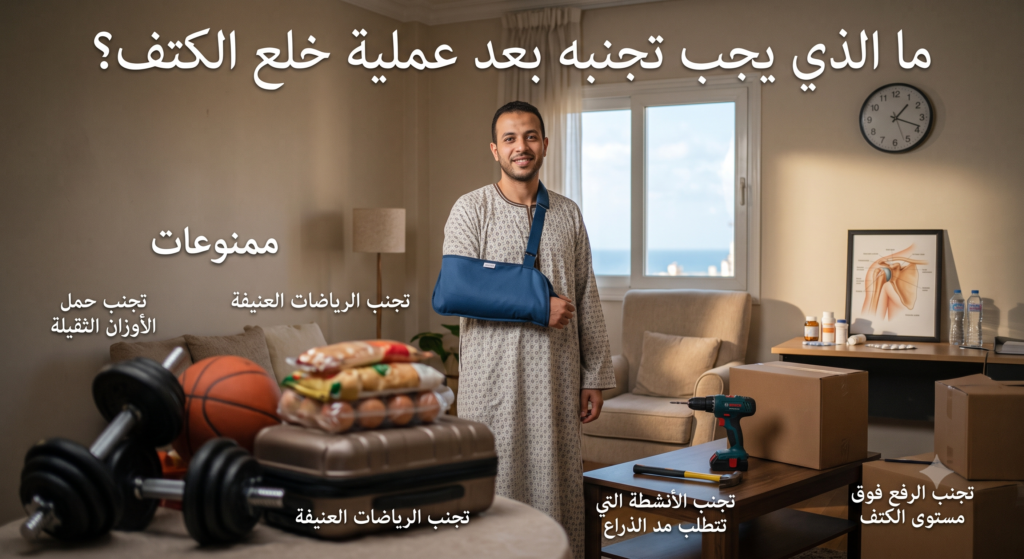
- Avoiding overhead arm movements and collision sports.
- Monitoring for signs of infection or recurrent instability and notifying your surgeon immediately if they occur.
Hospital discharge typically occurs on the same day for most arthroscopic shoulder surgeries, whereas an overnight stay is generally required for an open Latarjet procedure. Wearing a sling does not mean freezing the joint indefinitely; its purpose is to protect the structural repair during the initial phases of tissue healing. Failing to adhere to recovery instructions and delaying movement creates joint adhesions that severely restrict long-term range of motion, making it the costliest error on the path to recovery.
Sleeping Positions After Shoulder Dislocation Surgery
The optimal position for sleeping after shoulder dislocation surgery is flat on your back or on the uninjured side, with a pillow placed under the operative arm for support. Sleeping directly on the operative shoulder is strictly prohibited for the first six weeks to avoid placing direct pressure on the fresh surgical repair.
Many patients in Cairo are accustomed to sleeping on low beds with soft mattresses, a setup that makes it difficult to lean and stand up using the injured arm. It is temporarily recommended to sleep semi-upright in a comfortable recliner chair or by placing extra pillows behind the back to elevate the torso, particularly during the first week. Night pain that disrupts sleep should be managed primarily with the pain medications prescribed by your surgeon, not by altering the position of the shoulder.
What Should Be Avoided After Shoulder Dislocation Surgery?
Six specific things must be avoided and represent the core pillars of post-operative restrictions:
- Lifting any weight exceeding 1 kilogram during the first four weeks.
- Reaching behind your back or lifting your arm overhead before the sixth post-operative week.
- Wetting the surgical wound or showering without a protective waterproof covering for at least the first week.
- Driving a car before regaining full grip strength, full rotation, and receiving explicit clearance from your surgeon.
- Stopping physical rehabilitation prematurely just because pain has subsided, as the absence of pain does not equal complete tissue healing.
- Returning to collision sports (e.g., football, wrestling, martial arts) before the fourth month.
The Role of Physical Therapy After Shoulder Dislocation Surgery
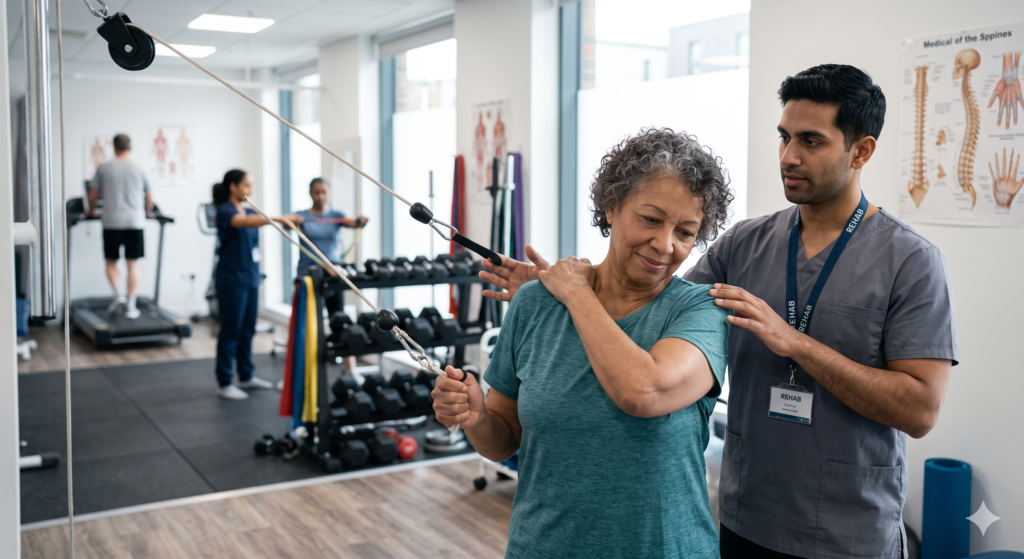
Physical therapy after shoulder dislocation surgery is not an optional luxury; it is the fundamental cornerstone of surgical success. Rehabilitation begins on the first or second post-operative day and progresses systematically through three distinct chronological phases:
| Phase | Timeline | Primary Objective |
| Phase 1: Passive Range of Motion | Weeks 1 to 6 | Restoring joint mobility safely without muscular load. |
| Phase 2: Active Strengthening | Weeks 6 to 12 | Strengthening the shoulder girdle and the rotator cuff muscles. |
| Phase 3: Functional & Sports Training | Months 3 to 6 | Gradual, progressive transition back to full athletic activity. |
Activity Timelines and Post-Operative Guidelines
The schedule for returning to daily activities and sports scales progressively from the least demanding tasks to high-impact activities:
| Activity | Expected Timeline |
| Light Daily Activities (Eating, typing) | 1 to 2 weeks |
| Sedentary / Desk Work | 2 to 3 weeks |
| Driving a Car | 3 to 4 weeks (with explicit surgeon approval) |
| Lifting Light Weights (Up to 5 kg) | 6 to 8 weeks |
| Non-Collision Sports (Swimming, cycling) | 3 to 4 months |
| Full Collision Sports (Football, wrestling) | 4 to 6 months (following direct surgical clearance) |
Common Mistakes in Following Post-Operative Instructions
Four frequent errors can severely jeopardize the structural results of your shoulder surgery:
- Premature Cessation of Physical Therapy: The most common mistake among Egyptian patients is stopping rehabilitation sessions around the third or fourth week as soon as the pain goes away. At this stage, the shoulder muscles have not yet regained their structural strength, and stopping therapy exposes the joint to a recurrent dislocation even from a simple, normal daily movement.
- Early Return to Sports: Returning to collision sports prior to the fourth month is the primary cause of recurrent dislocations following a Bankart repair in published surgical literature.
- Sling Non-Compliance: Neglecting to wear the protective sling during the initial critical weeks.
- Ignoring Instability Signs: Failing to promptly notify the surgeon if a sensation of shoulder instability arises after the sixth week.
How Long Does Full Recovery Take From Shoulder Dislocation Surgery?
Achieving full recovery and returning to unrestricted athletic activity takes anywhere from 4 to 6 months. An arthroscopic Bankart repair typically allows a return to full activity within 4 to 5 months, whereas the Latarjet procedure requires 5 to 6 months due to the additional time needed for structural bone graft healing.
A systematic review of 2,134 Latarjet cases found that 88.8% of athletes returned to sport, 72.6% at the same level, after a mean of 5.8 months. Functional recovery for daily life is much faster; most patients safely return to sedentary desk work and routine daily activities within 3 to 4 weeks. The overall duration of recovery is directly influenced by patient age, pre-injury athletic conditioning, and the extent of the anatomical structural damage repaired during the operation.
Red Flag Symptoms Requiring Immediate Medical Attention
You must contact your surgeon immediately if you experience any of the following warning signs:
- Signs of Wound Infection: Developing progressive redness, localized warmth, or fluid drainage/pus from the surgical site.
- Systemic Fever: A body temperature spike exceeding 38.5°C after the third post-operative day, necessitating urgent blood tests.
- Neurological Deficits: Persistent numbness, tingling, or sudden weakness in the hand or fingers, requiring an immediate neurological evaluation.
- Instability Sensations: A distinct feeling that the shoulder is slipping out of place or unstable after the sixth week, requiring urgent imaging and surgical re-evaluation.
- Sudden Acute Pain: A sudden, sharp spike in pain that is entirely unrelated to physical therapy exercises, which is necessary to rule out a broken Latarjet screw or an anchor fixation failure.

Frequently Asked Questions
Post-Operative Instructions FAQ
Clinical timelines, movement restrictions, and recovery instructions for patients following shoulder stabilization surgery.
The first six weeks represent the most sensitive and vulnerable window for biological tissue healing. While the surgery mechanically reconstructs or transfers damaged components, daily patient choices determine long-term success.
Adhering to recovery guidelines ensures the delicate structural repair remains protected from failure, preventing permanent range of motion limitations, joint adhesions, and early recurrent instabilities.
American Knee & Shoulder Center GuidelinesStandard protocols dictate wearing the immobilizing sling or brace for one to three weeks depending on the specific procedure performed, though it is typically worn continuously for four to six weeks across most rehabilitation paths.
It should be worn throughout the day and night. It may only be removed during specified, controlled physical therapy exercises to protect the healing structural anchor points from unexpected muscular load.
Source: Standard Post-Operative ProtocolsThe optimal position is sleeping flat on your back or on your uninjured side, ensuring that a pillow is always placed under the operative elbow and arm to provide sufficient mechanical support.
Strict Restriction: Sleeping directly on the operative shoulder is prohibited for the first six weeks to avoid placing direct pressure on the fresh surgical repair. In the first week, sleeping semi-upright in a recliner chair or utilizing extra wedge pillows to elevate the torso can significantly decrease resting pain.
Source: Patient Recovery GuidelinesTo avoid stretching or tearing the newly anchored tissues, you must strictly comply with the following limits:
- Weight Limit: Avoid lifting any objects or weights exceeding 1 kilogram during the first four weeks.
- Overhead Restrictions: Reaching behind your back or lifting the arm overhead is completely forbidden before the sixth post-operative week.
- Rotation: Avoid rotating the forearm outward away from your torso in an exaggerated or forced fashion.
The arthroscopic shunts and wound dressings must remain entirely dry for the first 48 to 72 hours following surgery.
After this window, quick showering is permitted provided the incisions are securely shielded with water-resistant waterproof dressings. Submerging the shoulder fully under water (baths, hot tubs, or swimming) is prohibited until the incisions are fully healed and your stitches are removed around days 7 to 10.
Source: Wound Care & Hygiene GuidelinesPhysical therapy is the cornerstone of structural success and should begin as early as the first or second post-operative day. It progresses systematically through three phases:
- Phase 1 (Weeks 1 to 6): Passive Range of Motion. Focuses on gentle, unresisted movements (such as wrist rotations and pendulum exercises) to stimulate circulation and prevent severe joint stiffness without contracting the shoulder muscles.
- Phase 2 (Weeks 6 to 12): Active Strengthening. Introduces active-assisted mobility and direct strengthening targeting the shoulder girdle and rotator cuff muscles.
- Phase 3 (Months 3 to 6): Functional Training. Progresses to sport-specific coordination and unrestricted physical conditioning.
Driving must be avoided entirely while you are structurally dependent on the protective shoulder sling, covering the first 4 to 6 weeks.
Operating a motor vehicle requires rapid, bilateral coordination; sudden emergency steering adjustments can easily disrupt healing ligaments. Most patients are cleared to drive once adequate grip strength, full rotation, and explicit clearance are obtained from the surgeon between weeks 6 and 8.
Source: Patient Safety & Legal GuidelinesThe most common mistake is stopping physical therapy sessions prematurely around the third or fourth week simply because local surgical pain has faded.
At this milestone, the surrounding stabilizing muscles are still severely weakened; stopping rehabilitation leaves the joint unprotected and vulnerable to a new dislocation even during basic daily activities. Furthermore, returning to collision sports before the fourth month is the primary driver of Bankart repair failure in published medical literature.
American Knee & Shoulder Center DataAchieving complete structural recovery and returning to high-impact activities typically spans 4 to 6 months:
- Arthroscopic Bankart Repair: Generally permits an athletic return within 4 to 5 months.
- Open Latarjet Procedure: Requires an extended timeline of 5 to 6 months due to the additional biological time necessary for the transferred bone block to completely fuse and integrate with the glenoid bone socket.
You must reach out to your surgeon immediately if you observe any of the following warning signs:
- Infection Signals: Progressive redness, localized heat, or foul-smelling fluid drainage/pus from the wounds.
- Systemic Fever: A body temperature spike exceeding 38.5°C after the third post-operative day.
- Neurological Deficits: Constant numbness, tingling, or sudden motor weakness in your hand or fingers.
- Structural Failure Signs: A sudden sharp pain at rest unrelated to exercise (ruling out a broken screw or anchor failure) or a distinct feeling that the shoulder is subluxating after week 6.
References
- American Academy of Orthopaedic Surgeons (AAOS), OrthoInfo: Shoulder Dislocation
- American Academy of Orthopaedic Surgeons (AAOS), OrthoInfo: Chronic Shoulder Instability
- Peckston, et al. A comparison of arthroscopic Bankart repair and the Latarjet procedure in contact athletes with anterior shoulder instability: a systematic review and meta-analysis. Am J Sports Med. 2026. doi:10.1177/03635465261441255
- American Academy of Orthopaedic Surgeons (AAOS), OrthoInfo: Rotator Cuff and Shoulder Conditioning Program
- Hovelius L, et al. Nonoperative treatment of primary anterior shoulder dislocation in patients forty years of age and younger: a prospective twenty-five-year follow-up. J Bone Joint Surg Am. 2008;90(5):945-952. doi:10.2106/JBJS.G.00070
- Zacchilli MA, et al. Epidemiology of shoulder dislocations presenting to emergency departments in the United States. J Bone Joint Surg Am. 2010;92(3):542-549. doi:10.2106/JBJS.I.00450
- Griesser MJ, et al. Complications and re-operations after Bristow-Latarjet shoulder stabilization: a systematic review. J Shoulder Elbow Surg. 2013;22(2):286-292. doi:10.1016/j.jse.2012.09.009
- Murphy AI, et al. Long-term outcomes of the arthroscopic Bankart repair: a systematic review of studies at 10-year follow-up. J Shoulder Elbow Surg. 2019;28(11):2084-2089. doi:10.1016/j.jse.2019.04.057
- Hurley ET, et al. Return to play after the Latarjet procedure for anterior shoulder instability: a systematic review. Am J Sports Med. 2019;47(12):3002-3008. doi:10.1177/0363546519831005
- Imam MA, et al. Bankart repair versus Latarjet procedure for recurrent anterior shoulder instability: a systematic review and meta-analysis of 3275 shoulders. Am J Sports Med. 2021;49(7):1945-1953. doi:10.1177/0363546520962082