
Shoulder osteoarthritis exercises are the single most effective non-surgical tool for managing glenohumeral joint degeneration — reducing chronic pain, preserving range of motion, and strengthening the rotator cuff muscles that protect what remains of the joint cartilage. A 2024 network meta-analysis confirmed that shoulder-specific exercise therapy produces statistically significant pain reduction in chronic shoulder conditions. This step-by-step guide walks you through three progressive phases: passive motion exercises including the Codman pendulum, active stretching exercises including cross-body stretch and wand rotation, and progressive strengthening exercises targeting the rotator cuff and scapular stabilizers. Each exercise is explained with clear positioning, repetitions, and safety cues — plus guidance on when to stop, when to add resistance, and when conservative treatment is no longer enough.
What is Shoulder Osteoarthritis?
Shoulder osteoarthritis is the gradual degeneration of the articular cartilage lining the glenohumeral joint, causing direct friction between the shoulder bones, resulting in chronic pain, stiffness, and a progressive reduction in range of motion. This condition affects between 16% and 20% of individuals over the age of 65.
Unlike the knee or hip, the shoulder is a non-weight-bearing joint, which gives exercises and conservative treatment a very high success rate before considering any surgical intervention. Understanding the condition early allows patients to enjoy years of normal life without complex procedures.
Causes of Shoulder Osteoarthritis
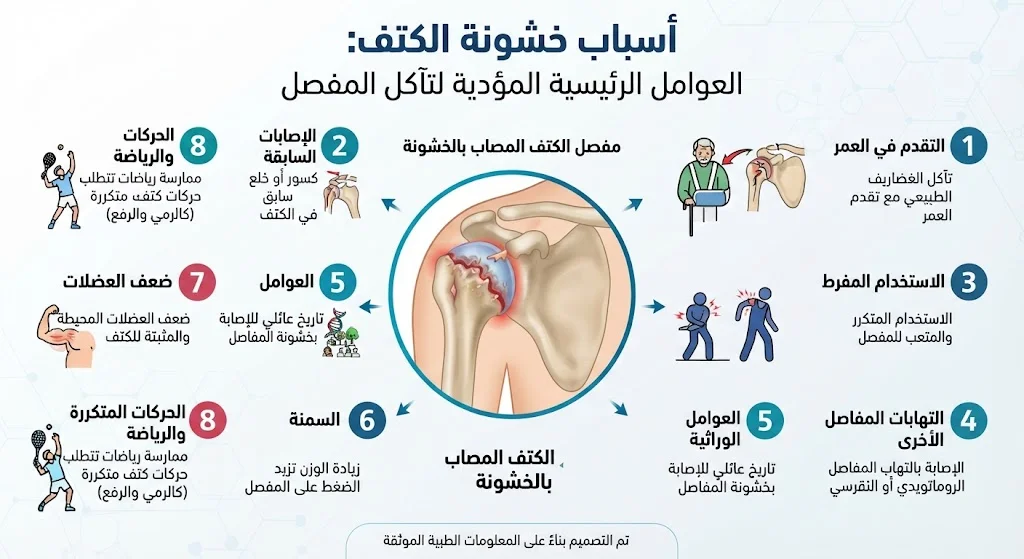
Shoulder osteoarthritis stems from the gradual wear and tear of the articular cartilage due to several primary factors:
- Osteoarthritis: The most common cause, affecting individuals over 55 due to cumulative use and aging.
- Past Injuries: Previous dislocations or fractures damage the cartilage, causing premature osteoarthritis regardless of age.
- Rheumatoid Arthritis: An autoimmune disease attacking the synovial membrane and progressively destroying cartilage (affecting women 2 to 3 times more than men).
- Cuff Arthropathy: Caused by a long-standing, untreated complete tear of the rotator cuff tendons, leading to chronic joint friction.
- Overuse from Repetitive Movements: Working for years in professions requiring overhead arm elevation (such as painters and construction workers) accelerates cartilage degeneration between ages 40 and 60.
Symptoms of Shoulder Osteoarthritis
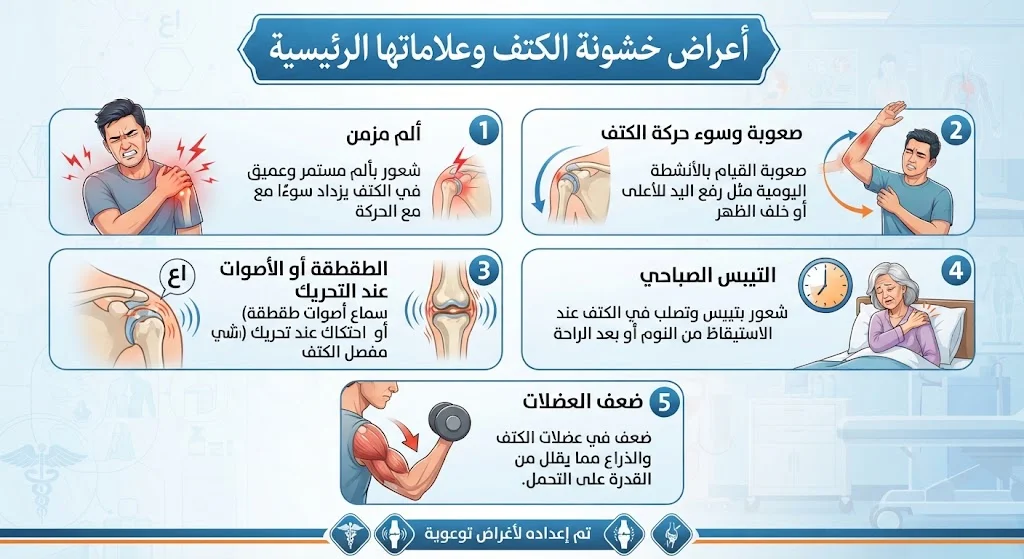
Shoulder osteoarthritis is characterized by four core symptoms:
- Deep posterior pain: Worsens with cold weather and temperature changes.
- Morning stiffness: Lasting more than 30 minutes after waking up.
- Crepitus: A grinding or cracking sound/feeling heard or felt when moving the shoulder.
- Night pain: Prevents the patient from lying and sleeping on the affected side.
In the early stages, pain appears only after exertion and subsides with rest, but it later progresses to accompany all movements (even simple ones like combing hair and getting dressed), accompanied by a gradual loss in range of motion. (Note: The appearance of swelling accompanied by localized heat and redness is a danger sign requiring urgent medical evaluation to rule out septic arthritis).
Shoulder Osteoarthritis Exercises — Step-by-Step
Therapeutic exercises are the primary pillar for reducing pain and maintaining range of motion. Recent studies (such as the PLoS ONE, 2024 review) have demonstrated that specialized exercises significantly reduce chronic shoulder pain.
Golden Rule: Any exercise that triggers sharp pain must be stopped immediately.
Phase One: Passive Range of Motion Exercises (Weeks 1–4)
Goal: Move the joint without straining the tendons (movement driven by gravity rather than muscles).
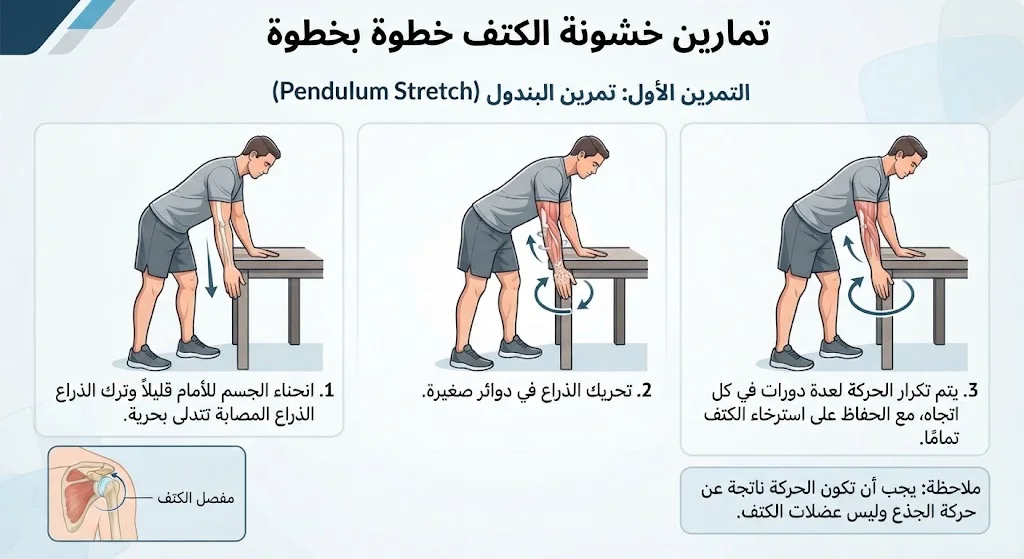
- Codman / Pendulum Exercise:
- Position: Lean forward at a 45–90° angle, supporting the healthy hand on a chair or table.
- Movement: Completely relax the affected arm so it hangs freely, then let it swing forward and backward, side to side, and in small circles driven purely by its own weight—without any muscular effort from the shoulder.
- Repetitions: 10 times in each direction, 2–3 times daily.
- Wall Circle Exercise:
- Position: Stand at arm’s length facing a wall.
- Movement: Place the fingertips of the affected arm on the wall and move them in slow, small circles, gradually making the circles bigger.
- Repetitions: 10 circles in each direction, twice daily (without exceeding shoulder level).
Phase Two: Stretching and Flexibility Exercises (Weeks 4–8)
Goal: Gradually and systematically restore full range of motion.
- Cross-Body Stretch:
- Movement: Extend the affected arm horizontally across the chest, using the healthy hand to gently pull it toward the opposite shoulder until a mild stretch is felt behind the shoulder.
- Hold: 20–30 seconds, 3 repetitions, twice daily.
- Wall Walk / Finger Walk:
- Movement: Place fingertips on the wall and “walk” them gradually upward to the point of mild tension, then slowly back down.
- Repetitions: 10 repetitions, twice daily.
- Wand Stretch (External Rotation):
- Movement: Hold a horizontal stick with both hands with elbows bent at 90°, and use the healthy arm to gently push the affected arm outward.
- Hold: 20 seconds, 5 repetitions, twice daily.

Phase Three: Strengthening Exercises (Weeks 8–16)
Goal: Strengthen the rotator cuff and scapular muscles to offload pressure from the damaged joint.
- Side-Lying External Rotation:
- Position: Lie on the healthy side with the affected elbow bent at 90° against the body.
- Movement: Rotate the forearm upward (without weight or using a light 0.5–1 kg dumbbell), then lower slowly.
- Repetitions: 3 sets × 15 reps, 3 times weekly.
- Scaption:
- Position: Stand with thumbs pointing upward.
- Movement: Raise the arm forward at a 30° angle away from the body’s axis, only up to shoulder level—do not go higher.
- Repetitions: 3 sets × 12 reps.
- Scapular Retraction:
- Movement: Pull the shoulder blades back and down, hold for 5 seconds, then relax.
- Repetitions: 3 sets × 15 reps daily.

The Role of Physical Therapy in Shoulder Osteoarthritis
Physical therapy serves as the cornerstone of shoulder osteoarthritis management. Modern medical surveys show that the vast majority of physical therapists rely on strengthening and range of motion exercises as a first line of defense.
- Individualized Assessment: The therapist identifies weak movement angles and designs a program tailored to the stage of osteoarthritis and pain level.
- Manual Therapy: Helps improve range of motion in ways difficult to achieve through home exercises alone.
- Importance of Compliance: Quitting therapy as soon as temporary pain disappears is a common mistake that causes symptoms to return with greater severity.
Treating Shoulder Osteoarthritis with Herbs
There is no strong, documented clinical evidence proving that herbs can directly cure shoulder osteoarthritis or regenerate cartilage, but certain substances possess anti-inflammatory properties:
- Turmeric (Curcumin): Contains anti-inflammatory compounds comparable to certain painkillers, though its oral absorption is poor without special formulations.
- Fish Oil (Omega-3): In doses of 2–4 grams daily, it helps reduce inflammatory mediators in the body.
- Ginger and Boswellia: Some limited studies have shown supportive benefits in joint pain relief, provided a physician is consulted to avoid interactions with other medications.
Treatment of Shoulder Osteoarthritis: Other Options
Treatment options range from home remedies to surgical intervention:
| Treatment Option | Indicated Cases | Approximate Duration of Effect |
| Exercises + Physical Therapy | First line for all degrees of osteoarthritis | Continuous (slows cartilage degradation) |
| NSAIDs | Moderate pain and inflammatory stages | 2–4 weeks |
| Cortisone Injections | Acute pain and active, resistant inflammation | 4–12 weeks |
| Hyaluronic Acid Injections (Synvisc / Durolane) | Mild-to-moderate osteoarthritis | 3–6 months |
| PRP Injections | Moderate osteoarthritis and athletes | 6–12 months |
| Total / Reverse Shoulder Replacement | Advanced osteoarthritis (Grade 4) with failed conservative care | Permanent improvement > 90% |
Book Your Appointment with Prof. Dr. Ibrahim Abdelmonem
If you suffer from chronic shoulder pain, you can consult Prof. Dr. Ibrahim Abdelmonem (Professor of Orthopedic and Joint Surgery at Ain Shams University and Visiting Professor at Ohio State University). He provides a comprehensive, accurate evaluation and an integrated treatment program combining exercises, targeted injections, and advanced surgical solutions when necessary.
Clinic Branches in Cairo and Giza:
- Nasr City Branch
- Fifth Settlement Branch
- Mohandessin Branch
- Batal Ahmed Abdel Aziz Branch (Mohandessin)

Frequently Asked Questions: Shoulder Osteoarthritis Exercises
What are the therapeutic benefits of exercising with shoulder osteoarthritis?
What are the essential safety rules for performing shoulder osteoarthritis exercises?
How are Codman pendulum exercises performed and why are they important?
What role do joint capsule stretches play in managing shoulder stiffness from arthritis?
When and how should light resistance and muscle strengthening exercises begin?
Can improper exercises worsen the symptoms of shoulder osteoarthritis?
What is the role of scapular stabilization exercises in protecting an arthritic shoulder?
How frequently should shoulder osteoarthritis exercises be performed each week?
How can cold and warm compresses be integrated with an exercise routine?
When do exercises become insufficient, making an orthopedic consultation necessary?
References
- Hospital for Special Surgery (HSS) — Best Exercises for Shoulder Osteoarthritis
- Healthline — Pendulum (Codman) Exercises for Shoulder Rehabilitation
- PLoS ONE (2024) — Shoulder-Specific Exercise Therapy: Network Meta-Analysis
- Musculoskeletal Care (2024) — UK Physiotherapy Practice for Shoulder OA
- AAOS — Management of Glenohumeral Joint Osteoarthritis Clinical Practice Guideline
- Glenohumeral Osteoarthritis: Diagnosis & Treatment — Physiotutors (2023)
- Osteoarthritis of the Glenohumeral Joint: Overview, Causes, Symptoms & Management — Patient Care Online
- Non-Operative Treatment Options in Primary Glenohumeral Osteoarthritis: A Comprehensive Review — Medical Research Archives (2022)
- Exercises for Osteoarthritis of the Shoulder — Arthritis Society Canada (5 Parts with Photos)
- Three Safe Exercises for Shoulder Osteoarthritis — Buffalo Rehab (2023)
- Progressive Shoulder Exercises for Glenohumeral Osteoarthritis: Feasibility Study — PMC (2022)
- Physical Therapist Management of Glenohumeral Joint Osteoarthritis: Clinical Practice Guideline — APTA / PubMed (2023)
- Effect of Scapular Stabilization Exercises on Subacromial Pain Syndrome: Systematic Review & Meta-Analysis — Frontiers in Neurology (2024)
- Natural Remedies for Arthritis Pain (Glucosamine, Chondroitin, Capsaicin, Fish Oil) — UCLA Health
- Intra-Articular Injections for Shoulder Arthritis (Corticosteroid, HA, PRP, BMAC): Systematic Review — PMC (2025)
- Comparing Outcomes After Physical Therapy for Glenohumeral Osteoarthritis — Cureus (2023)